A trade-in is not one price. It is two: the price the shop will pay for what you bring in, and the price it asks for what you want to take home. The gap between those two quotes, multiplied by the number of ounces involved, is what the trade actually costs you.
Nothing about the metal changes in a swap. A troy ounce of silver in a generic round and a troy ounce in an American Silver Eagle are the same ounce of the same metal. What changes is the premium — the amount above the metal value that each product commands — and that is where the whole cost of a trade-in lives.
Spot is the starting point, not the price
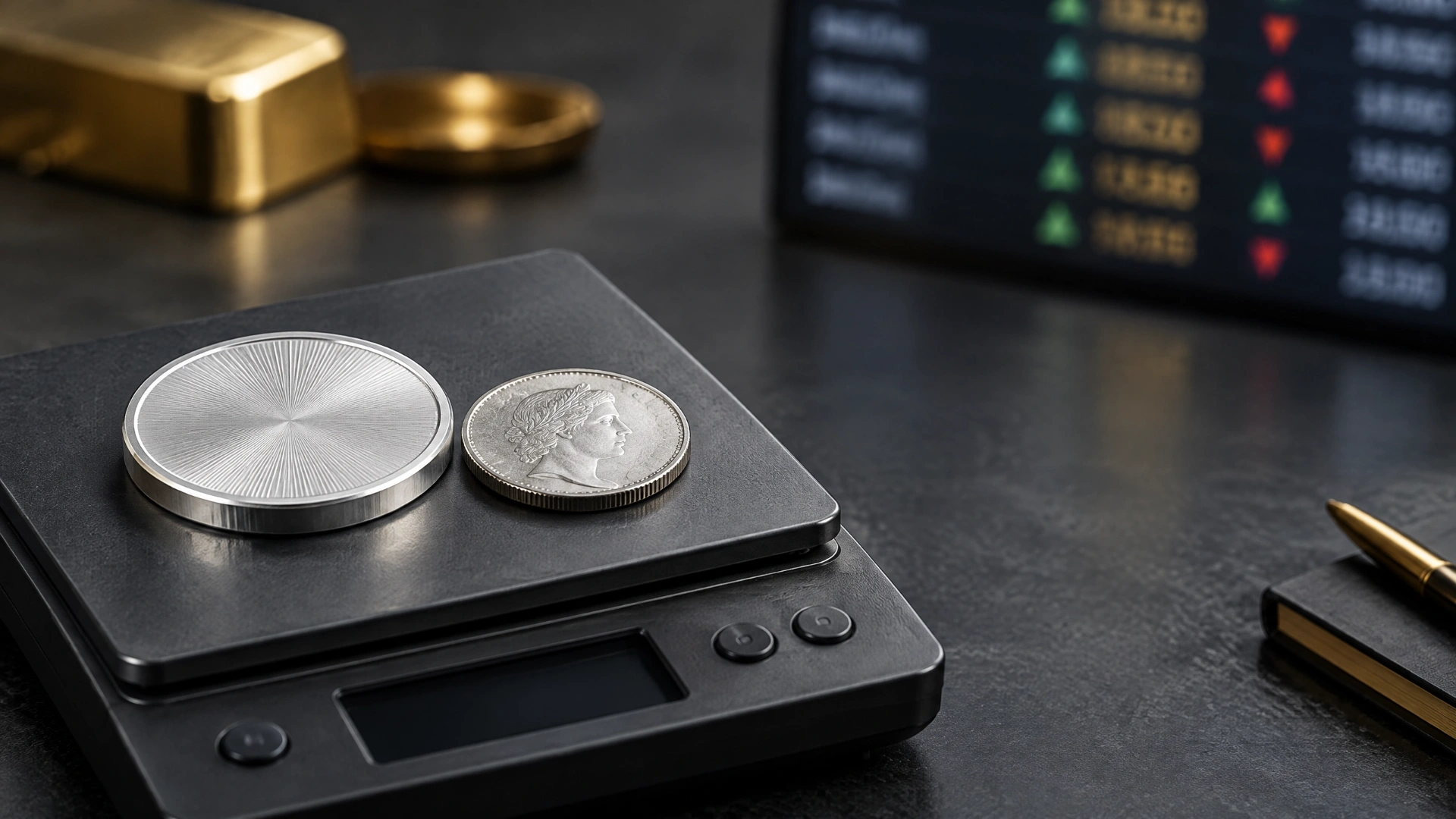
Spot price is the quoted price for immediate delivery of unfabricated metal in the wholesale market. It is a reference number, not a retail number. The London Bullion Market Association administers the daily benchmark auctions that much of the trade prices against, and those benchmarks describe large lots of refined metal moving between institutions.
No physical coin or bar changes hands at spot. Somebody had to refine the metal, strike the product, package it, ship it, insure it and finance the inventory sitting on a shelf. Every one of those costs is real, and they are recovered in the premium. That is true of every dealer and every product, which is why comparing two quotes means comparing premiums, not comparing who mentions spot more often.
If you have not worked with troy weight before, an ounce of silver is not the ounce on a kitchen scale — our guide to what a troy ounce is covers the difference.
What separates a round from a sovereign coin
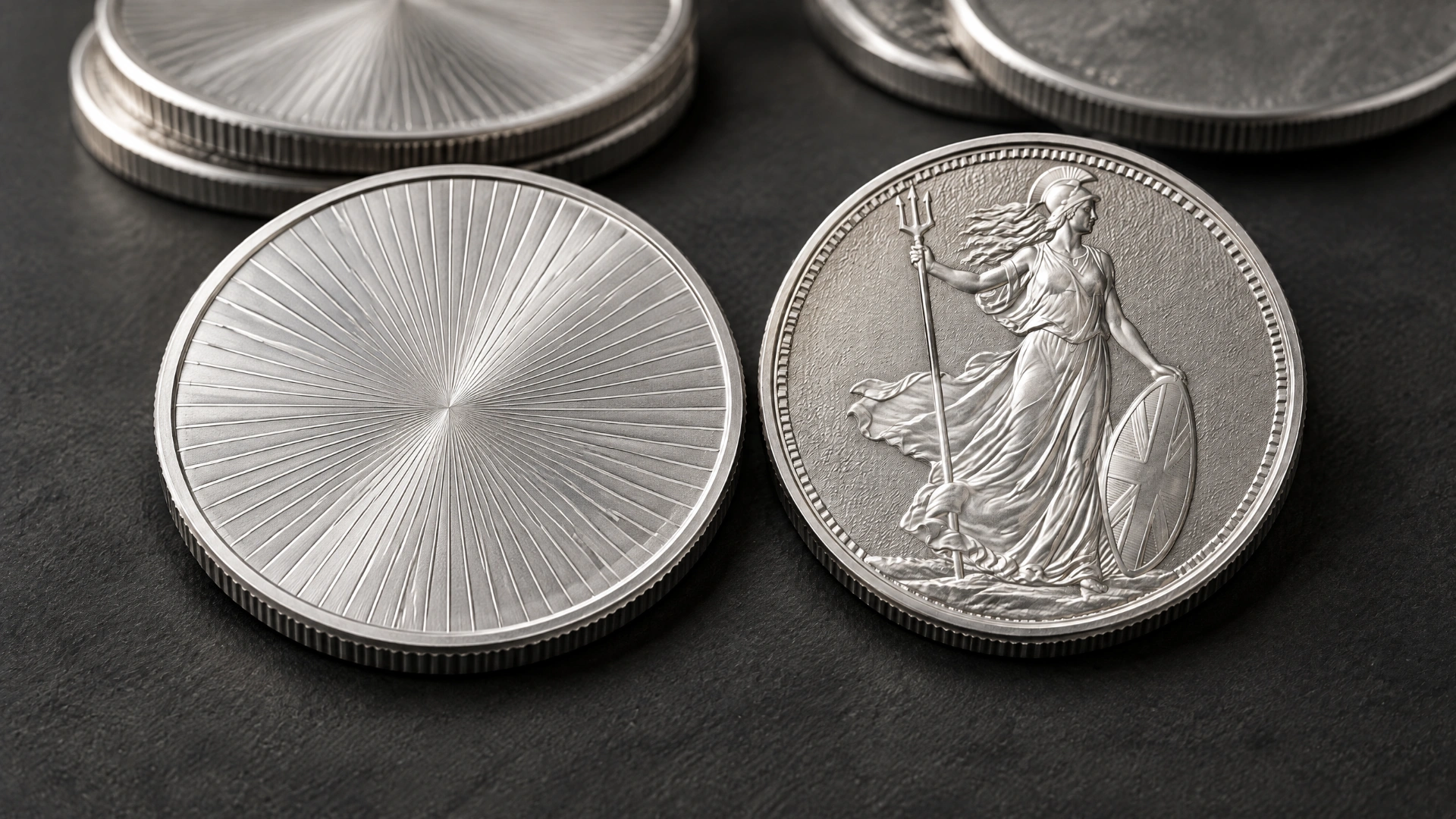
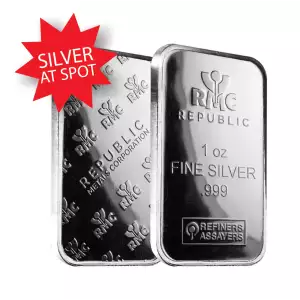
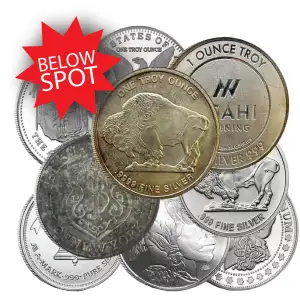
A round is a privately minted disc of bullion. It carries no denomination, no issuing government and no legal-tender status. Most modern silver rounds are struck at .999 fineness, the same as an Eagle, and many are struck by well-regarded private mints.
A sovereign bullion coin is struck by a government mint. The American Silver Eagle carries a $1 face value and is legal tender; the United States Mint specifies it as one troy ounce of 99.9% fine silver, 40.60 mm in diameter. The important point about that face value is what it does and does not mean: the United States guarantees the coin's weight, content and purity. It does not guarantee what the coin is worth. A $1 denomination on a one-ounce silver coin is a legal formality, not a floor under the price.
| Generic silver round | American Silver Eagle | |
|---|---|---|
| Issuer | Private mint | United States Mint |
| Legal tender | No | Yes, $1 face value |
| Typical fineness | .999 | .999 |
| What is guaranteed | The mint's own stated specification | Weight, content and purity by the issuing government — not value |
| Premium over metal | Lower | Higher |
| Recognition at resale | Varies by mint and design | Recognised by most buyers without discussion |
Neither column is the right answer. A round puts more metal in your hands per dollar spent, which is the entire reason the format exists. A sovereign coin costs more per ounce and is easier to sell to anyone, anywhere, without a conversation about who struck it. Buyers who never intend to sell care about the first; buyers who value an exit that takes no explaining care about the second.
What a bullion trade-in value is built from
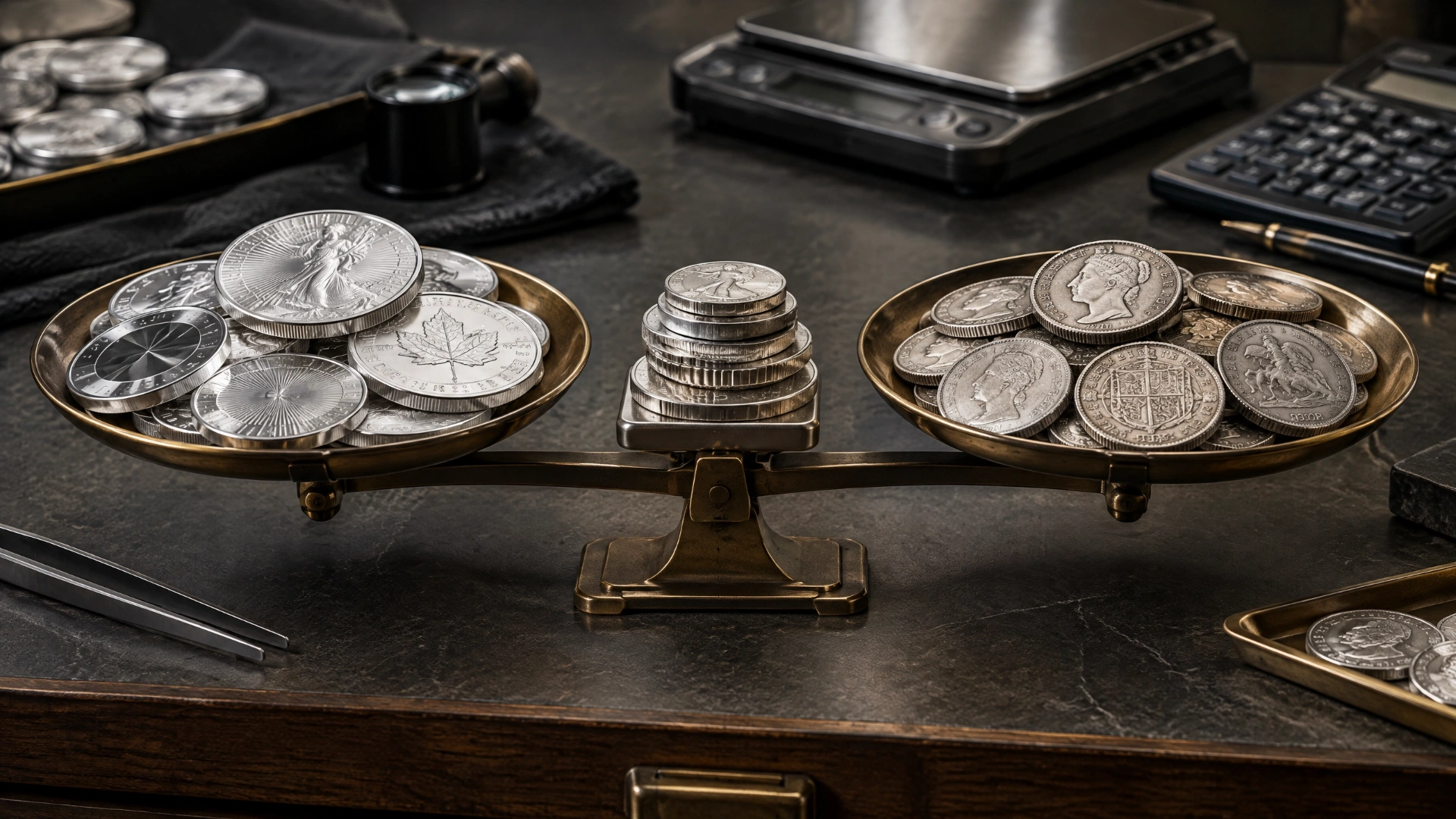
Set the two quotes side by side and the cost of a trade becomes obvious. Every bullion quote can be written as spot plus or minus something:
| Side of the trade | How it is quoted | What moves it |
|---|---|---|
| What the shop pays you for rounds | Spot, less a buy-side margin per ounce | Mint, condition, packaging, how quickly the shop can resell |
| What the shop asks for Eagles | Spot, plus a sell-side premium per ounce | Mint availability, dealer inventory cost, demand for the series |
Add those two figures together and you have the cost per ounce of moving from one to the other. Multiply by the number of ounces and you have the cost of the trade. If you are swapping twenty ounces, you pay that per-ounce gap twenty times — spot itself cancels out on both sides of the transaction, which is why a trade-in can be quoted and agreed without either party taking a view on where the metal price is going.
Two consequences follow from that arithmetic, and both are worth knowing before you walk in.
First, a like-for-like swap is rarely ounce-for-ounce. If the premium you are buying into is higher than the premium you are selling out of, you either write a cheque for the difference or you come out with fewer ounces than you went in with. Either is a legitimate way to settle; ask which one the quote assumes.
Second, the gap is paid once, at the moment of the trade. It is not an ongoing cost and it does not compound. But it is also not recovered by waiting — it is the cost of changing what you hold, and it is the reason most people trade in a batch rather than a coin at a time.
Current premiums move with the market and with what is on the shelf, so a figure written into an article is out of date by the time it is read. Ask for the live numbers on both sides of the counter; we will show you the calculation before you decide.
Why the bid on a generic round sits lower
The buy-side quote reflects what the shop can do with the item next. A sovereign coin can be resold to a walk-in customer the same week, in the same condition, with no explanation required. A generic round may sell as readily, or it may sit, or it may eventually go out by weight to a refiner — and a round that ends up priced as metal is priced as metal.
Verification is part of it too. A widely counterfeited sovereign coin has published specifications and a known feel, and it gets tested against them. A round from an unfamiliar private mint has to be tested on its own merits. At our counter that means X-ray fluorescence analysis, ultrasound and specific-gravity testing, which is the same battery we describe in our piece on why lead turns up inside fake gold bars. Testing takes time, and time is priced.
Several things cut the other way. A round from a well-known private mint is verified about as quickly as a sovereign coin, because its specifications are equally published. Once verified, silver is silver: a round and an Eagle go into the same wholesale metal market at the same fineness. A round also carries no premium for a series or a mint year, so there is no format premium to lose if interest in a particular issue fades. And the lower entry premium is money that stays with the buyer unless and until they trade.
Sovereign coins have a corresponding drawback that is easy to skip past. The higher premium is paid on the way in, and it is recovered only if the eventual buyer also pays a premium for the format. Sold to a buyer pricing purely on metal, an Eagle and a round fetch the same.
So the honest summary is that the spread on rounds is generally wider than the spread on sovereign coins — not that one is the better thing to own.
Condition, packaging and what they do to the quote
Bullion is priced as metal, but presentation still moves the number at the margin.
- Original mint packaging. Coins still in sealed mint tubes or an unopened monster box need less handling and less individual inspection than loose coins in a bag.
- Surface condition. Milk spots, haze and heavy toning do not remove any silver, but they do narrow the pool of buyers for a bullion coin. We cover what they are and how they affect resale in our article on milk spots, toning and patina.
- Mixed lots. A tub of assorted rounds from a dozen mints is sorted and tested item by item. A single sealed tube is one decision.
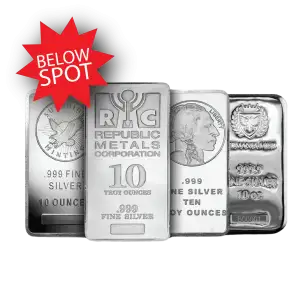
- Bars. Swapping silver bars for coins follows exactly the same two-quote arithmetic. Larger bars usually carry a lower premium per ounce than one-ounce coins, so a bar-to-coin trade typically costs more per ounce than a coin-to-coin trade of the same size.
What Texas law does — and does not — cover at this counter
Texas regulates dealers who buy crafted precious metal from the public through Chapter 1956 of the Occupations Code, administered by the Office of Consumer Credit Commissioner. The definition is where the useful detail sits. Under Tex. Occ. Code § 1956.051, as set out by the Office of Consumer Credit Commissioner, "crafted precious metal" means jewellery, silverware, an art object or another object made wholly or partly from precious metal and used primarily for personal, family or household purposes. The term does not include, among other things:
- a coin
- a bar
- a commemorative medallion
- an item selling at 105 percent or more of the scrap value of the item
- items made from precious metal for dental, pharmaceutical or medical applications
So the same counter can operate under two different frameworks depending on what is put on it. A gold chain or a set of sterling flatware is crafted precious metal. Government-issued coins and bars are named in the exclusions.
Privately minted rounds are the case worth being precise about. A round is not on the exclusion list, because that list names coins, bars and commemorative medallions. Whether it falls inside the definition at all turns on the inclusive half — jewellery, silverware, an art object or another object used primarily for personal, family or household purposes — which is not an obvious fit for a bullion round either. That is not a settled reading and we do not offer it as one; ask what paperwork applies to your own transaction rather than assuming.
Texas also exempts qualifying precious metals from sales tax under Tex. Tax Code § 151.336, which changes the arithmetic of a trade in a way that is easy to overlook — that is covered in full in our article on the Texas sales tax exemption for bullion.
Trading the other way, and trading up in size
Trades run in both directions, and the arithmetic does not care which way you go.
Moving from sovereign coins into rounds or bars means selling the higher premium and buying the lower one, so the same transaction that costs ounces in one direction can add ounces in the other. Moving from one-ounce coins into ten-ounce or hundred-ounce bars usually works the same way, because premium per ounce generally falls as unit size rises. What you give up is divisibility: a hundred-ounce bar is one decision, not a hundred of them, and it cannot be sold in pieces.
People also trade sideways for reasons that have nothing to do with premium — consolidating a collection into one format, building a set, or moving into a series they simply prefer to own. There is no version of this article that tells you which of those is right for you, and a shop that sells both is the last place that should try.
How a trade works at Stout
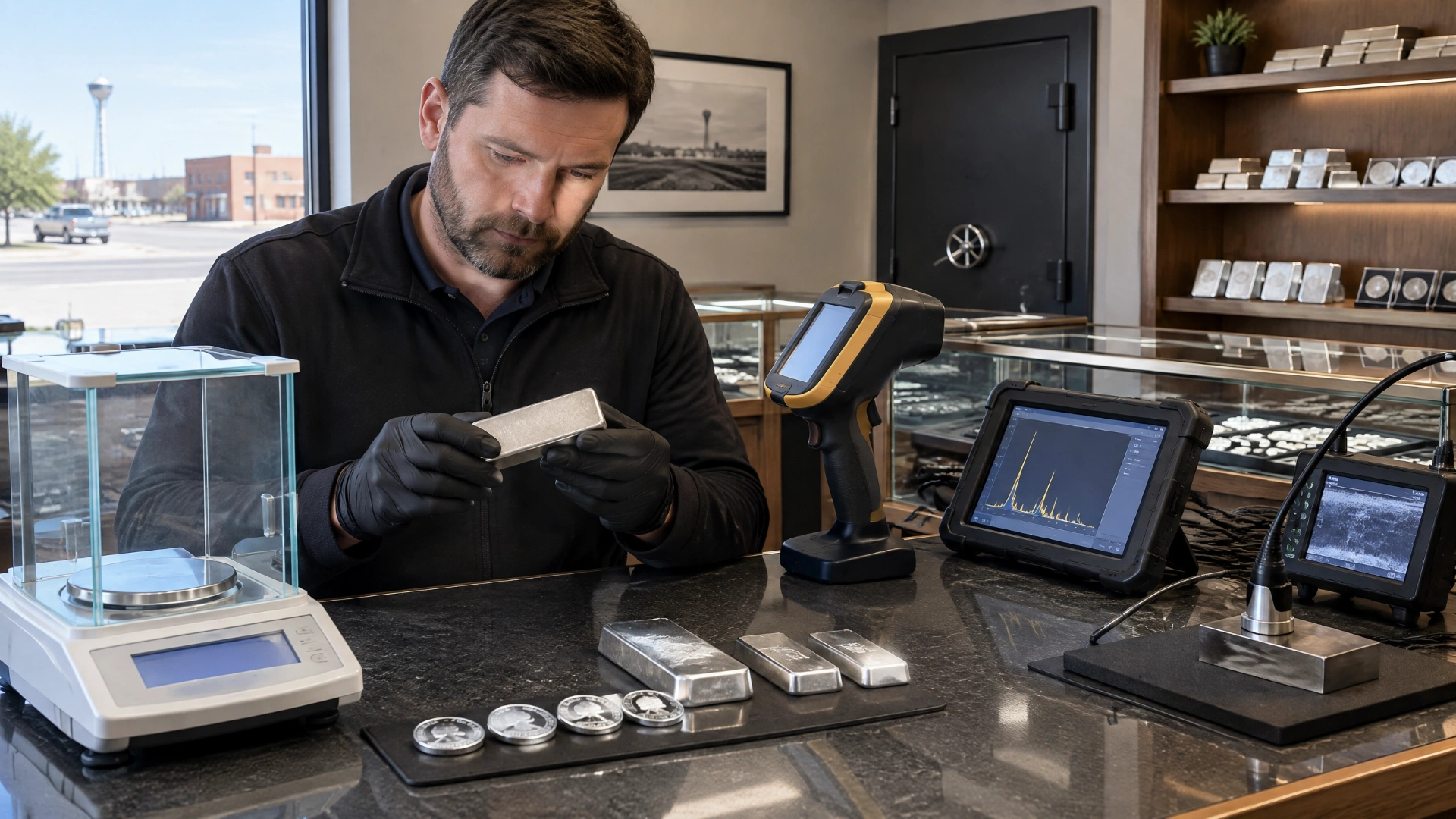
We buy, sell and trade precious metals at the counter in Amarillo, and we evaluate both bullion and numismatic coins. Walk-ins and appointments are both fine.
Bring what you have. We weigh it, test it, and quote both sides of the trade against the live market so you can see the gap for yourself before anything is agreed. Payment, where a trade settles in your favour, can be made by check, cash, e-check, PayPal or bank wire. Online orders over $199.99 ship free.
We are a family business — Brett and Hannah Stout, on SW 7th since 1986 — and we are members of the ANA, the BBB and ICTA, and submit coins to PCGS and NGC. We are not a registered investment adviser and we do not tell customers what to hold.
This article is educational and reflects general information about precious metals and collectible coins. It is not investment, tax or legal advice, and Stout Gold & Silver is not a registered investment adviser, broker-dealer or tax professional. Metal prices fluctuate and past performance does not indicate future results. Consult a qualified professional about your own situation.
Frequently asked questions
Can I trade silver rounds for Silver Eagles one for one?
Usually not without settling the difference. Eagles typically carry a higher premium per ounce than generic rounds, so an equal-ounce swap leaves a gap. It is normally closed either by paying the difference in cash or by taking fewer Eagles than the number of rounds traded in. Ask which method the quote assumes before you agree to it.
What is my bullion trade-in value based on?
The metal content, verified by weight and testing, then adjusted by what the shop can do with the item next. Recognised sovereign coins in original packaging sit closest to spot. Generic rounds, mixed lots and loose coins sit further back, because they take more handling and reach a narrower pool of buyers.
Do I lose money by trading silver bars for coins?
You pay the gap between the two premiums, which is a real cost and is paid once. Whether that is worth it depends on what you want the metal to do — divisibility, recognisability or simply preference. It is not recovered by waiting, so it is worth deciding the format question before buying rather than after.
Does Texas law require ID when I trade coins?
Chapter 1956 of the Occupations Code names coins, bars and commemorative medallions among the exclusions from "crafted precious metal", so a trade in those sits outside that framework. Jewellery and silverware do not. Privately minted rounds are not on the exclusion list, so ask at the counter. Identification may be requested for other reasons, and federal reporting rules apply to certain transactions regardless of state law.
Is it better to buy rounds or sovereign coins?
That depends entirely on what you want, and it is not a question a dealer that stocks both should answer for you. Both are the same metal at the same fineness; what differs is the premium, and we set out where that premium comes from in silver rounds versus government coins.
Bring it in and we will show you both numbers
If you are weighing a trade, the useful thing is not a figure from an article — it is the two live quotes side by side, with the arithmetic in front of you. Bring what you have to the counter on SW 7th, or call before you drive out.
Stout Gold & Silver
2300 SW 7th Ave Ste 105
Amarillo, TX 79106
(806) 374-8698
Monday–Friday 10:00–16:00 · Saturday and Sunday closed
Browse current bullion and numismatic coins, or see what we are buying.