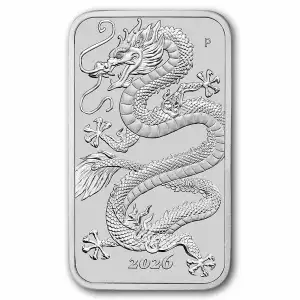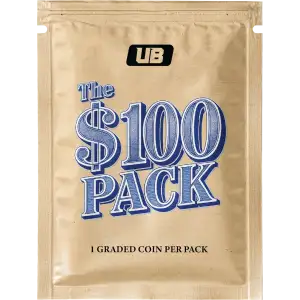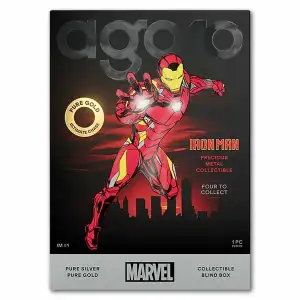
A coin mystery box is a sealed package whose contents are drawn at random from a published list of possible coins, usually with one stated "floor" coin and a small number of scarcer "chase" coins. What you are buying is the floor coin plus a chance at something better. Whether that chance is worth the price depends on three numbers the seller should publish: how many boxes exist, how many of each tier are in the run, and exactly what the floor coin is.
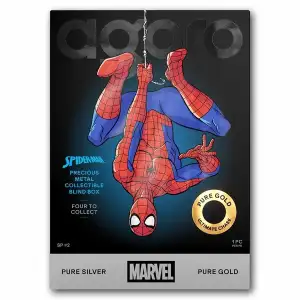
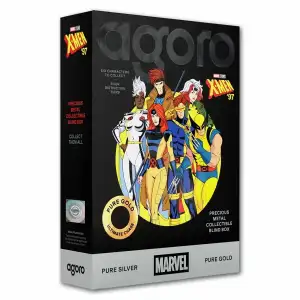
Below we walk through how to read those numbers, using two sealed products we carry as worked examples: a graded Morgan dollar mystery box and a Niue trading-coin mystery set.
What a Coin Mystery Box Is
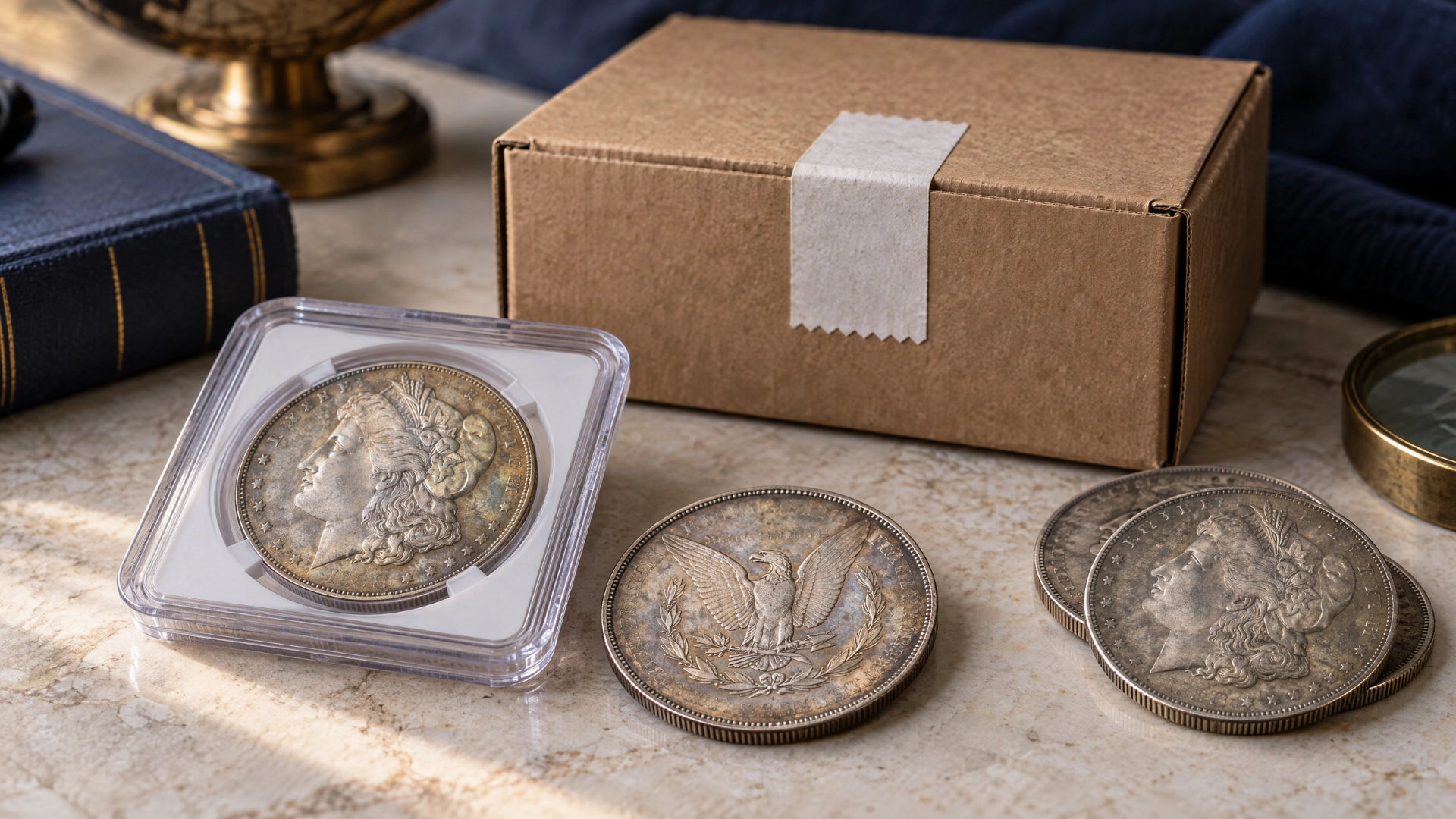
A mystery box is a sealed product in which the buyer does not know which specific coin is inside until it is opened. The term "blind box" means the same thing and is borrowed from the collectible-toy world.
Every honest mystery box has two layers:
- The floor is the minimum every box in the run contains, per the listing. In a well-described box, the floor is a specific coin — a certified Morgan dollar, a one-ounce silver round — not a vague "collectible coin."
- The chase is the scarcer content: a key date, a better grade, a proof, a gold piece. Chase coins are what make the box a "mystery," and they are deliberately few.
A silver mystery box usually has a bullion floor, so part of what you pay is anchored to metal content. A graded-coin box, such as a Morgan dollar mystery box, has a numismatic floor, so its value depends on the coin's grade and date rather than on silver alone.
The Three Numbers That Describe Any Box
The odds in any mystery box come from three published figures: the total run size, the count of each tier and the floor contents. If a seller publishes all three, you can work out your chances yourself. If one is missing, you cannot.
The Holy Grail Graded Morgan Silver Dollar Mystery Box, produced by Rogue's Island Mint, publishes all three on its product listing. Each sealed package holds one pre-1922 Morgan dollar graded by PCGS, NGC or CAC, and the run is limited to 1,000 boxes:
| Tier | Contents, per the product listing | Stated odds | Boxes in the run |
|---|---|---|---|
| Top tier | 1895 Morgan dollar, Proof, graded PCGS PR-63 CAM with a CAC sticker | 1 in 1,000 | 1 |
| Second tier | Carson City Morgan dollar, CAC-graded | 1 in 10 | 100 |
| Floor | Mint State Morgan dollar graded by PCGS or NGC | the remainder | 899 |
The counts add up: 1 + 100 + 899 = 1,000. That arithmetic check is worth doing on any box, because a listing whose tiers do not sum to the run size is not describing the product completely.
The 1895 is the chase coin for a reason. According to PCGS CoinFacts, the 1895 Philadelphia Morgan is a proof-only issue; the 1895-O and 1895-S were struck as business strikes at other mints.
Reading the Odds: What "1 in 10" Actually Means
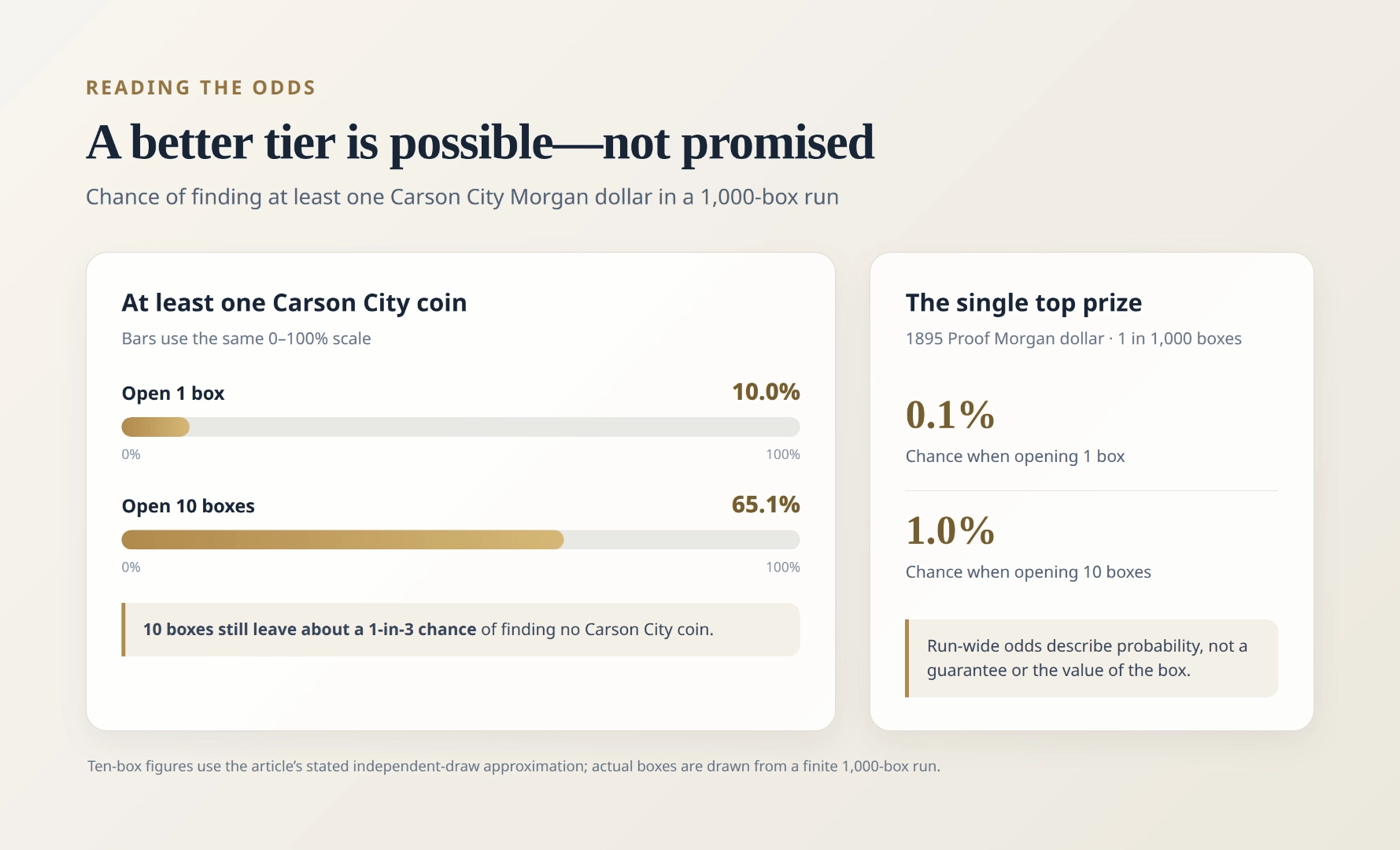
"1 in 10" describes the whole production run, not any ten boxes you happen to buy. Out of 1,000 boxes, 100 contain a Carson City coin — but those 100 are scattered through the run, and buying ten boxes does not guarantee you one.
The chance of finding at least one second-tier coin rises with each box, but more slowly than intuition suggests. Treating each box as an independent 1-in-10 draw (a close approximation for a run of 1,000):
| Boxes opened | Chance of at least one Carson City coin | Chance of the 1895 Proof |
|---|---|---|
| 1 | 10.0% | 0.1% |
| 10 | 65.1% | 1.0% |
The calculation is 1 minus 0.9 multiplied by itself once for each box. Ten boxes still leave roughly a one-in-three chance of no Carson City coin at all. The cost rises with every box, while the chance of a better tier rises more slowly; the table describes probability, not value.
Two further points matter. First, odds stated by a producer apply to the full run; once boxes have been sold and opened, no buyer can know which tiers remain unopened, including in any one dealer's stock. Second, the top prize is a single coin. At 1 in 1,000, it is a reason the box is interesting, not a reasonable expectation for any one buyer.
The Floor Is the Number to Price First
The floor coin is the most likely outcome of any mystery box, so it is the baseline for judging the price. In the Morgan box, 899 of 1,000 boxes contain a Mint State Morgan dollar graded by PCGS or NGC. The listing does not specify the grade or date, so the realistic floor is the lowest Mint State grade and most common date that description allows.
A Morgan dollar weighs 26.73 grams and is 90% silver and 10% copper, according to PCGS CoinFacts. That works out to about 0.773 troy ounces of silver, so its melt value is only part of what a graded Mint State example sells for. The rest is numismatic value: the date, the mint and the grade. If you are unsure how those two layers differ, our guide to numismatic versus bullion value covers it.
The practical comparison is simple. Look up what a common-date Morgan in the lowest Mint State grade costs on its own, then compare it with the box price. The difference is what you are paying for the chance at a higher tier. Some collectors find that worth it for the experience of opening a sealed box; others prefer to buy the exact coin they want. Both are reasonable, and the table above tells you what the chance actually is.
Silver Mystery Sets and Trading Coins
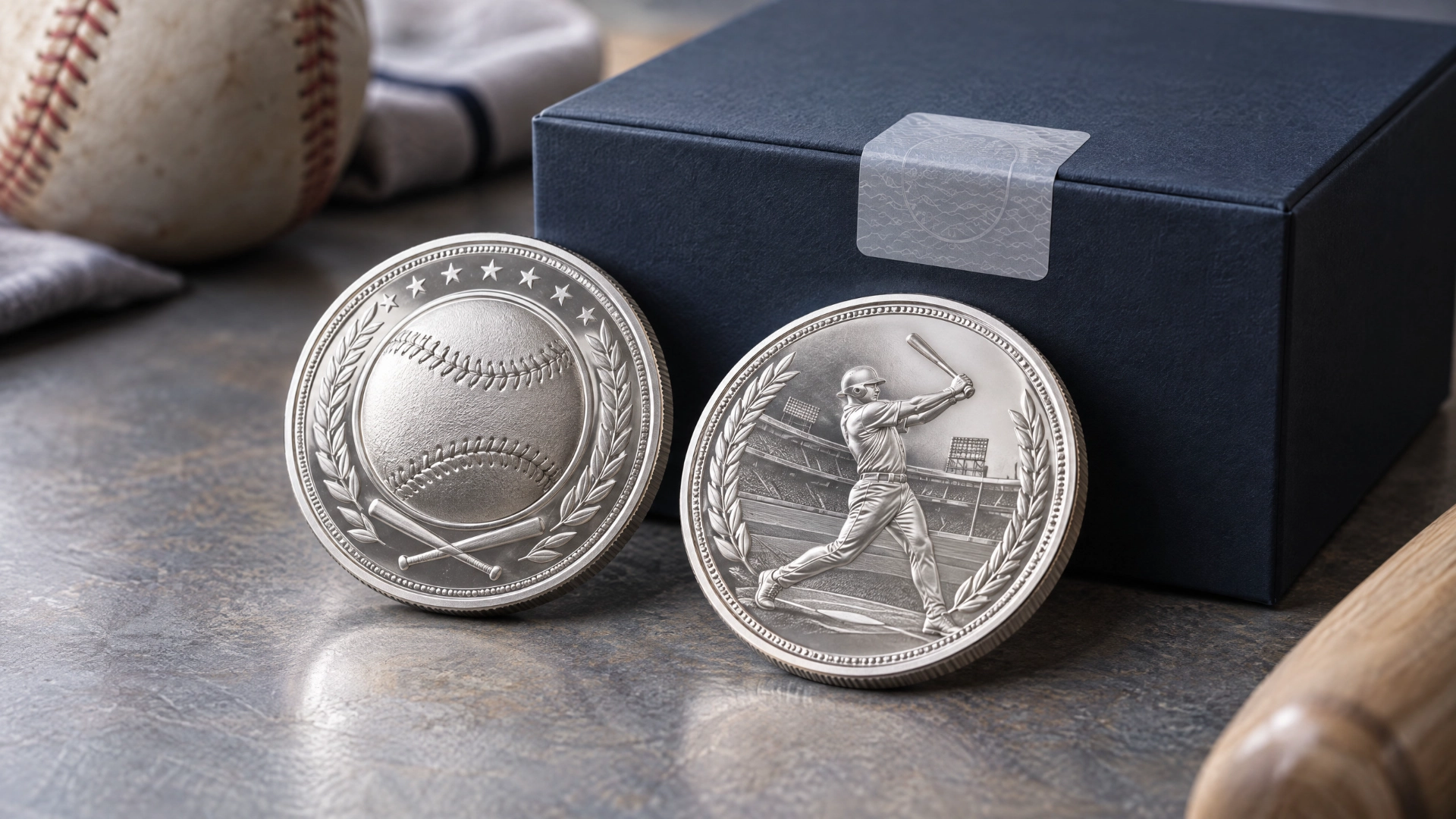
Not every mystery product publishes enough to calculate odds. The 2024 Niue Major League Baseball Mint Trading Coins Mystery Set is a good example of reading what is and is not on the listing.
Each sealed box is closed with anti-tamper tape and contains two surprise coins. The listing gives the weight as two one-ounce coins of .999 silver, struck by New Zealand Mint for Niue. The collection runs across six sets and 51 designs, with mintage falling by edition:
- Emerald Edition: 500 per design
- Topaz Edition: 300 per design
- Ruby Edition: 100 per design
- Sapphire Edition: 60 per design
- Amethyst Edition: 40 per design
- Onyx Edition: 20 coins in total
The listing also mentions 20 MLB logo coins struck in 1/4 oz of gold.
The listing describes the contents as two one-ounce .999 silver coins and separately mentions the gold coins; it does not say whether a gold coin replaces a silver one, so ask before treating two ounces of silver as the floor. What it also does not give is the number of designs in each edition or the total number of boxes, so per-box odds for, say, an Onyx coin cannot be calculated from the listing alone. That is not unusual for trading-coin sets, but it is the difference between a stated chance and an unknown one.
Mintage figures like these are a large part of why licensed issues carry premiums above their metal. Our article on what limited mintage means for licensed collectible bullion explains how those caps work. Secondary-market prices for licensed series also tend to move more than prices for sovereign bullion.
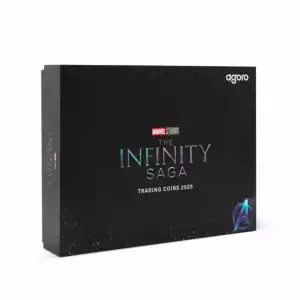
Questions to Ask Before Buying Any Mystery Box
Six questions separate a well-described mystery box from a poorly described one. Ask them of any box, from any seller:
- How many boxes are in the run? Without a run size, "limited" means nothing.
- How many coins are in each tier? The counts should add up to the run size.
- What exactly is the floor? "A graded Mint State Morgan from PCGS or NGC" is specific. "A collectible silver coin" is not.
- Who graded the coins, and can you verify them? PCGS and NGC certificate numbers can be looked up on each service's website.
- Who sealed the box, and how? A producer's seal and tamper-evident packaging show whether a box has been opened since it was sealed.
- How is the top prize valued? A price-guide figure and a realized auction price are different things; neither is a promise of what the coin would bring when sold.
Check the return terms too. Our terms and conditions state that all sales of bullion products are final, so ask us how that applies to a sealed mystery product before you order.
This article is educational and reflects general information about precious metals and collectible coins. It is not investment, tax or legal advice, and Stout Gold & Silver is not a registered investment adviser, broker-dealer or tax professional. Metal prices fluctuate and past performance does not indicate future results. Consult a qualified professional about your own situation.
Frequently Asked Questions
What is in a Morgan dollar mystery box?
It depends on the product, so read the listing. The Holy Grail box we carry holds one graded pre-1922 Morgan dollar per sealed package. Of 1,000 boxes, 899 contain a Mint State Morgan graded by PCGS or NGC, 100 contain a CAC-graded Carson City Morgan and one contains an 1895 Proof graded PCGS PR-63 CAM with a CAC sticker.
Are mystery box odds per box or per production run?
Stated odds describe the whole production run. "1 in 10" means 100 of 1,000 boxes hold that tier, not that every tenth box does. Across ten boxes opened, the chance of at least one is roughly 65%, assuming independent draws, and about one in three of none.
Is a silver mystery box priced at melt value?
No, and it is not designed to be. A silver mystery box is priced above the silver it contains because you are paying for the chance at scarcer coins and for packaging, licensing or grading. Compare the box price with what the floor contents cost when bought on their own; the gap is the price of the chance.
What is the difference between a blind box and a mystery box?
None in practice. "Blind box" is the collectible-toy term for a sealed product with randomized contents, and coin producers use both names. What matters is not the label but whether the run size, the tier counts and the floor coin are published so you can judge the odds.
Can I buy mystery boxes in person at Stout Gold & Silver?
When they are in stock, yes. Call (806) 374-8698 before you drive in to confirm a box is on the shelf. We are at 2300 SW 7th Ave Ste 105 in Amarillo, open Monday to Friday, 10am to 4pm, and closed weekends.
Talk to Us Before You Open the Box
Stout Gold & Silver has been family owned and operated in the Texas Panhandle since 1986. If you want help reading a mystery box listing, checking a certificate number or comparing a box against the floor coin bought on its own, we are glad to walk through it with you. Browse current stock in our bullion catalog; orders over $199.99 ship free.
Stout Gold & Silver
2300 SW 7th Ave Ste 105
Amarillo, TX 79106
(806) 374-8698
Monday–Friday 10:00am–4:00pm · Saturday and Sunday closed