Junk silver is circulated United States coinage that trades for its silver rather than its collector value. In practice that means dimes, quarters and half dollars dated 1964 and earlier, which are 90% silver, and Kennedy half dollars dated 1965 to 1970, which are 40% silver. The word "junk" describes the collector premium, which on worn, common dates is close to nothing. The silver is real, and it is priced by face value.
Pricing by face value is what sets junk silver apart from a bar or a round. A dollar of face value in 90% coin holds the same silver whether it arrives as ten dimes, four quarters or two halves, so dealers buy and sell it by the face dollar.
Which coins count as junk silver
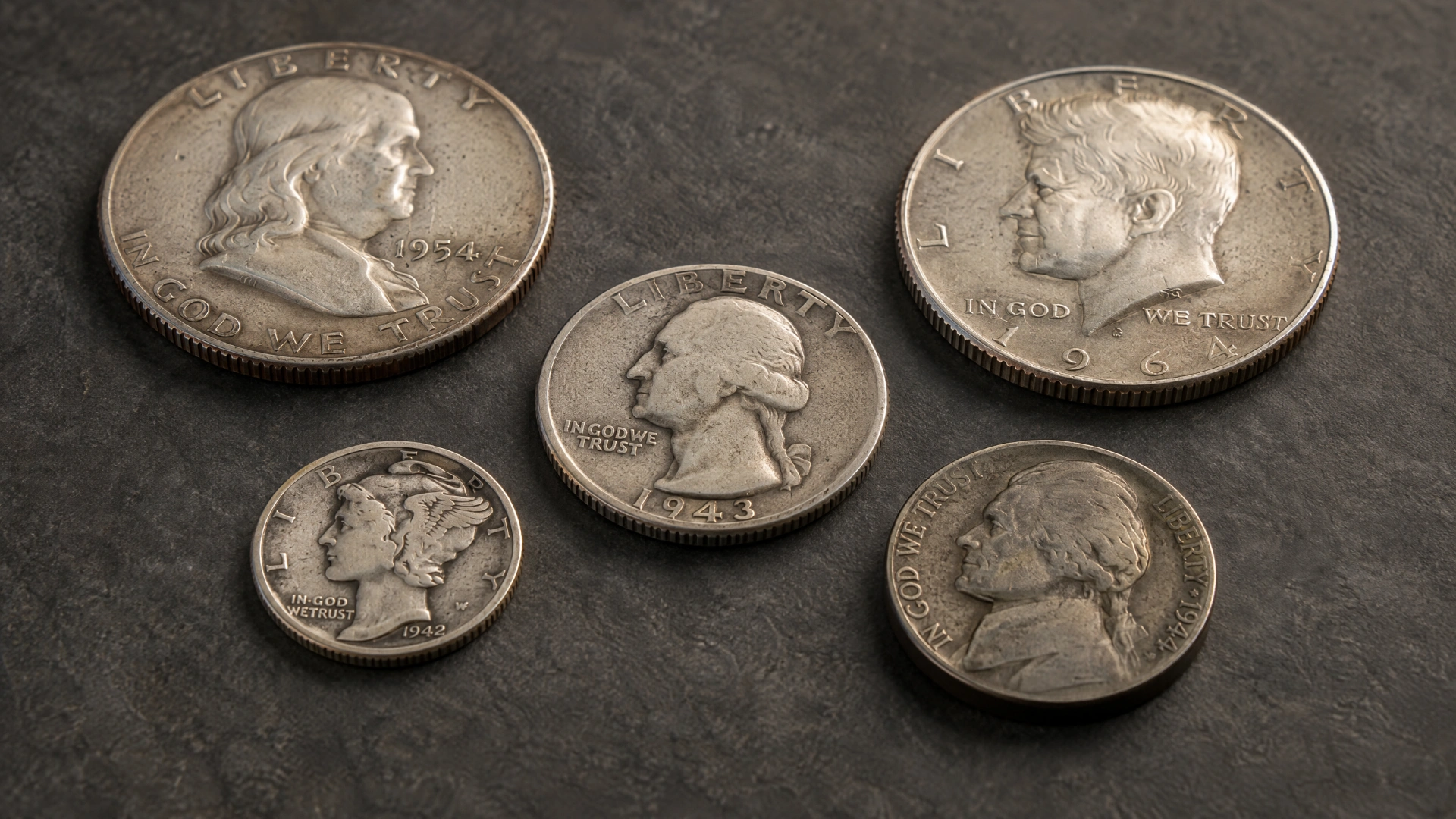
Junk silver is any common, circulated US coin struck in a silver alloy for everyday spending. The table lists the series most often sold as junk silver. Weights and finenesses are from PCGS CoinFacts for the 1964 dime, the 1964 Kennedy half, the 1965 Kennedy half and the 1943-P nickel, and from Greysheet's catalog entry for the 1964 quarter.
A troy ounce is the unit precious metals are weighed in, equal to 31.1035 grams. Silver per coin in the last column is the coin's weight times its silver fineness, converted to troy ounces.
| Coin | Dates | Silver | Coin weight | Silver per coin |
|---|---|---|---|---|
| Mercury and Roosevelt dimes | 1916-1964 | 90% | 2.50 g | 0.0723 troy oz |
| Washington quarters | 1932-1964 | 90% | 6.25 g | 0.1808 troy oz |
| Walking Liberty, Franklin and 1964 Kennedy halves | 1916-1964 | 90% | 12.50 g | 0.3617 troy oz |
| Kennedy halves | 1965-1970 | 40% | 11.50 g | 0.1479 troy oz |
| Jefferson "war" nickels | 1942-1945 | 35% | 5.00 g | 0.0563 troy oz |
Older designs, such as Barber coins and Standing Liberty quarters, are 90% silver too. They wear down to a few common dates in junk lots, but they deserve a look one at a time before they are priced by the face dollar.
What 40% silver means, and why 1964 is the cutoff
Dimes and quarters dated 1964 are the last 90% silver issues because of the Coinage Act of 1965, Public Law 89-81, approved July 23, 1965. The Act moved both coins to an outer layer of 75% copper and 25% nickel bonded to a copper core, at 2.268 grams for the dime and 5.67 grams for the quarter.
The half dollar kept some silver, and the Act built it in layers. Its outer layers are 800 parts silver to 200 parts copper, bonded to a core of silver and copper, and the whole coin weighs 11.5 grams with 4.6 grams of silver in it. That is where the 40% comes from: 4.6 grams in 11.5. NGC's guide to silver coins still found in circulation gives the 1964 Kennedy as 90% silver and the business strikes dated 1965 to 1970 as 40%.
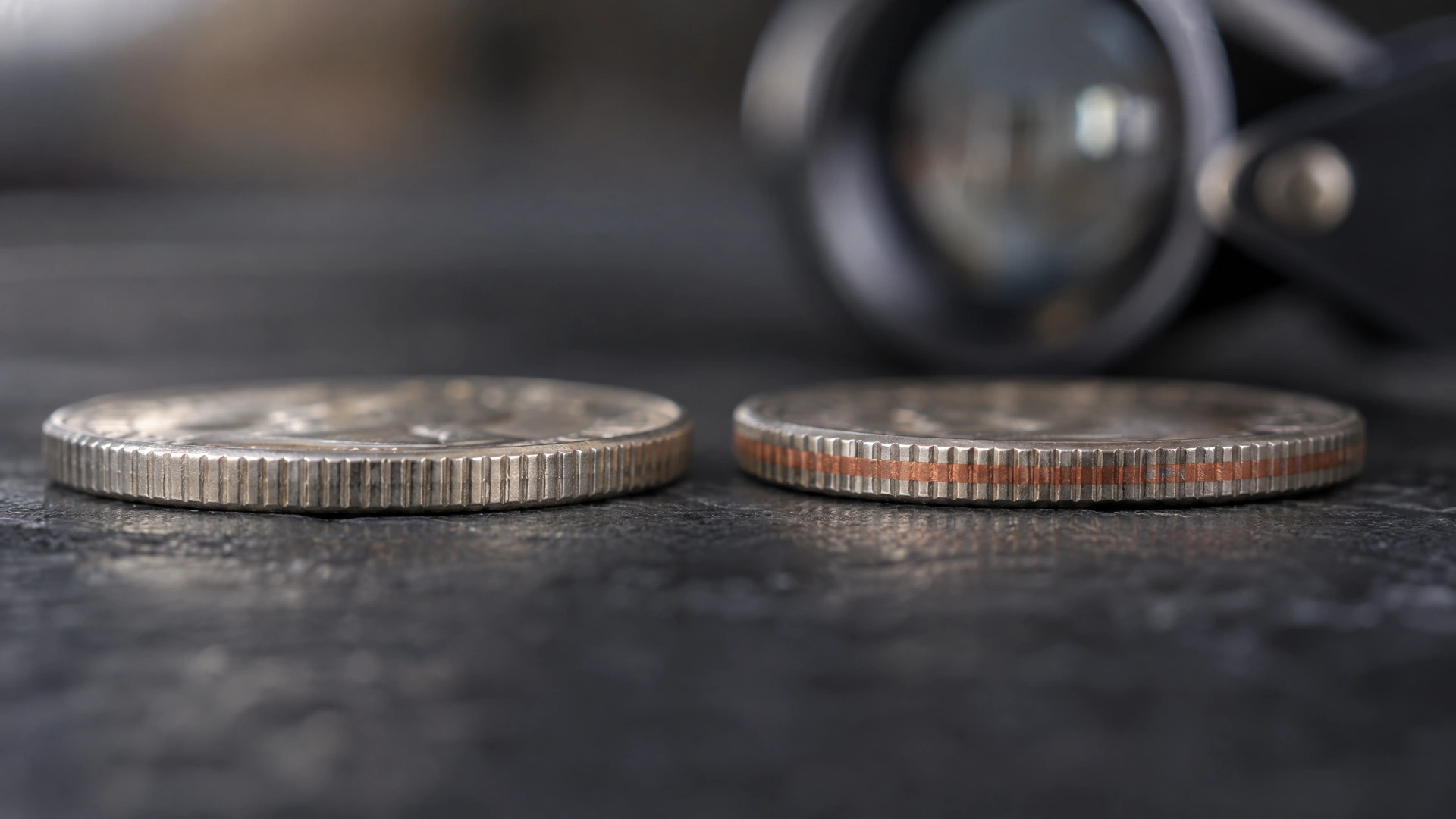
A small digital scale settles most questions. A 90% dime weighs 2.50 grams against 2.268 for a clad one, and a 90% quarter 6.25 grams against 5.67. NGC suggests weighing a suspect coin for exactly this reason, since the silver version is noticeably heavier. The edge helps as well: the copper core of a clad coin shows as a stripe.
How much silver is in a dollar of face value
A dollar of face value in new 90% coin holds about 0.723 troy ounces of silver. Ten dimes, four quarters and two halves each weigh 25 grams, and 90% of 25 grams is 22.5 grams of silver. Our 90% dime, quarter and half listings each state 0.715 troy ounces per face dollar, a little under the new-coin figure, because the coins in these lots are circulated and have lost some metal to wear.
| Coin type | Silver per $1 face, new coins | Figure on our listings |
|---|---|---|
| 90% dimes, quarters or halves | 0.7234 troy oz | 0.715 troy oz |
| 40% Kennedy halves (two coins) | 0.2958 troy oz | 0.295 troy oz |
| 35% war nickels (20 coins) | 1.1253 troy oz | about 1.125 troy oz |
Melt value is the value of the metal alone at the spot price, and spot is the current market price for one troy ounce of silver for immediate delivery. For a junk silver lot, melt value is face value times silver per face dollar times spot. At the 0.715 figure on our listings, one hundred dollars face in circulated 90% coin works out to 71.5 troy ounces of silver.
Junk silver dimes, quarters and halves compared
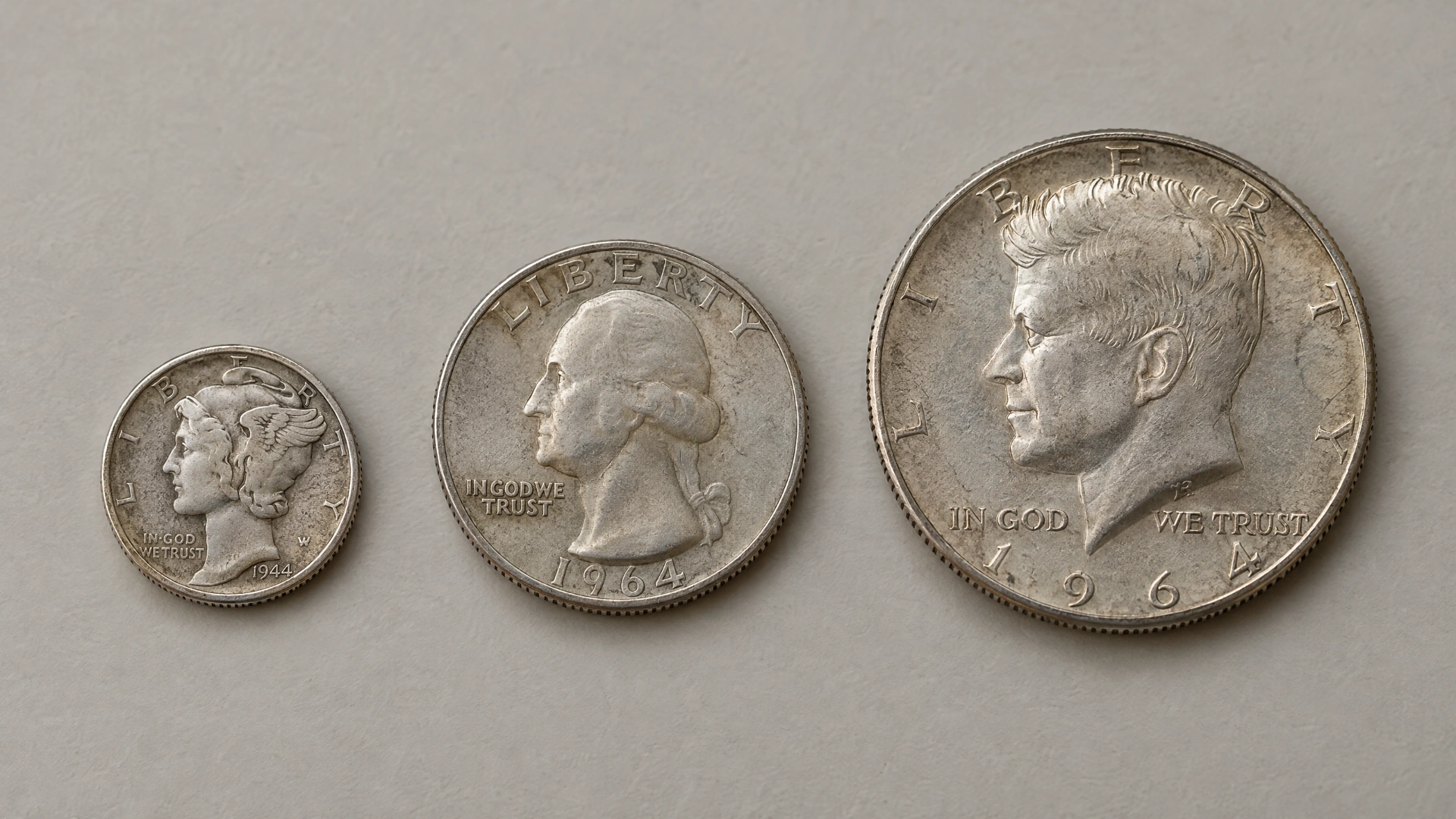
The silver per face dollar is the same in 90% dimes, quarters and halves, so the choice between them comes down to size, count and price per ounce. A dime holds about seven hundredths of an ounce, the smallest piece of silver most people will ever trade. A half dollar holds five times that, and $100 face takes 200 halves against 1,000 dimes.
What each 90% lot usually contains is stated on its listing in our US silver coins. Quarters are typically various-date Washington quarters through 1964. Dimes are usually Roosevelt and Mercury dimes, and one unit on the dime listing is $1 face, or ten dimes.
Halves usually mix 1964 Kennedy, Franklin and later-date Walking Liberty halves. Lots of $100 to $500 face come in a Stout Gold & Silver cloth bag.
Premiums can differ by denomination, so compare the per-ounce figure each listing shows rather than the price per face dollar alone.


How a junk silver price is put together
A junk silver price is quoted per dollar of face value and has two parts: the silver in that dollar at spot, plus or minus a premium. A premium is the difference between what a product sells for and the value of its metal at spot. On junk silver it moves with how much circulated coin is coming in and how many buyers want it, so the same face dollar can cost a different amount per ounce from one month to the next.
Our listings show the structure plainly. Each prices a single face dollar, with lower prices per dollar at larger quantities, and two payment tiers: cash, check and wire at one price, card and PayPal at a higher one; why the card price is higher is explained in our guide to buying bullion online. The "as low as" figure is the lowest price in the table, the cash price at the largest quantity tier, not what a single face dollar costs on its own.
How spot, premium and dealer spread fit together is covered in how a bullion trade-in is priced.
Under Texas Tax Code § 151.336, the sale of gold, silver or numismatic coins is exempt from Texas sales and use tax, which covers junk silver. Our guide to the Texas sales tax exemption on bullion covers the rest of the rule.
Coins to set aside before they go in the bag
A few dates in these series are scarce enough that selling them at silver value would be a real loss, so sort a lot before it is priced as junk. The best known is the 1916-D Mercury dime: PCGS gives its mintage as 264,000, against 22,180,080 for the 1916 Philadelphia dime. Among Washington quarters, PCGS lists the 1932-D at 436,800 struck and the 1932-S at 408,000.
War nickels need a second look of their own. According to NGC, a 1942 nickel is the silver alloy only if it carries a large mintmark above Monticello, while nickels dated 1943, 1944 and 1945 should all be silver. Morgan and Peace dollars are 90% silver as well, but they are sold one coin at a time rather than by face value, and our common-date dollars are listed individually.
Not every coin dated after 1964 is copper-nickel clad. Silver proof sets such as the 2004-S and 2005-S 50 State Quarters 90% silver proof sets we carry are bought and sold as sets, and NGC reports that the US Mint moved its silver coins to 99.9% silver in 2019. If a lot contains anything in a slab, a proof finish or original mint packaging, set it aside: we look at numismatic coins in person before pricing them.
Selling junk silver to us
You can sell junk silver to us at the counter, or arrange it by phone and mail. We will lock a price over the phone if you give us a detailed and fairly accurate description, and that price can change if what arrives differs. You can also ship coins unpriced, and we will price them on arrival and mail a check.
Texas handles a coin differently from a gold chain at the same counter. Tex. Occ. Code § 1956.051 excludes a coin from the definition of crafted precious metal, so the seller list, police report and holding period that apply to jewelry do not attach to a coin sale. The full chapter is explained in our guide to Texas crafted precious metal dealer law.
More often than not we pay sellers by physical check. Cash is available on smaller transactions, and Deluxe E-Check, PayPal and bank wire are also options. The details are on our sell to us page.
This article is educational and reflects general information about precious metals and collectible coins. It is not investment, tax or legal advice, and Stout Gold & Silver is not a registered investment adviser, broker-dealer or tax professional. Metal prices fluctuate and past performance does not indicate future results. Consult a qualified professional about your own situation.
Frequently asked questions
How much silver is in a junk silver dime?
A 90% silver dime dated 1964 or earlier contains about 0.0723 troy ounces of silver when new: 2.50 grams of coin at 90% fineness. Worn dimes hold slightly less. Ten dimes make a dollar of face value, and our listings state 0.715 troy ounces of silver per face dollar, so a common-date dime's worth follows the silver price.
Are 1965 quarters and dimes silver?
Ordinary 1965 dimes and quarters are not silver. The Coinage Act of 1965 moved both to copper-nickel over a copper core. NGC notes that a small number of 1965 dimes and quarters were struck by mistake on 90% silver planchets, and those are errors rather than junk silver. A silver 1965 quarter weighs about 6.25 grams instead of 5.67, and certification settles it.
Are war nickels junk silver?
War nickels are 35% silver and are often traded alongside junk silver. They were struck from 1942 to 1945 in an alloy of 56% copper, 35% silver and 9% manganese. Twenty nickels make a dollar of face value and hold about 1.125 troy ounces of silver. A 1942 nickel is silver only if it shows a large mintmark above Monticello.
Is junk silver a good investment?
Whether junk silver suits you depends on your own goals, and that is a question for you and a financial professional, not for a dealer. What we can explain is what you are paying for: about 0.715 troy ounces of silver per circulated face dollar, plus or minus the premium shown on the listing, in small, recognizable US coins.
Where can I buy or sell junk silver in Amarillo?
Stout Gold & Silver buys and sells 90% and 40% silver coins at 2300 SW 7th Ave Ste 105 in Amarillo, Monday to Friday, 10am to 4pm. Walk-ins are welcome, and appointments take priority, so call (806) 374-8698 before bringing a large lot. Coins can also be ordered online and shipped.
Buy or sell junk silver in Amarillo
Browse 90% silver quarters and halves and 35% war nickels online, with free shipping on orders over $199.99, or bring your old silver change to the shop on a weekday. Family owned and operated in the Texas Panhandle since 1986.
Stout Gold & Silver
2300 SW 7th Ave Ste 105
Amarillo, TX 79106
(806) 374-8698
Monday-Friday 10am-4pm, Saturday and Sunday closed