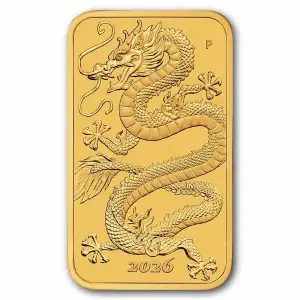
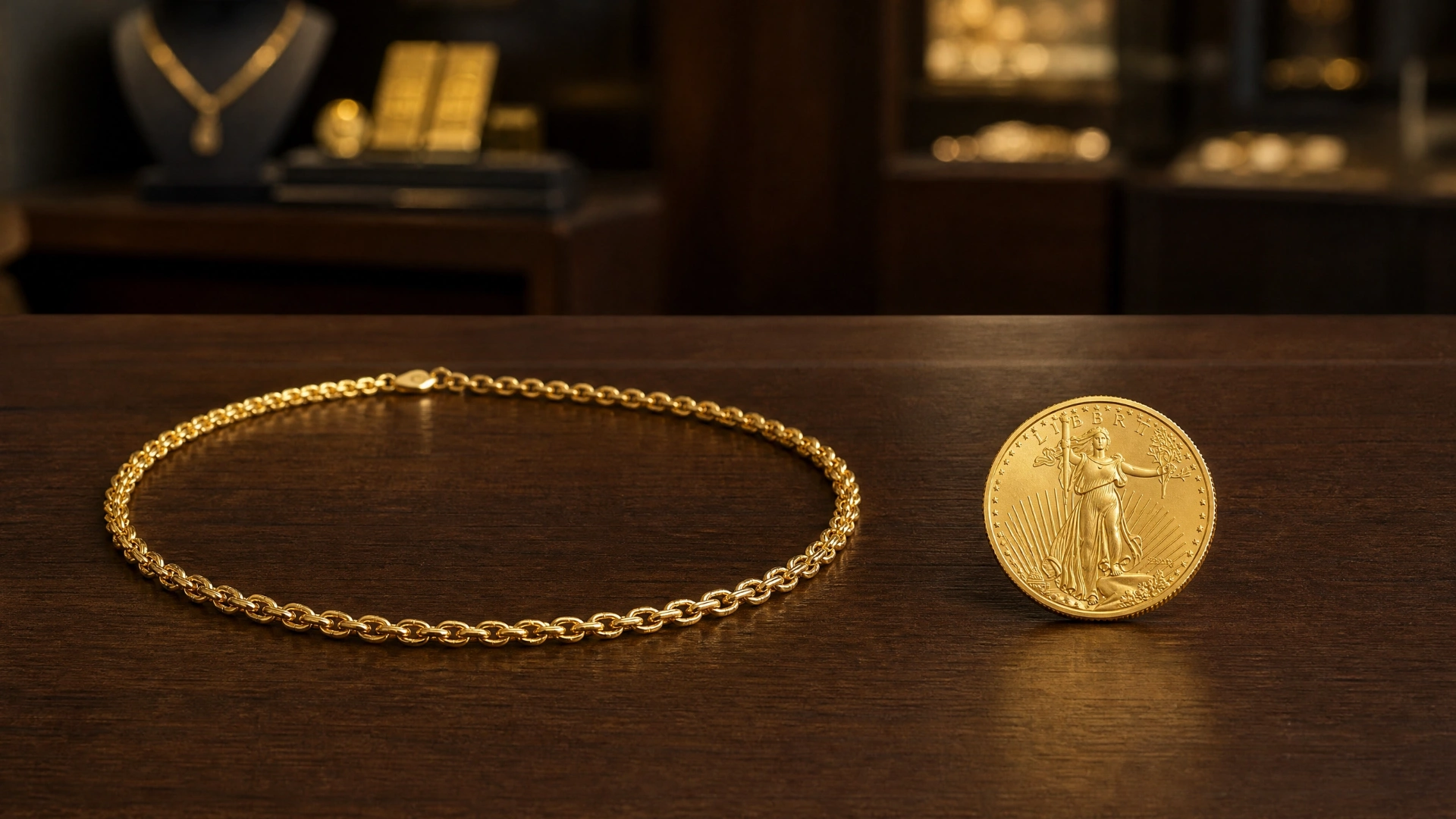
Put a gold chain and an American Gold Eagle on the same counter in Texas and two different sets of rules apply. The chain is a crafted precious metal, and Chapter 1956 of the Texas Occupations Code tells the dealer to register with the state, take a certified list from you, record your driver's license number, send a copy to law enforcement, and leave the item alone for ten days. The Eagle is excluded from that definition by name, and none of it applies.
That split is not a shop policy. It is written into the statute, and it explains most of what feels inconsistent about selling metal in Texas — why a bracelet takes paperwork and a coin does not, why an estate lot gets split into two piles before anyone talks price, and why the answer to "do I need my ID?" is genuinely "it depends what you brought."
What Texas means by "crafted precious metal"
Section 1956.051 of the Occupations Code defines crafted precious metal as jewelry, silverware, an art object or another object made wholly or partly from precious metal. "Precious metal" in the same section is broad — gold, silver, platinum, palladium, iridium, rhodium, osmium, ruthenium, or an alloy of them.
The definition then lists six exclusions. Four of them decide what happens at a retail counter. Crafted precious metal does not include:
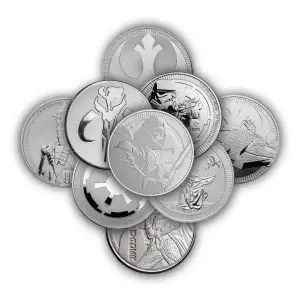
- a coin
- a bar
- a commemorative medallion
- an item selling at 105 percent or more of the item's scrap value
The remaining two exclusions cover dental, pharmaceutical and medical items and precious metal recovered from industrial by-product or waste. Everything in Subchapter B — the registration, the list, the report, the holding period — attaches only to what is left after those exclusions. A Gold Eagle, a one-ounce bar and a struck commemorative medallion are all outside it on the face of the text.
The same counter, two sets of rules
| Gold chain (crafted precious metal) | Gold Eagle (coin) | |
|---|---|---|
| Covered by Ch. 1956, Subchapter B | Yes | No — excluded by § 1956.051 |
| Dealer must be state-registered to buy it | Yes (§ 1956.0612) | Not under this chapter |
| You file a certified list describing the items | Yes (§ 1956.062) | No |
| Driver's license or DPS ID number recorded | Yes, on physical presentation | No |
| Copy sent to police or sheriff | Within 48 hours (§ 1956.062(d)) | No |
| Item held before melting or altering | Until the 11th day after the report is filed | No |
| Dealer keeps the record | Three years (§ 1956.063) | No requirement under this chapter |
What actually happens when you sell jewelry
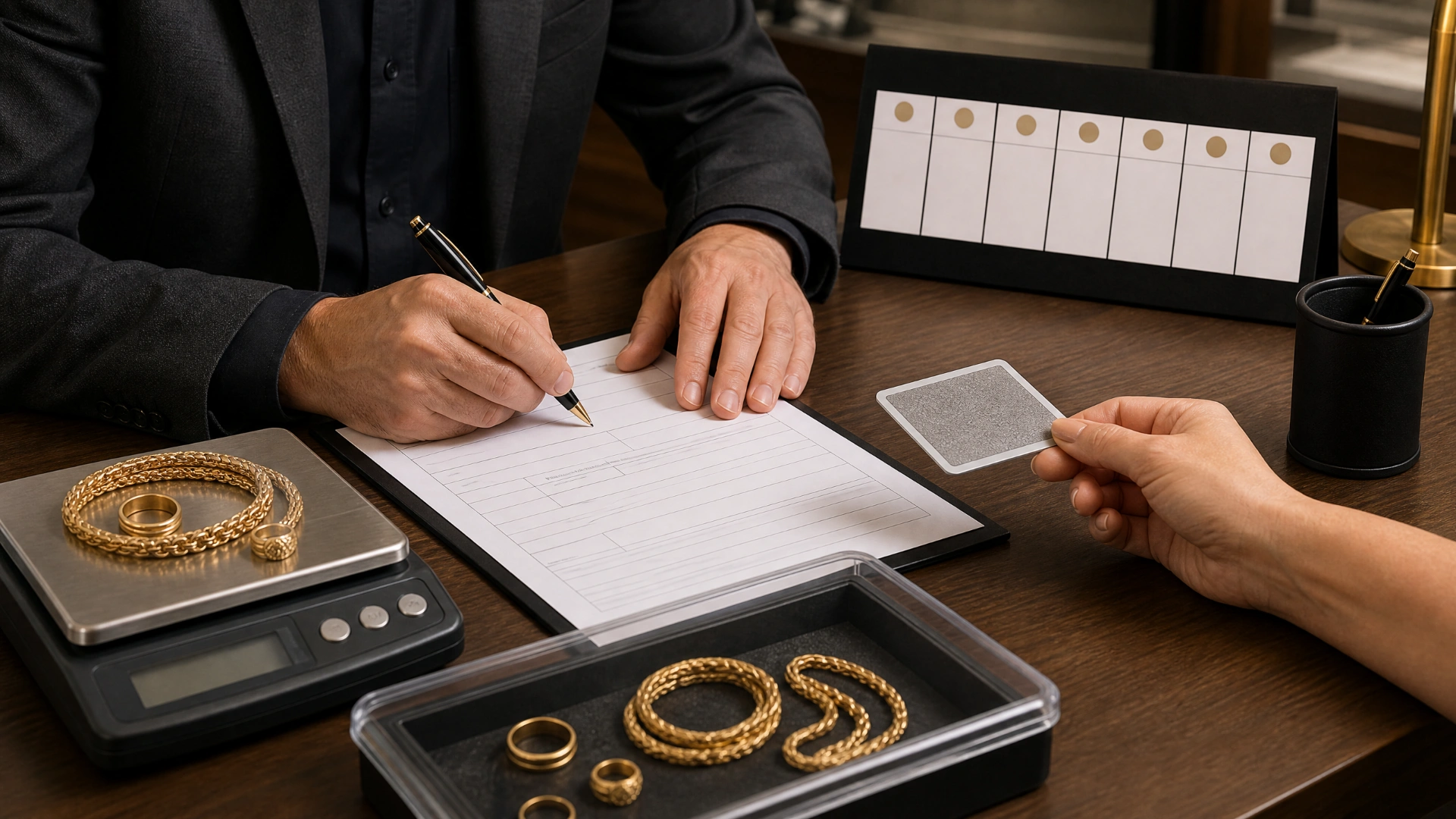
Selling jewelry to a Texas dealer runs through five statutory steps: you file a certified list, the dealer records your ID, a copy goes to law enforcement, the item sits untouched for ten days, and the paperwork is kept for three years.
You file a list. Under § 1956.062, the person selling gives the dealer a list describing all of the crafted precious metal being offered, with their name and address, a complete description of the metal, and the seller's certification that the information is true and complete. You certify it — it is your statement about your own property, not the shop's.
The dealer records your ID. The same section requires the dealer to record your driver's license number or Texas Department of Public Safety personal identification certificate number, on physical presentation of the document. A photocopy in your phone does not satisfy "physical presentation."
A copy goes to law enforcement within 48 hours. Section 1956.062(d) requires the dealer to mail or deliver a complete copy of that list to the chief of police of the municipality, or to the county sheriff where there is no municipal police department, not later than 48 hours after the list is filed with the dealer. Section 1956.063 sets out the report itself — transaction date, description of the metal, the dealer's name and address, and the seller's name, address and physical description — on a form prescribed by the commissioner.
Nothing is melted for ten days. Section 1956.064 bars the dealer from melting, defacing, altering or disposing of the item before the 11th day after the report is filed, absent authorization from the reporting officer or documentation from a buyer. This is the provision that surprises people most often: the shop can pay you today and still cannot touch the item for a week and a half.
The paperwork outlives the transaction. The dealer retains a copy of the report until the third anniversary of the date it was filed.
The 105 percent rule, and why it matters for estate pieces
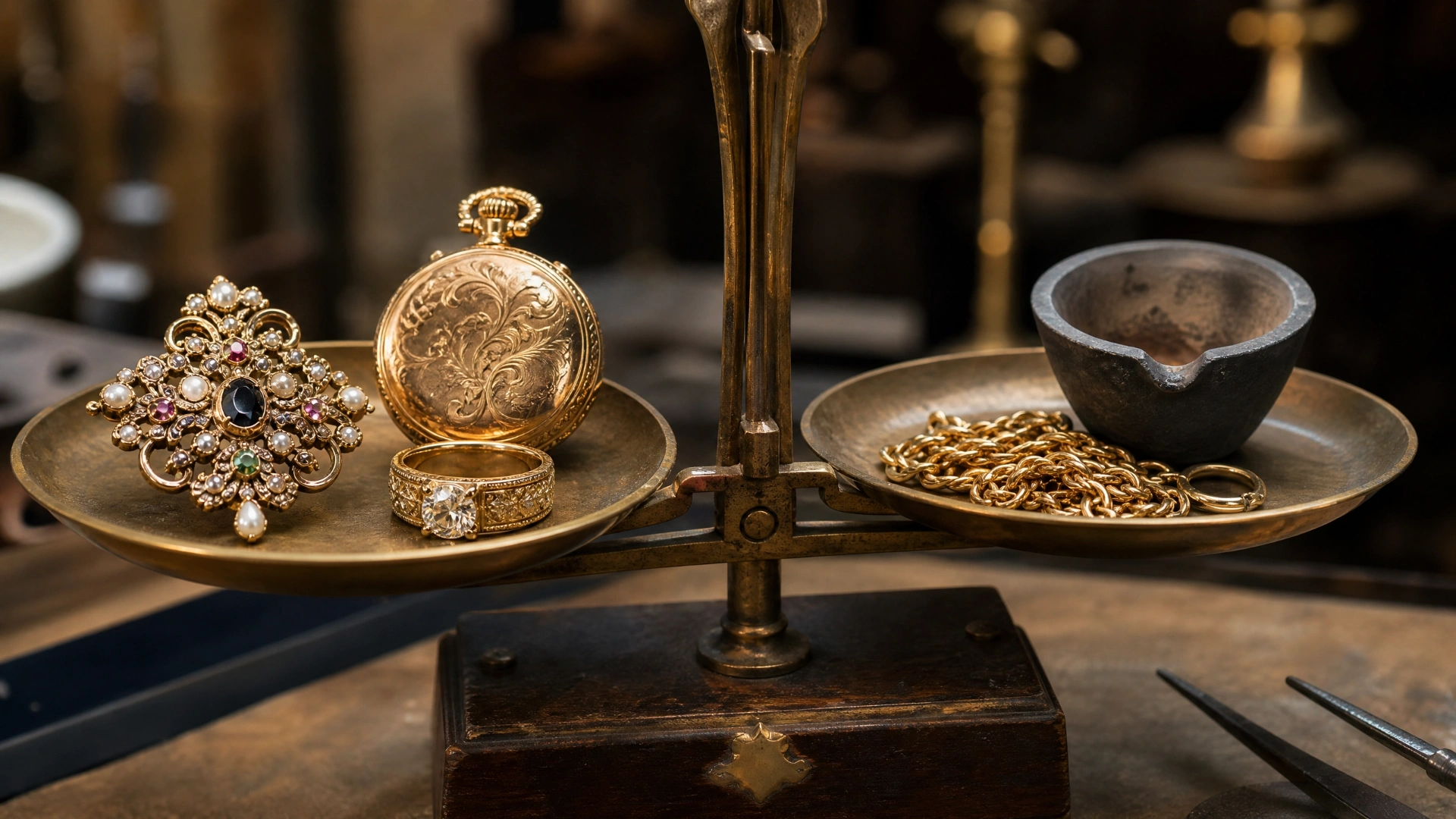
An item selling at 105 percent or more of its scrap value is not crafted precious metal for the purposes of this chapter — the exclusion that catches people out, because it turns on price rather than on what the object is.
Scrap value is what the metal in the piece is worth by weight and purity. A plain 14K chain with no maker, no stones and no design interest usually changes hands close to that number, so it stays inside the definition. A signed Art Deco brooch, a designer piece, an antique watch case or a piece whose workmanship is worth more than its gold content can trade well above scrap — and once the price crosses that 105 percent line, the transaction falls outside Subchapter B.
This is why the same estate lot can be handled two ways at the same counter. The pile being bought for its metal follows the statute. The pieces being bought as jewelry, because they are worth more intact than melted, may not. It is also a decent reason to have a piece looked at rather than assuming it is scrap: the classification follows the price, and the price follows what the piece actually is. If you are working through an estate, our guide to selling gold jewelry in Amarillo covers what to bring and how a lot gets sorted.
Who registers, and with whom
Section 1956.0612 states that a person may not engage in the business of purchasing and selling crafted precious metal unless registered with the commissioner as a dealer. In practice that is the Office of Consumer Credit Commissioner, which administers crafted precious metals dealer registration in Texas and confirms on its own page that transaction reporting is handled by local law enforcement rather than by the OCCC. Registration renews annually.
The obligations run to the dealer, not to you. A violation under § 1956.069 is a Class B misdemeanor, and the conduct listed there is dealer-side conduct. Nothing in Subchapter B creates an offence for a member of the public selling their own jewelry.
What Chapter 1956 does not cover
Two rules regularly get folded into this conversation and belong to other statutes: sales tax, and federal cash reporting.
Sales tax is a separate statute. Buying bullion and coins in Texas is governed by Tax Code § 151.336, not by Chapter 1956, and the two use different definitions — which is why a purchase can be tax-exempt and a sale can still be paperwork-heavy. We cover that separately in Texas sales tax on bullion.
Cash-transaction reporting is federal. Reporting obligations tied to large cash payments come from the Internal Revenue Code and are unrelated to the state's crafted-metal rules — they turn on the form and size of the payment, and the IRS sets out the mechanics in its guidance on Form 8300 and reporting cash payments of over $10,000. Ask a tax professional about your own transaction.
What to bring to the counter in Amarillo
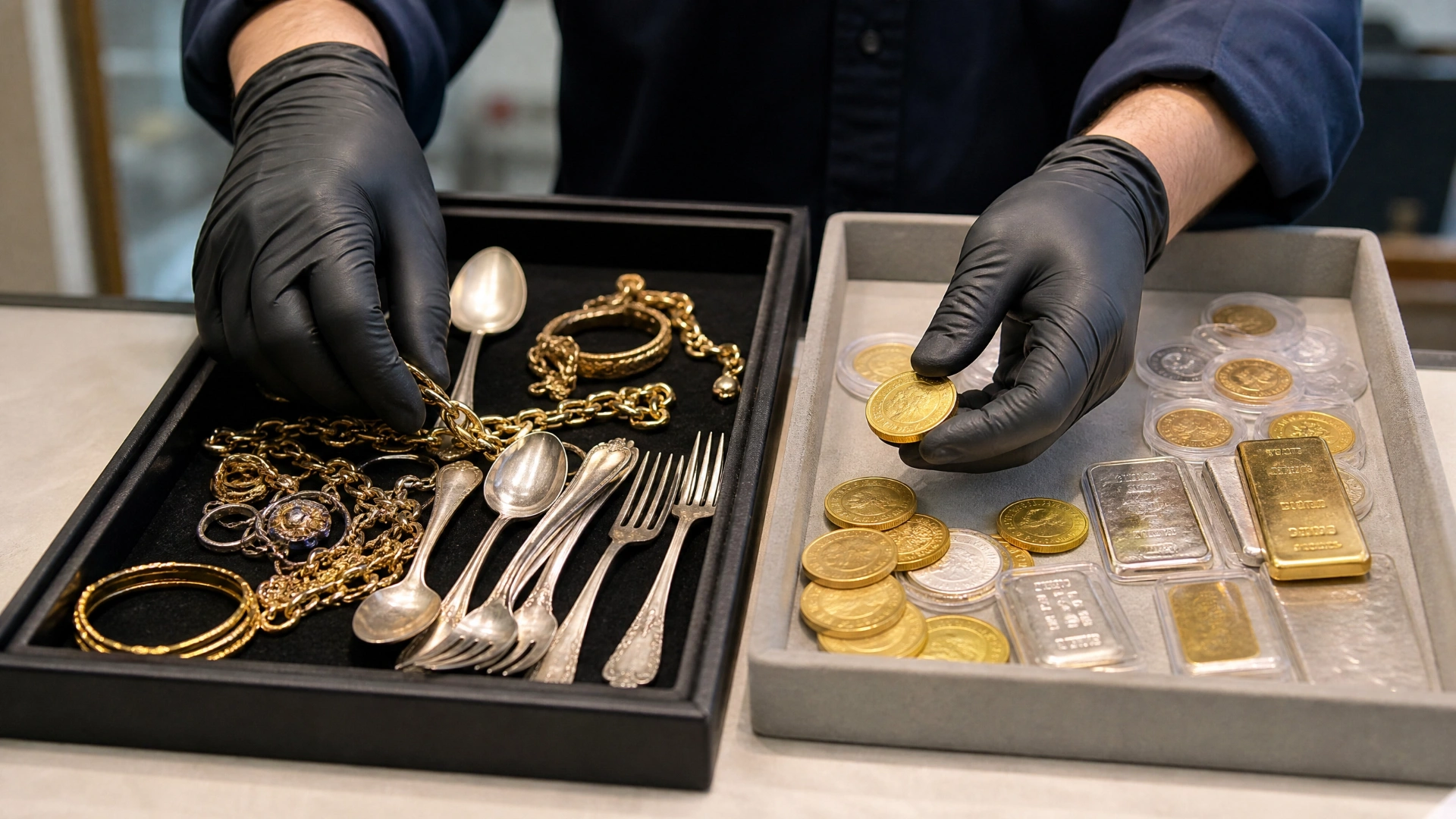
If you are bringing jewelry, flatware or anything fabricated, bring a current driver's license or Texas DPS identification card, and expect to hand it over rather than read the number off it. Bring the pieces loose rather than in a sealed bag — the description on the list has to match what is on the scale.
If you are bringing coins, bars or medallions, none of that applies under this chapter, though a dealer may still ask for identification for its own reasons.
If you are bringing both — which is what most Panhandle estate lots look like — expect the lot to be sorted before it is weighed. Sorting is not the shop being difficult. It is the statute deciding which pile it governs.
How we handle it at our counter
Brett and Hannah Stout have run this shop on SW 7th since the family started buying and selling metal in the Texas Panhandle in 1986. We buy, sell and trade bullion and numismatic coins, we hold our own vault, and we are members of the ANA and the BBB. Walk-ins are always welcome, and appointments take priority. We do not buy paper currency or vintage postage stamps.
Our bullion range is online, and sell to us sets out what we look for on the buy side and how a quote is put together.
This article is educational and reflects general information about precious metals and collectible coins. It is not investment, tax or legal advice, and Stout Gold & Silver is not a registered investment adviser, broker-dealer or tax professional. Metal prices fluctuate and past performance does not indicate future results. Consult a qualified professional about your own situation.
Frequently asked questions
Do I need photo ID to sell gold jewelry in Texas?
Yes, if the item is crafted precious metal. Section 1956.062 requires the dealer to record your driver's license number or Texas DPS personal identification certificate number on physical presentation of the document. The requirement is on the dealer, and it applies to jewelry and fabricated items rather than to coins, bars or commemorative medallions.
Does the same rule apply when I sell a gold coin?
Not under this chapter. Section 1956.051 excludes coins, bars and commemorative medallions from the definition of crafted precious metal, so the registration, list, reporting and holding provisions in Subchapter B do not attach to a coin sale. A dealer may still ask for identification, but it is not this statute asking.
Why can't the shop melt my chain right away?
Section 1956.064 prevents a dealer from melting, defacing, altering or disposing of crafted precious metal before the 11th day after the report is filed, unless the reporting officer authorizes it or a buyer's documentation permits it. The hold applies to the item rather than to the transaction, and the chapter says nothing at all about when a dealer pays you.
What is the 105 percent scrap-value exception?
An item selling at 105 percent or more of its scrap value is excluded from the definition of crafted precious metal. Pieces bought for design, maker or collector interest often exceed that threshold, so they fall outside the chapter, while plain scrap bought close to metal value stays inside it. The classification follows the transaction price.
Does a Texas dealer have to be registered?
Section 1956.0612 requires anyone in the business of purchasing and selling crafted precious metal to be registered with the commissioner as a dealer, and the Office of Consumer Credit Commissioner administers that registration. The requirement sits on the dealer. The OCCC also states that it does not handle transaction reporting, which is filed with local law enforcement instead.
Bring the mixed lot in
Jewelry, coins, bars, the drawer you have not sorted — bring the lot as it is. Our hours are narrow, so plan around them: weekdays only, and we close at four.
Stout Gold & Silver
2300 SW 7th Ave Ste 105
Amarillo, TX 79106
(806) 374-8698
Mon–Fri 10:00–16:00 · Sat closed · Sun closed