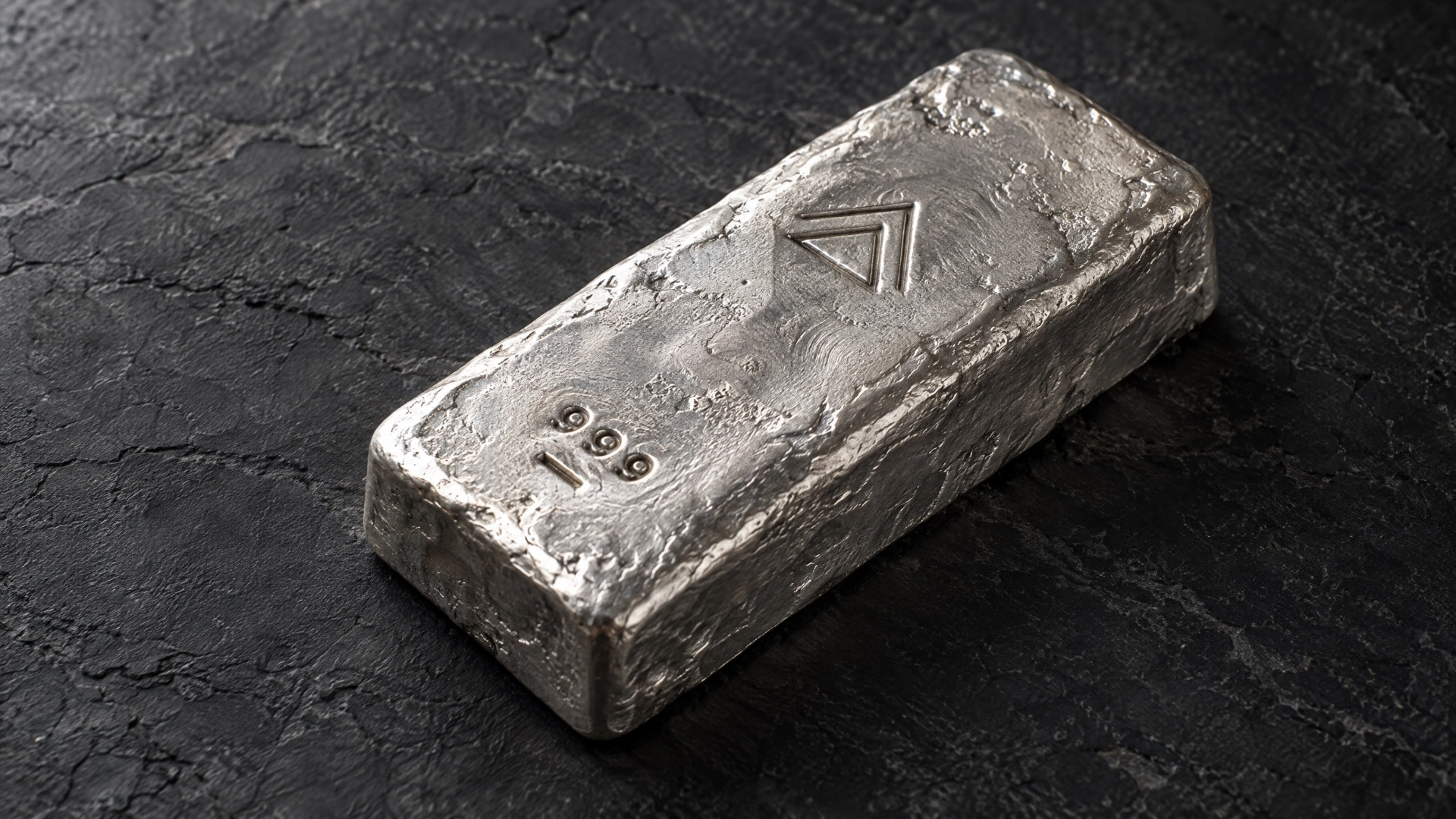
A hand-poured silver bar carries a maker's mark, not a hallmark. The distinction matters: a hallmark in the strict sense is applied by an independent assay office that has tested the metal, and the United States has no assay office system for bullion. Everything stamped into a poured bar — the logo, the fineness, the weight, the serial number — was put there by the person who poured it. That is not a reason to distrust it. It is a reason to know what each mark is claiming, and what it is not.
This article is about reading a bar you have in your hand. If you are still deciding between a poured bar and a minted one, or working out what should appear on the invoice, that question is answered separately in hand-poured vs minted silver bars.
Maker's mark, hallmark, and why the words are not interchangeable
A hallmark is a mark applied by an assay office after the office has itself tested the metal. In the United Kingdom, where the system is one of the longest continuously running, the Hallmarking Act 1973 makes hallmarking compulsory on precious metal articles above the exemption weights, and the Sheffield Assay Office sets out the three compulsory components: a sponsor's mark identifying the maker, a fineness mark, and the mark of whichever of the four UK assay offices carried out the assay. The third mark is the point of the system. It is a third party, independent of the maker, saying the metal tested as claimed.
There is no equivalent for a silver bar poured in Texas, Ohio or Idaho. A US pourer applies its own mark. The mark identifies the maker and, by identifying the maker, attaches the maker's reputation to the bar — which is a real form of accountability, just not the same one. When a listing or a forum post calls the stamp on a poured bar a "hallmark", it is using the word loosely. So is the search: people looking up a poured silver bar hallmark are almost always looking at a maker's mark, and the accurate term is a maker's mark, or simply a stamp.
Two bodies of US rule are often assumed to cover this and largely do not. The Federal Trade Commission's jewelry guides at 16 CFR § 23.5 govern how silver content may be represented, setting sterling at 925 parts per thousand and coin silver at 900, but the guides address jewelry industry products — jewelry, optical frames, pens, flatware and hollowware. The National Stamping Act at 15 U.S.C. § 294 is written around dealers in "gold or silver jewelry or gold ware, silver goods or silverware". An investment bar is not obviously any of those things, and we have found no authority applying either regime to poured bullion. Treat that as unsettled rather than as settled in either direction, and treat the stamp on the bar as what it plainly is: the maker's own statement.
The marks you will actually see
Poured bars vary more than minted ones, and some carry nothing but a logo. Where the marks are present, this is what each one is doing.
| Mark | What it is | What it does not establish |
|---|---|---|
| Maker's logo, initials or name | Identifies who poured the bar | That anyone independent tested the metal |
| .999, 999, or 999 FINE | The maker's stated fineness | A measured result on this particular bar |
| AG | The element symbol for silver | A fineness — on its own it says only "silver" |
| A weight, such as 10 OZ or 10 TROY OZ | Either a nominal size or the actual weight — see the next section | Which of the two it is, unless the bar or the paperwork says |
| Serial number | A production record, where the maker keeps one | Registration with any registry or authority |
| Pour date, batch or mould number | When and from which mould the bar came | Anything about purity or weight |
An unmarked or lightly marked poured bar is not automatically a problem. Small pourers have always sold plain bars. What changes is how much work a future buyer has to do, because a bar that identifies its maker can be traced and a bar that does not has to be tested on its own merits.
The weight stamp: nominal size, or actual weight?
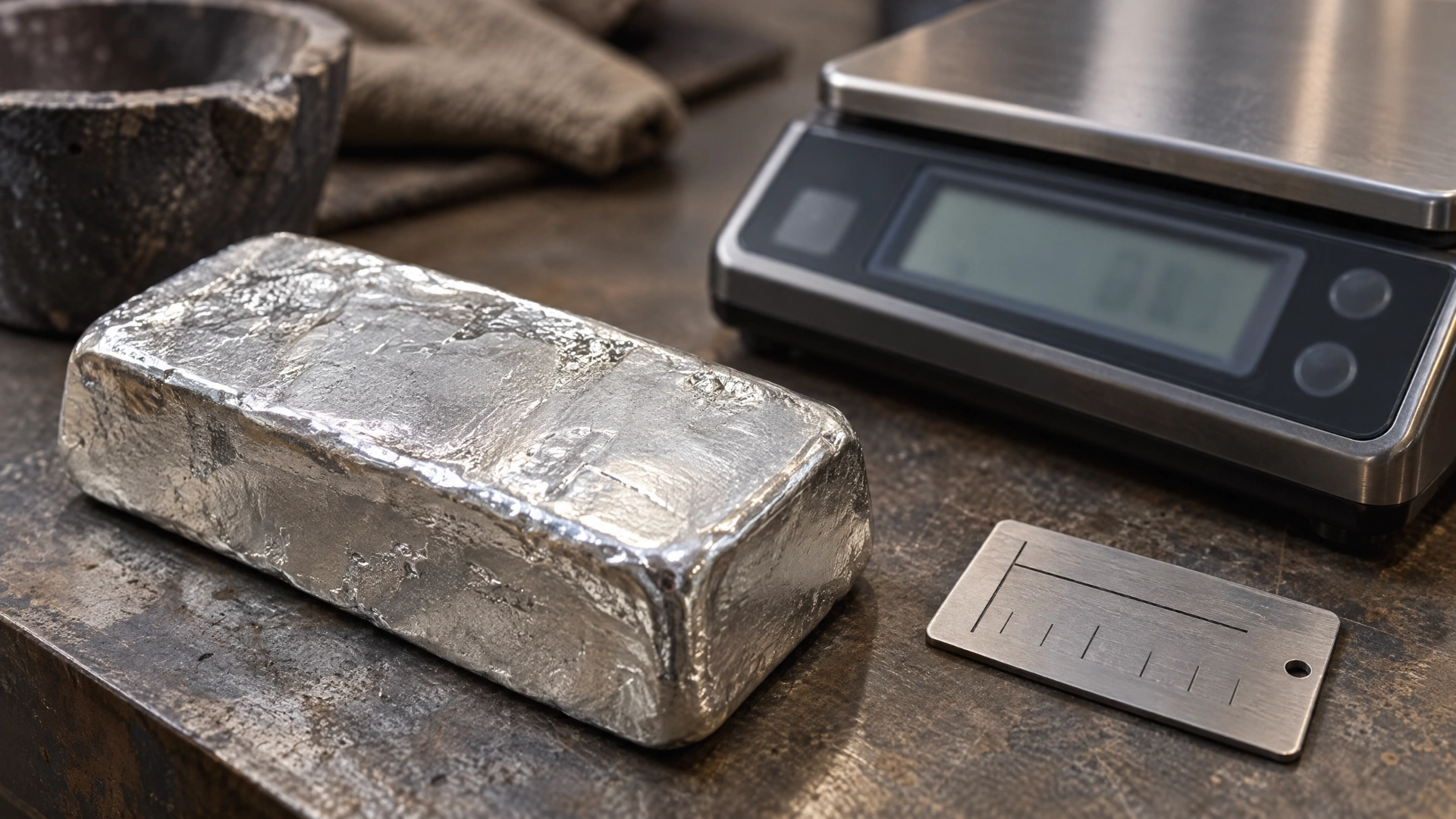
Why a poured bar's weight varies from its nominal size at all, and what that should look like on an invoice, is covered in hand-poured vs minted silver bars. What matters when you are reading the bar itself is narrower: a number stamped into the metal may be the size the bar was sold as, or the weight it actually is, and the two are different statements.
The wholesale market resolves the same ambiguity by recording the real figure. The London Bullion Market Association's technical specifications require that "the gross weight of a Bar should be expressed in troy ounces in multiples of 0.10, rounded down to the nearest 0.10 of a troy ounce". Rounded down, so the holder is never credited with silver that is not in the bar. A number that has been rounded down to a tenth of an ounce is doing something a round "10 OZ" is not: it is reporting a measurement.
So a bar stamped 10.30 TOZ is telling you its weight, and a bar stamped 10 OZ is probably telling you its size. Neither is better. A bar sold to a nominal size is normally priced on that nominal size, so a fractionally heavy bar is not a discount; where a maker sells by actual weight, the paperwork should show the weight the price was built on. How a buy price is put together from the same figures is in how a trade-in is priced.
Checking a mark instead of taking it on trust
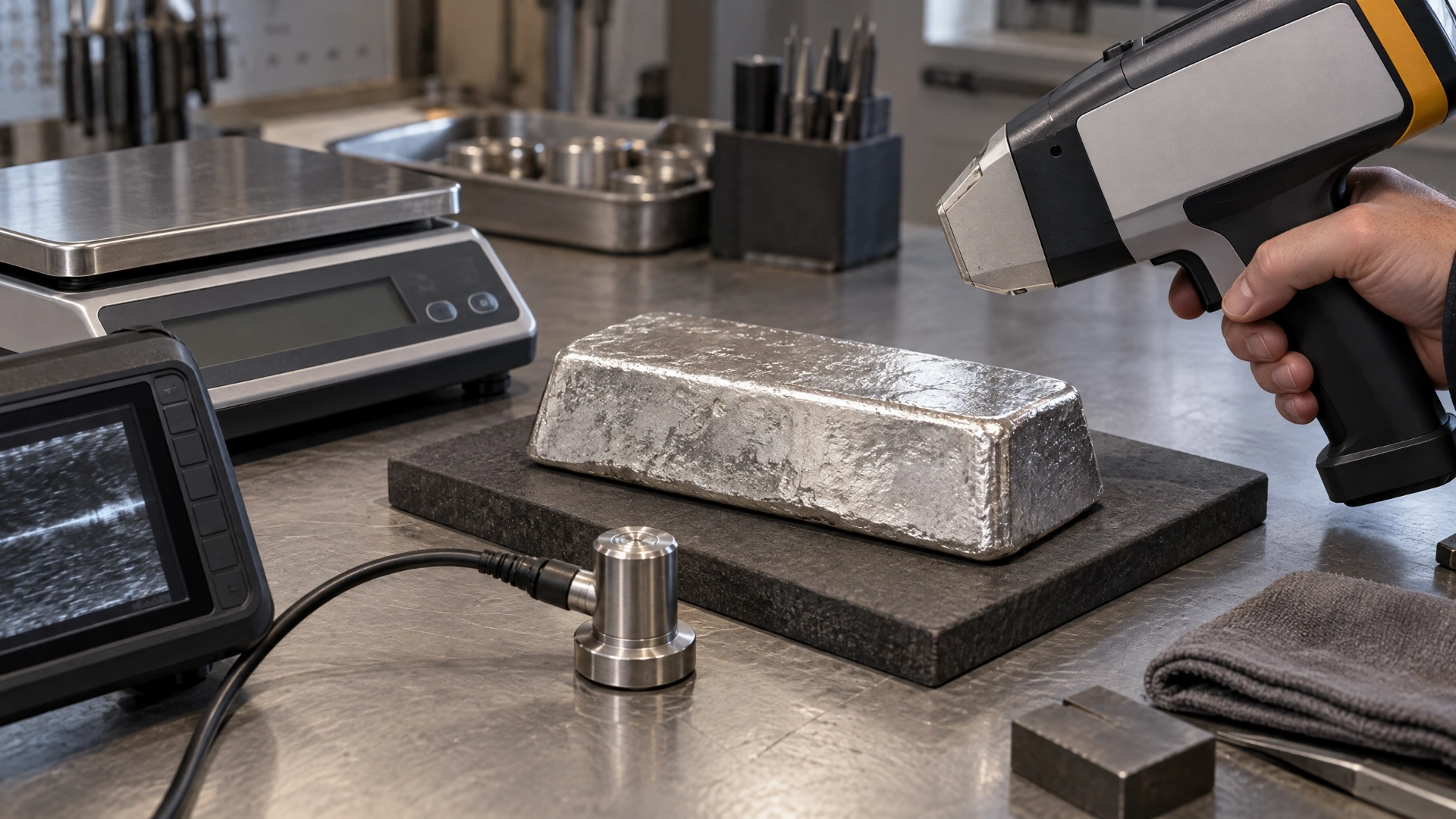
Three things can be done without specialist equipment, and one cannot.
Weigh it. A scale reading to a tenth of a gram will tell you whether the bar agrees with its own stamp. A poured bar sitting slightly above its nominal weight is expected. One sitting below it is a conversation.
Look up the maker. Does the business exist, is it currently trading, and does it publish the mark it uses? Pourers come and go, and a retired maker's mark is not a red flag — but a mark that cannot be matched to any maker at all leaves a future buyer with nothing to check.
Compare the density. Silver's density is about 10.5 grams per cubic centimetre, according to the Royal Society of Chemistry, and a specific-gravity test compares a measured value against that figure. On a poured bar the measurement is harder than on a machined one, because an irregular cast surface makes the volume harder to establish — which is why the test is never run alone. The three tests we use at the counter, and what each of them can and cannot see, are set out in why lead is poured inside gold bars.
What cannot be done from the outside is confirm the inside. No stamp, however crisp, is evidence about the core of the bar. That is what X-ray fluorescence, ultrasound and specific gravity are for, and it is why we run them together rather than singly.
Hand-poured silver makers: what "maker" means in this market
Hand-poured silver is a cottage industry. Most of it comes from small shops pouring limited runs, sometimes a few hundred bars of a design, sometimes fewer. There is no central register of marks, no licensing body, and no requirement that a pourer publish anything. Hand-poured silver makers start up, change their marks, and stop.
That structure is why the mark carries so much weight in this market and so little in the minted one. A sovereign mint's product is interchangeable; one 2019 Silver Eagle is the same as another. A poured bar is priced partly on who made it, which means the mark is doing work that a refinery stamp on a minted bar does not have to do. It also means the extra a buyer pays for a recognised pourer is a demand-led figure that can move in either direction, and nothing about a well-known mark guarantees what the next buyer will pay for it.
The useful question when buying is simply whether the maker is known to the people likely to buy the bar back. Ask the shop selling it. A dealer who handles poured silver regularly knows which marks move and which ones sit, and will say so.
Selling a poured bar in Texas: why the counter treats it as a bar
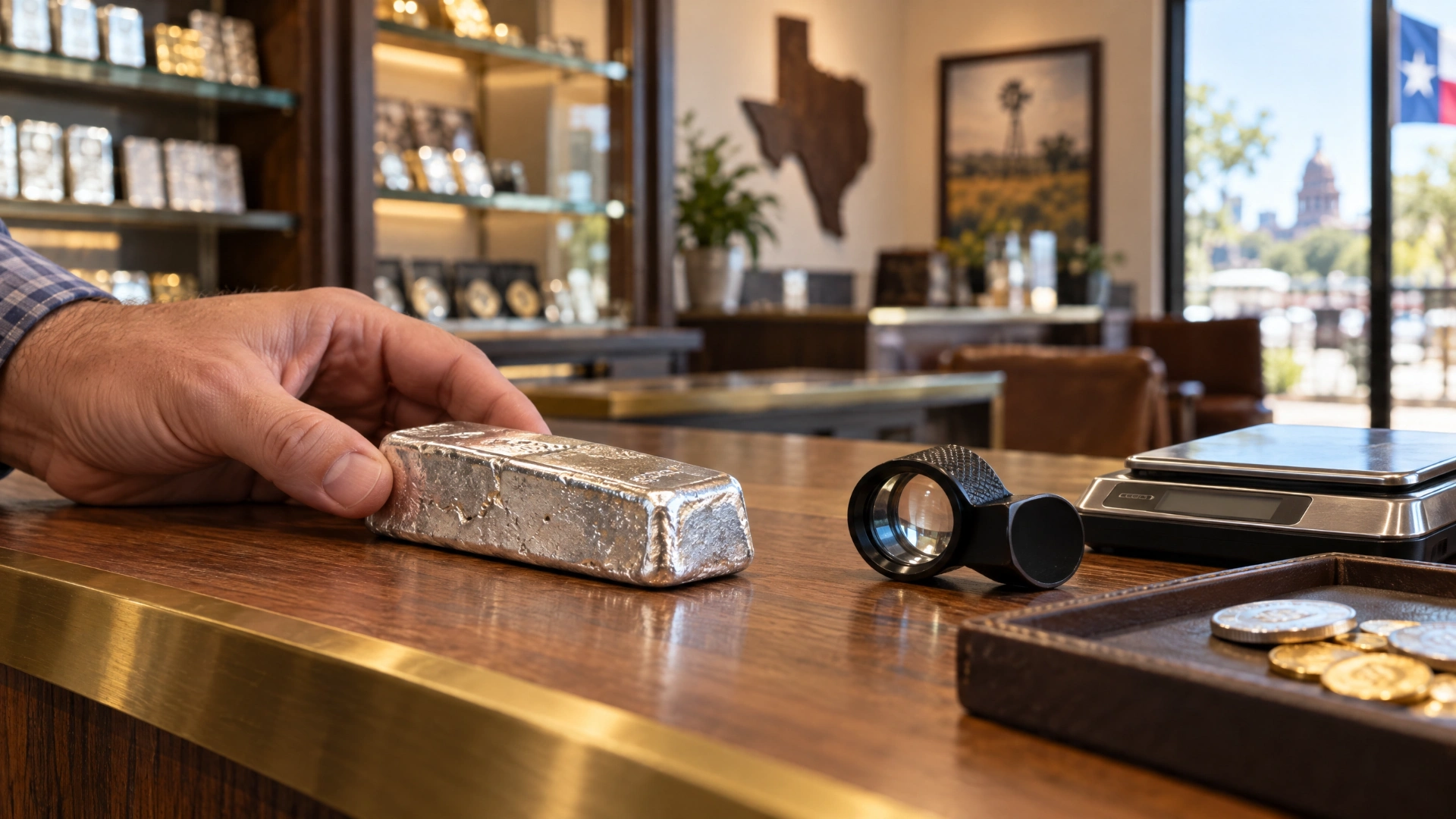
Texas regulates dealers who buy crafted precious metal from the public, and the definition at Tex. Occ. Code § 1956.051 expressly excludes "a bar", among other things. So a poured silver bar sold across a Texas counter is not handled under the crafted-precious-metal rules that apply to a bracelet or a set of flatware, even though both are silver and both are on the same counter. Why the state draws the line where it does, and what changes on either side of it, is the subject of why Texas handles a gold chain and a Gold Eagle differently.
Where Stout fits
Stout Gold & Silver has been family owned and operated in the Texas Panhandle since 1986, and hand-poured silver sits in our bullion line alongside sovereign coins, minted bars and rounds. Bars that come across the counter are weighed, measured and tested — X-ray fluorescence, ultrasound and specific gravity — before we quote on them, and we will tell you what the marks on a bar do and do not tell us.
Walk-ins are always welcome during opening hours, and appointments take priority over them. Online orders over $199.99 ship free.
This article is educational and reflects general information about precious metals and collectible coins. It is not investment, tax or legal advice, and Stout Gold & Silver is not a registered investment adviser, broker-dealer or tax professional. Metal prices fluctuate and past performance does not indicate future results. Consult a qualified professional about your own situation.
Frequently asked questions
Is a maker's mark on a poured silver bar the same as a hallmark?
No. A hallmark is applied by an independent assay office that has tested the metal, and one of its compulsory components is the office's own mark. A US poured bar carries the pourer's mark instead, which identifies the maker and attaches their reputation to the bar but is not third-party verification of the silver content.
What does a pour date or mould number on a bar tell me?
It is a production record: when the bar was poured, or which mould and run it came from. Makers who stamp them are recording their own process, which can help match a bar to a known series or batch later. It says nothing about purity or weight.
Does a serial number mean a poured bar is registered somewhere?
Not in any official sense. A serial number is a production record kept by the maker, useful for tracing a bar back to a run or a batch if that maker keeps records and is still trading. There is no registry of poured silver bars, and no authority issues or verifies serial numbers on them.
Should I buy an unmarked poured silver bar?
That is your decision, and the metal in an unmarked bar is the same metal. What you are giving up is traceability: a future buyer cannot look up a maker, so the bar has to be tested on its own. Ask any dealer to weigh and test it in front of you before money changes hands, marked or not.
How do I know the fineness stamp on a poured bar is accurate?
You do not, from the stamp alone — it is the maker's statement about a production run, not a measurement of the bar in front of you. Fineness is established by testing, and we run X-ray fluorescence, ultrasound and specific gravity together rather than singly, because each one has a blind spot the others cover.
Buy hand-poured silver in Texas, or bring a bar in
The marks on a poured bar are easier to understand with one in your hand than in a photograph. Hand-poured silver is part of our bullion line in Amarillo and we serve the wider Panhandle, including Canyon, Borger, Pampa, Dumas, Hereford and Plainview — call the shop on (806) 374-8698 to ask what is on the shelf before you drive in, and note we are open weekdays only. If you are selling, we will weigh and test the bar — X-ray fluorescence, ultrasound and specific gravity — and show you how we get to the number.
Stout Gold & Silver
2300 SW 7th Ave Ste 105
Amarillo, TX 79106
(806) 374-8698
Monday–Friday 10:00–16:00 · Saturday closed · Sunday closed