A hand-poured silver bar and a minted silver bar of the same weight usually contain the same metal at the same fineness — fineness being the proportion of the bar that is pure silver, expressed in parts per thousand. What separates them is how the bar was formed — one is cast in a mould, the other is struck between dies — and that difference shows up in the surface, the tolerances, the premium and the market each one resells into. If you have looked at two 10 oz bars with very different prices and wondered what the extra money is buying, this is the answer.
How a minted silver bar is made
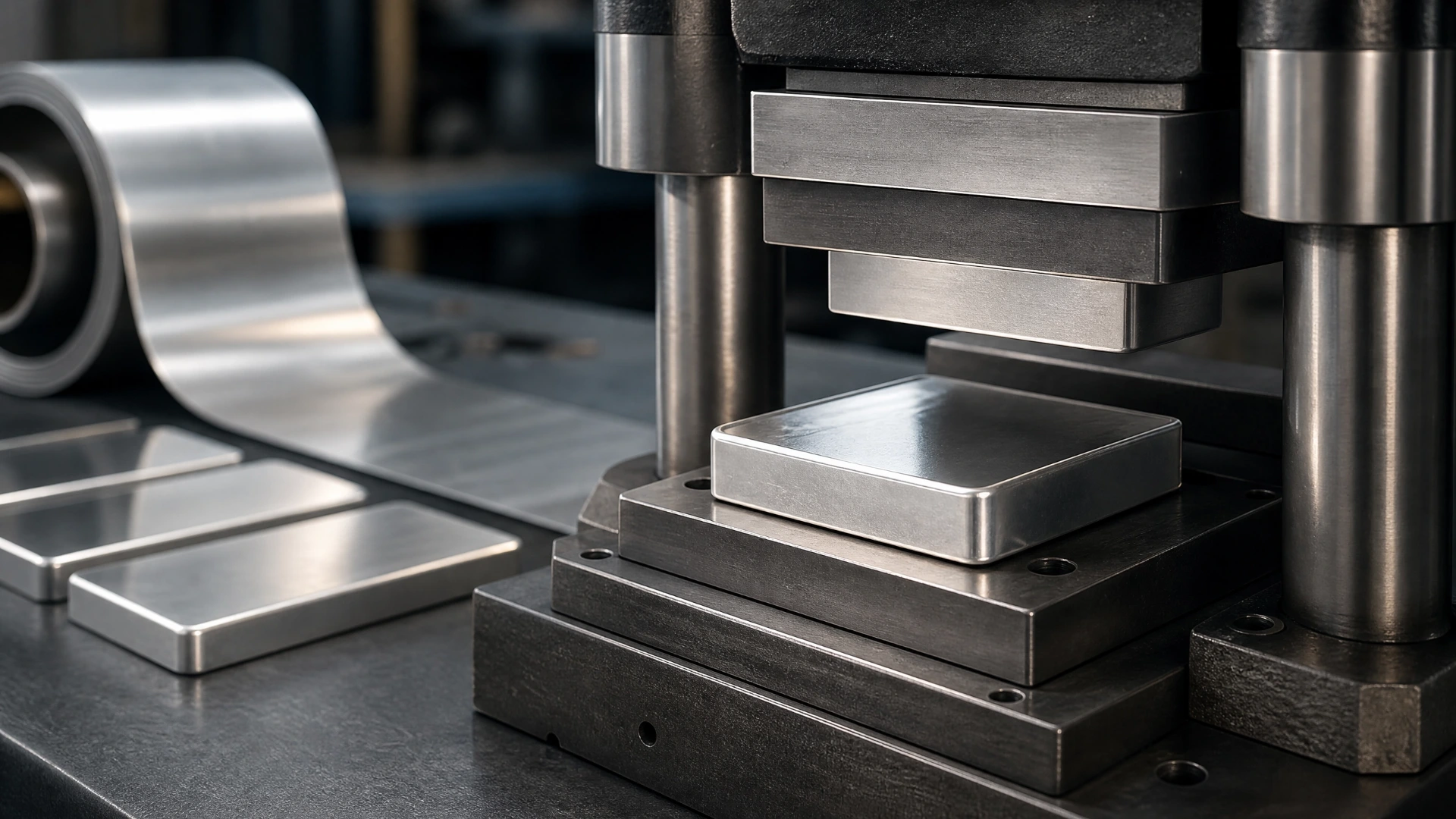
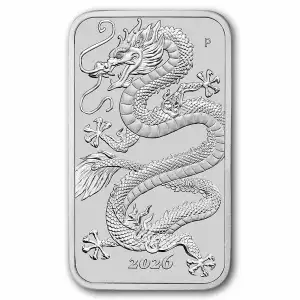
A minted bar is a bar blanked from rolled strip and then struck under pressure between dies. The silver is cast into a billet first, then rolled down to a precise thickness, so every blank that comes off the strip is dimensionally identical before it is ever stamped.
The U.S. Mint describes the same sequence for coinage: blanks are punched from strip, annealed to soften the metal, upset to raise a rim, then struck when "the press forces the obverse and reverse dies together." Bar production runs on the same principle with flat dies and a rectangular blank. The pressure is what produces the flat mirror field, the sharp square edges and the crisp lettering.
Because the process is dimensional from end to end, minted bars can carry serial numbers and can be sealed in an assay card — a sealed package in which the bar sits alongside a certificate stating weight and fineness, usually with the serial number matched to it.
How a hand-poured silver bar is made
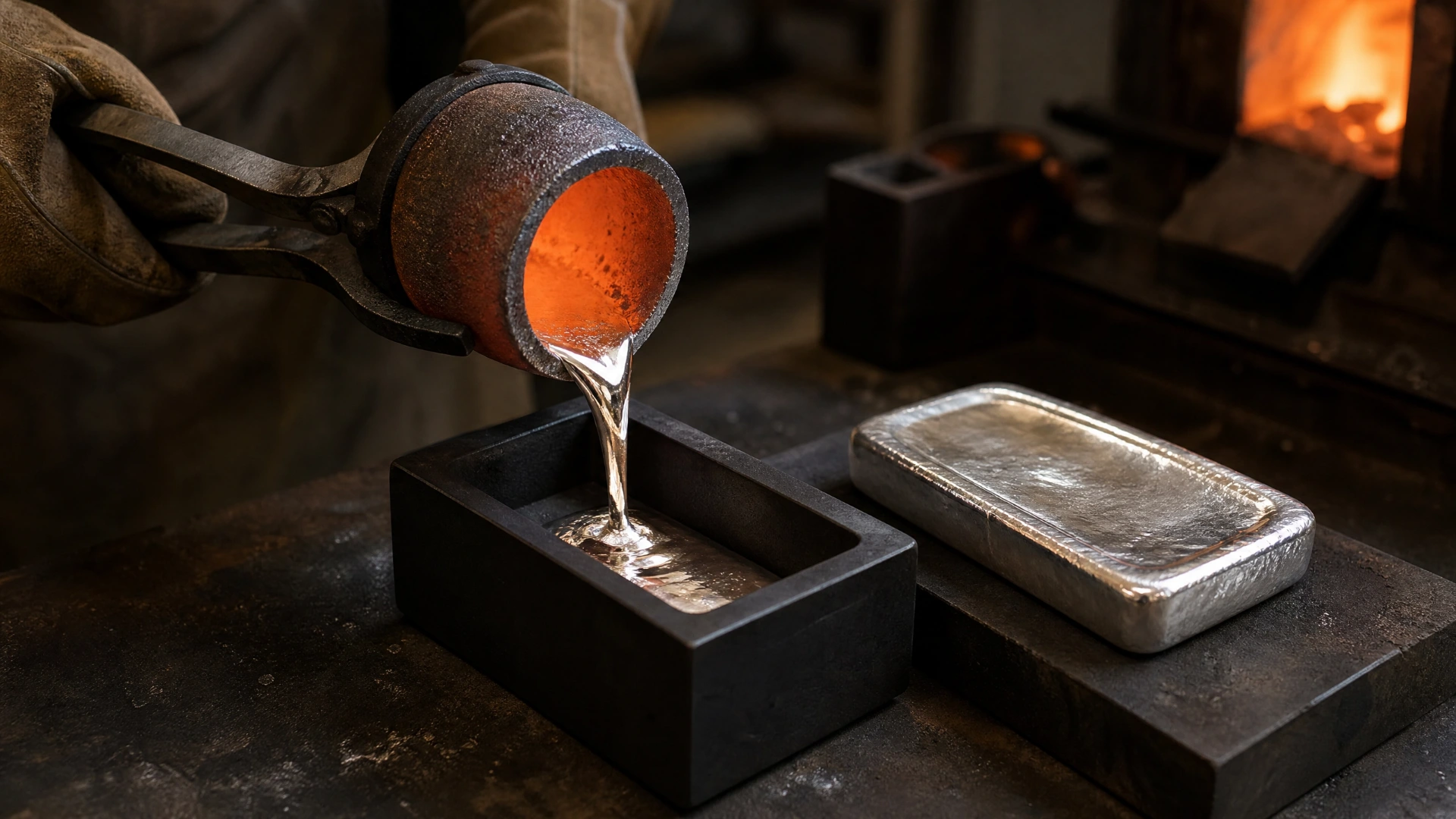
A hand-poured bar is made by melting silver and pouring it into an open mould, where it cools and solidifies in place. There is no rolling and no striking. The bar takes its shape from the mould and its surface from the way the metal cooled.
That is why no two are the same. Molten silver contracts as it solidifies, so the top face usually sinks slightly and can develop a dimpled or rippled texture; the sides pick up the mould's finish; the bottom is generally the flattest surface on the bar. Makers' marks and weights are usually stamped after the bar has cooled, which is why the stamping on a poured bar often sits at a slight angle rather than being perfectly centred.
The variation is not a defect. On poured silver it is the product — buyers of hand-poured bars are buying an object that shows how it was made.
Casting is not the cheap end of the trade
The standard silver bar in the wholesale market is a cast bar rather than a minted one — cast under an accredited refiner's process control rather than poured by hand, but cast. This is worth saying clearly, because "poured" reads as artisanal and "minted" reads as industrial, and at the top of the market the forming method runs the other way.
The London Bullion Market Association's Good Delivery specification — the standard used for settlement in the London market — sets the silver bar at a nominal 1,000 troy ounces, roughly 31,1 kilograms, with a ±10% tolerance, a minimum fineness of 999.0 parts per thousand, and required marks including a serial number, the refiner's stamp, the fineness, and the month and year of manufacture on bars produced from January 2019 onward. Those bars are cast. The LBMA's appearance rules exist precisely because they are cast: the specification requires bars to be free of surface cavities, cracks, holes, blisters and excessive shrinkage.
Getting onto that list is not trivial. The LBMA requires an applicant refiner to produce a minimum of 50 tonnes of refined silver a year — or 10 tonnes of gold — and to hold a tangible net worth of at least £15 million, alongside its responsible sourcing requirements.
So the distinction between poured and minted is not craft versus industry. It is a distinction between two ways of forming metal, both of which operate at every scale, and what accreditation adds on top is standardisation and traceability rather than a different kind of silver.
One qualification, because it matters: the appearance rules quoted above exist to eliminate exactly the surface variation a retail poured bar is sold for. The point here is that casting scales — not that the wholesale standard transfers to a hand-poured bar.
Why hand-poured silver bars carry a higher premium
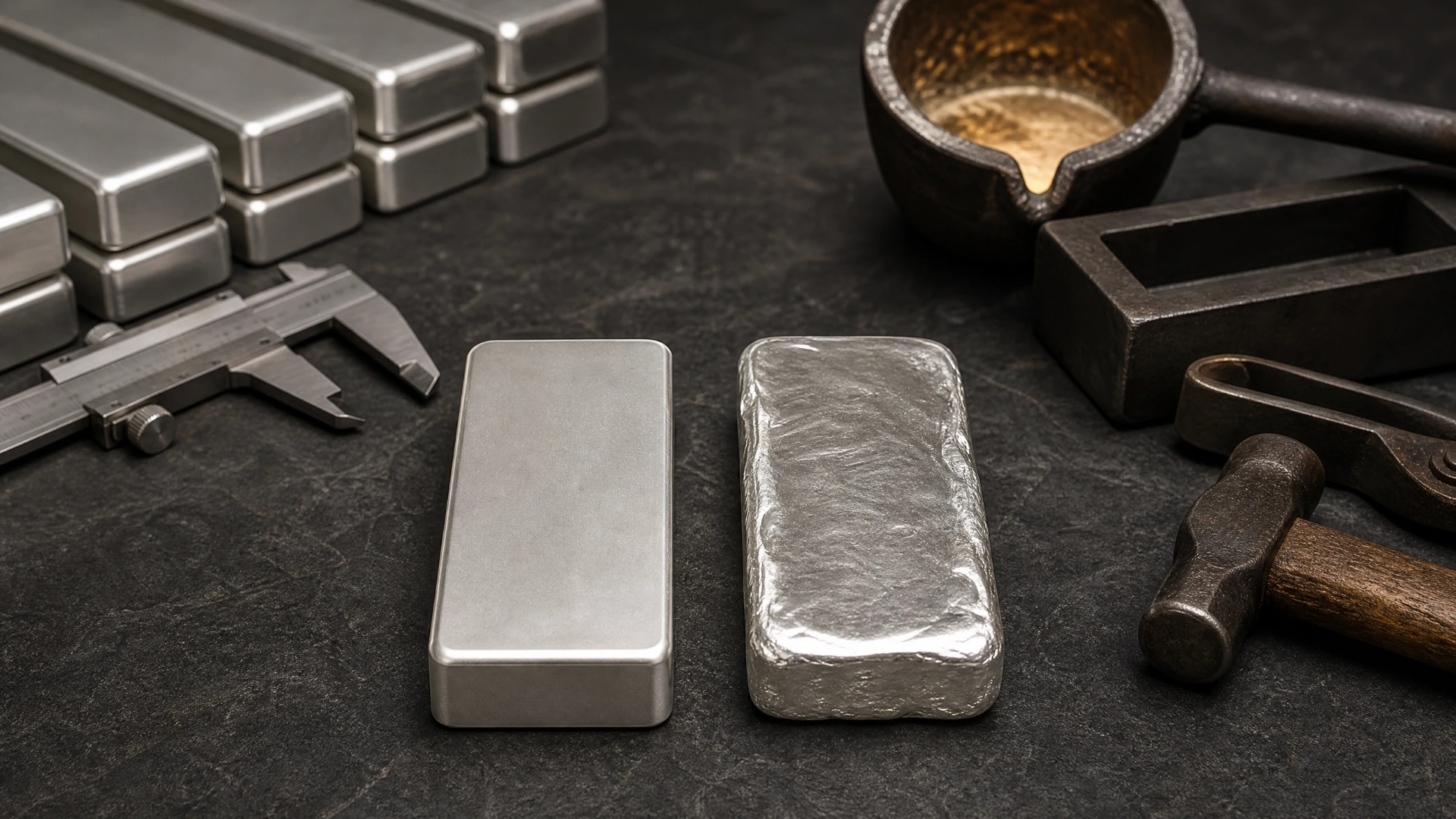
The premium on a hand-poured bar is mostly labour per unit. Premium is the amount a bar sells for above the value of the metal in it, quoted per ounce or per bar.
A minted bar is produced in a continuous mechanical process measured in units per minute. A hand-poured bar is produced one at a time by a person standing at a furnace, and the bar is handled again for finishing and stamping. Add small batch sizes, the cost of the mould work, and — for the better-known pourers — a design that people want, and the arithmetic goes where you would expect.
There is a second component that is worth naming honestly, because it is where the money actually goes on the more expensive poured bars: the maker's reputation. A pourer with a following prices above one without. That is a market price for the object as it stands today. It is not a statement about what the bar will fetch later, and nobody — this shop included — can tell you what the premium on a given maker will be when you come to sell.
The other side of the same arithmetic is the reason minted bars exist in the volumes they do. A lower premium puts more of the purchase price into metal: on the same spend, a minted bar buys more silver, and there is less above-metal cost sitting in the bar to recover when it is sold on. That is a real advantage of the minted form.
The poured premium buys something different: a single object that shows the process that made it, carrying one maker's mark, and for a buyer who wants that, the metal is only part of what is being paid for. The two are not better and worse uses of the same money — they buy different things.
Weight, fineness and what to check on the invoice
On a poured bar, check whether you are paying per bar or per actual troy ounce. A troy ounce is the unit precious metals are quoted in, and NIST puts it at 31.1034768 grams. NIST Handbook 130's uniform method-of-sale regulation, which individual states adopt, provides that where precious metals are sold by metric weight a conversion chart to troy weight must be prominently displayed so buyers can compare.
Minted bars are made to a nominal weight and hit it consistently, because the strip is rolled to thickness before blanking. Poured bars are often listed at a nominal weight with an actual weight stamped or recorded separately — a "10 oz" poured bar may weigh 10.3 oz. Neither approach is a problem; being unclear about which one you are paying for is. We go into the unit itself in more detail in what a troy ounce is.
Fineness is rarely the variable: both hand-poured and minted retail bars are commonly .999 fine. If a poured bar's fineness is not stated at all, that is a question to ask rather than an assumption to make.
Reselling hand-poured and minted silver bars: two markets
Minted bars resell on brand recognition; poured bars resell on the pourer's name. That is the whole difference, and it cuts both ways.
A minted bar from a refiner whose bar brands and hallmarks are widely recognised is quick to price. It is uniform, it stacks, its weight and dimensions can be checked against a published specification, and the format is one most dealers handle routinely. The flip side is that the most recognisable brands are the ones most worth counterfeiting, and sealed assay packaging is itself something that gets copied.
A hand-poured bar is a one-off, and to a buyer who follows a particular pourer that is the entire point — the object cannot be reproduced exactly, and the maker's mark is part of what is being collected. Poured bars are made in small batches, so a given design may not be repeated; where a maker publishes a run size, that figure is the thing to ask for. It sells into that collector market only where the buyer recognises the maker, though; where they do not, it is generally bought on metal content. The other flip side is that the uniqueness also means there is no reference specimen to compare it against, and irregular dimensions make it harder to verify by measurement alone.
Neither of those paragraphs is a recommendation. They are two different resale mechanisms, and which one suits you is a question about what you want to own.
How either kind gets checked at a counter
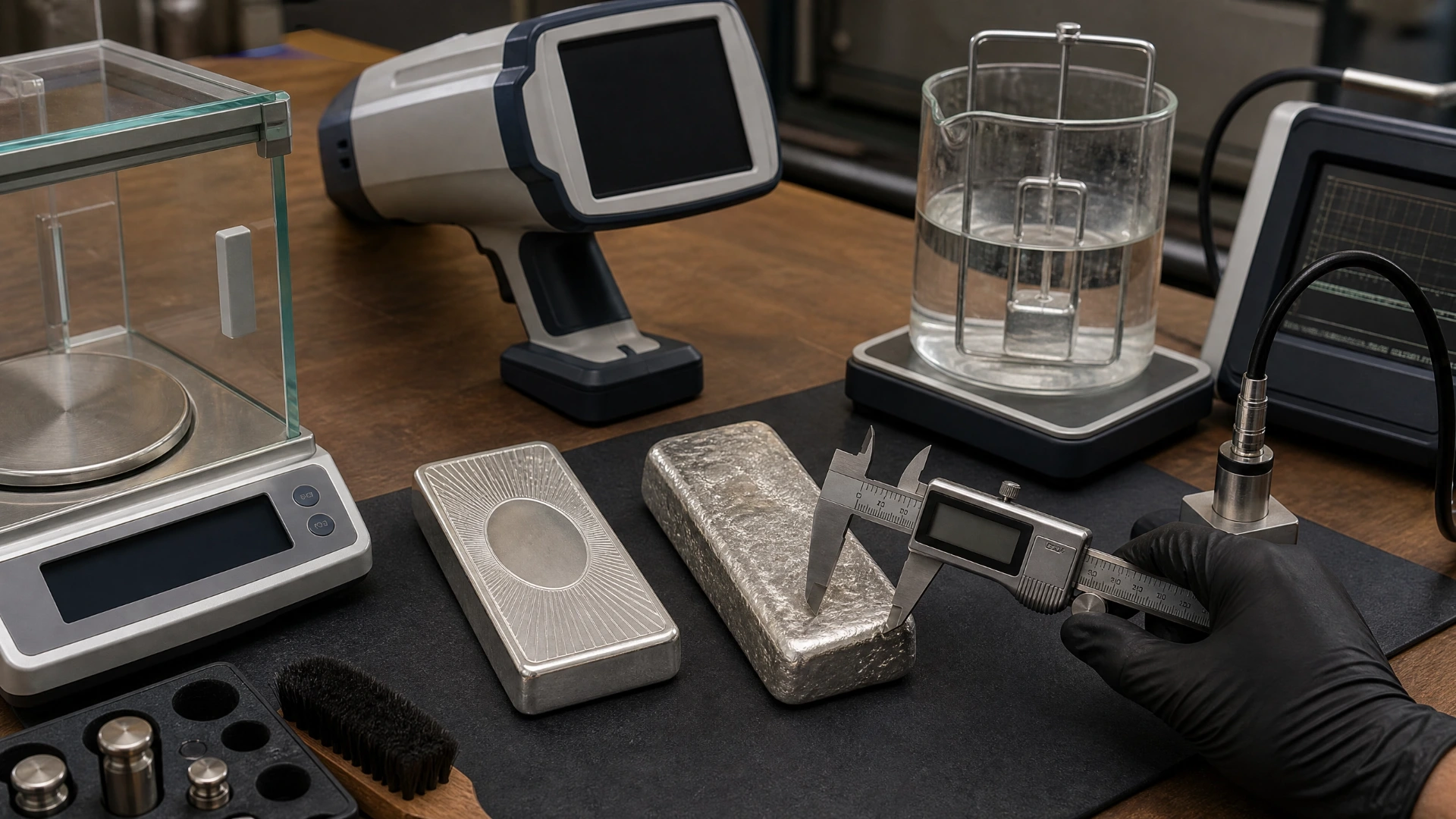
Both forms are checked the same way: weight, dimensions, then X-ray fluorescence, ultrasound and specific gravity — the three tests we set out in detail in why lead is poured inside gold bars.
What changes with a poured bar is the last one. Specific gravity is only as good as the volume measurement, and an irregular cast surface is harder to measure than a machined one. XRF, meanwhile, reads at and near the surface, so a plated or filled piece can still read correctly on the outside. That is why the tests are run together rather than singly, on poured and minted alike.
What we keep, and what we look at
Stout Gold & Silver has been family owned and operated in the Texas Panhandle since 1986, and Brett and Hannah Stout run it. We stock hand-poured silver alongside minted bars, and we buy, sell and trade both forms — which is also why we have no reason to talk you into one of them. Coin and bullion evaluation is available to walk-ins and by appointment.
This article is educational and reflects general information about precious metals and collectible coins. It is not investment, tax or legal advice, and Stout Gold & Silver is not a registered investment adviser, broker-dealer or tax professional. Metal prices fluctuate and past performance does not indicate future results. Consult a qualified professional about your own situation.
Frequently asked questions
What is a hand-poured silver bar?
A hand-poured silver bar is a bar formed by pouring molten silver into a mould and letting it cool there, rather than blanking and striking it from rolled strip. The surface texture, the slightly sunken top face and the dimensional variation between bars all come from that cooling process.
Are hand-poured silver bars real silver?
Hand-poured retail bars are commonly sold as .999 fine silver, the same fineness as most minted bars, and the maker should state it. Because poured bars come from many small private makers rather than a handful of accredited refiners, fineness is worth confirming by weight, dimensions and non-destructive testing rather than assuming. The pouring method changes the form of the bar, not the metal in it.
Why do hand-poured silver bars cost more?
Because each one is made individually. A minted bar comes off a mechanical line measured in units per minute; a poured bar is made one at a time and handled again for finishing and stamping. On bars from well-known pourers, part of the premium is also the maker's reputation.
Is hand-poured silver a better investment than minted silver?
They are not really competing on the same terms. Both are commonly .999 fine, so the metal is the same; what differs is the size of the premium you pay and the kind of buyer who will pay a premium when you sell. That makes it a question about what you want to own rather than a question with a right answer.
Do hand-poured bars weigh exactly what they say?
Not always exactly. Poured bars are frequently listed at a nominal weight with the actual weight recorded separately, so a bar sold as 10 oz may weigh a little over. Check whether the price you are quoted is per bar or per actual troy ounce.
Are hand-poured silver bars harder to sell?
It depends on the maker. A bar from a pourer the buyer recognises reaches a collector market built on the pourer's name; a poured bar with no maker's mark is generally valued on its metal content. Minted bars from widely known refiners are usually the quickest to price, because the specification is published and the format is familiar.
Can hand-poured silver bars be counterfeited?
Both poured and minted bars have been faked, in different ways. Minted bars are copied because the hallmarks and sealed assay packaging are worth copying; poured bars are harder to compare against a reference piece because no two genuine ones are identical. Weight, dimensions, XRF, ultrasound and specific gravity are how either gets checked.
What does .999 fine mean?
Fineness is the proportion of a bar that is pure silver, expressed in parts per thousand, so .999 fine means 999 parts silver in every 1,000. For comparison, the LBMA's Good Delivery standard sets a minimum of 999.0 for wholesale silver bars.
How can I tell whether a bar was poured or minted just by looking at it?
Look at the edges and the top face. A minted bar has square, machined edges and a flat, even field because it was blanked from rolled strip and struck; a poured bar has softer edges taken from the mould and a top face that usually shows a slight sink or ripple from cooling. Stamping on a poured bar is often applied after cooling and sits slightly off-centre or at an angle.
Are poured bars worth more than spot?
Every retail bar of either kind sells above the metal value, because refining, fabrication and distribution all cost money. How much above depends on the form, the maker and the size. What a bar fetches when you resell it is a separate question and depends on who is buying.
Do you have hand-poured silver in stock in Amarillo?
We keep hand-poured silver alongside minted bars at our shop on SW 7th in Amarillo. Stock changes, so call ahead on (806) 374-8698 if you want to see something specific. We are open Monday to Friday, 10:00 to 16:00, and closed at weekends.
See Poured and Minted Silver Side by Side
The difference between a cast face and a struck one is a thing you notice in the hand and miss in a photograph. If you are within reach of Amarillo, come in and pick up one of each — it settles the question faster than any article can, and evaluation is available to walk-ins and by appointment.
If you are further out in the Panhandle or beyond, you can order from our silver bullion selection online. Shipping is free on orders over $199.99.
Stout Gold & Silver
2300 SW 7th Ave
Amarillo, TX 79106
(806) 374-8698
Hours: Monday–Friday 10:00–16:00 · Saturday closed · Sunday closed
We are a weekday shop, so plan the visit accordingly.