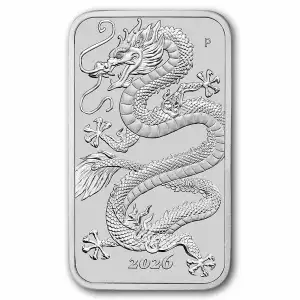
A one-ounce silver round and a one-ounce American Silver Eagle hold the same amount of silver, and they do not cost the same. The gap is the premium — what you pay above the metal's market value — and on a government coin a share of that premium is written into federal law rather than set by the seller. This article takes the premium apart piece by piece, explains why the two move differently, and sets out what changes when you bring either one back to a counter.
It is a question about cost structure, not about which product is better. Both are silver, both weigh what they say they weigh when they come from a reputable source, and the right answer depends on what you want the metal to do.
What actually separates a round from a government coin
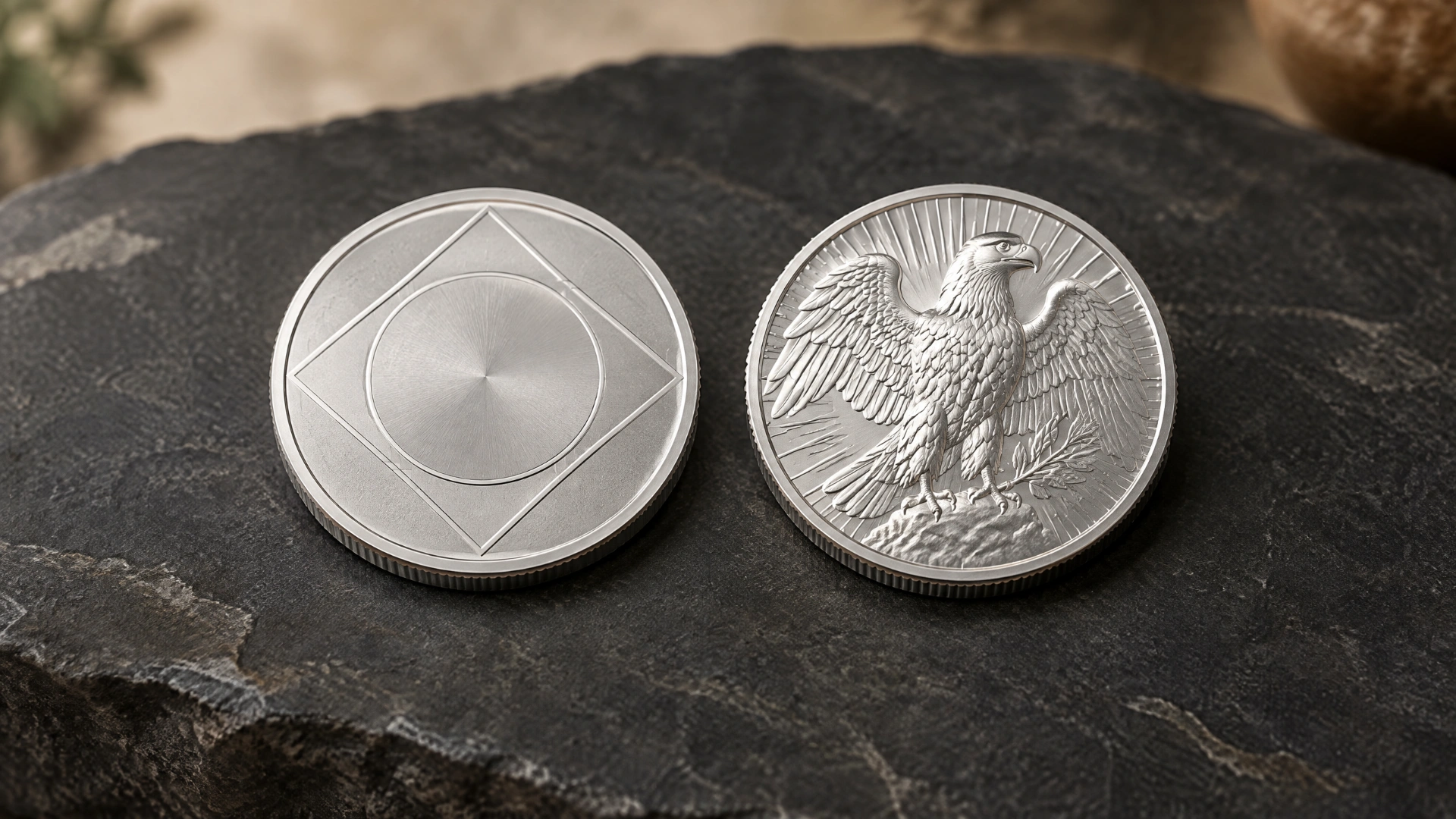
A round is a privately minted disc of bullion. It is shaped like a coin because that shape stacks, stores and handles well, but it is not currency: it has no face value, no legal tender status, and no specification set in law. The producing mint decides the weight, the fineness and the design, and the mint's name is what stands behind them.
A government bullion coin is struck by a sovereign mint to a specification fixed by statute. For the American Silver Eagle, that specification sits in 31 U.S.C. § 5112(e), which requires a coin "40.6 millimeters in diameter" that weighs "31.103 grams" and contains ".999 fine silver", with the inscriptions "1 Oz. Fine Silver" and "One Dollar". The United States Mint states that on its bullion coins "their weight, content, and purity are guaranteed by the United States Government."
Read that guarantee precisely, because it is regularly repeated in a form that means something else. The government stands behind the coin's weight, content and purity. It does not stand behind what the coin is worth. A Silver Eagle's price moves with the silver market like everything else on the counter.
| Privately minted round | Government bullion coin | |
|---|---|---|
| Who sets the specification | The producing mint | Statute — for the Silver Eagle, 31 U.S.C. § 5112(e) |
| Face value | None | Stated on the coin (One Dollar on the Silver Eagle) |
| Legal tender | No | Yes, under 31 U.S.C. § 5103 |
| What is guaranteed | The mint's own stated weight and fineness | Weight, content and purity, per the US Mint |
| Typical premium level | Lower — fewer layers in the chain | Higher — includes statutory minting and distribution costs |
| Design changes | At the mint's discretion | Set in law; changes require legislation |
Part of the coin premium is written into the statute

Federal law sets the price at which the Mint sells silver bullion coins, and that price already contains a premium over the metal. This is the part most comparisons skip.
The same section of federal law that specifies the coin also specifies how it is priced. Under 31 U.S.C. § 5112(f), the Secretary sells silver bullion coins at "market value of the bullion at the time of sale, plus the cost of minting, marketing, and distributing". Subsection (f)(2) then allows bulk sales to distributors "at a reasonable discount", and it is the Mint's agreements with those distributors that set the premium at the first sale. So the statute does not fix the number — it establishes that a premium exists above the metal before anyone downstream has touched the coin.
Then there is the distribution chain. The Mint is explicit that "The United States Mint does not sell its bullion coins directly to the public." Instead, it distributes the coins "through a network of official distributors called 'Authorized Purchasers' who, in turn, create a two-way market buying and selling to wholesalers, financial institutions, and other secondary retailers." Every hand in that chain carries cost and takes a margin. By the time a Silver Eagle reaches a retail counter in Amarillo, it has been through a structure that a privately minted round never enters.
Mint supply conditions feed into retail premium as well, and they change: the Mint publishes the current allocation status for American Eagle silver bullion on the same Authorized Purchaser page. Allocation means distributors receive less than they order, and that shows up downstream. It is a supply condition rather than a signal about price direction, and the page is worth reading rather than assuming.
What a round's premium is buying instead
There is no such thing as buying silver at spot. A round carries a premium too; it simply covers fewer layers.
- The blank. Refining silver to .999 and rolling it into planchets costs money before anything is struck.
- The strike. Dies, presses, labour, rejects.
- Handling and packaging. Tubes, monster boxes, freight, insurance.
- The mint's margin and its name. A well-known private mint's rounds usually carry a slightly higher premium than an unfamiliar one's, for the same reason a known brand does anywhere: the buyer does not have to take as much on trust.
What is absent is the statutory pricing formula, the sovereign distribution network and the face value. That absence is most of the gap.
Two things follow from it that are worth stating plainly, because comparisons of this kind tend to leave them out. A round carries no collector premium, so there is nothing of that sort to lose — what you paid above metal is a manufacturing and distribution cost, not a valuation of the design. And because the per-piece premium is smaller, both accumulating and selling in small increments costs less: ten rounds sold one at a time give back less premium than ten sovereign coins would.
The premium you pay and the premium you get back are two different numbers
A premium is not a deposit. It is the cost of turning metal into a finished, recognisable product, and it does not automatically survive the round trip. How a counter arrives at a buy price — spot, premium and the spread between the two — is set out in our guide to how a bullion trade-in is priced, and we will not repeat it here. What matters for this comparison is the reason the two product types behave differently on the sell side.
Recognition. A Silver Eagle's specification is public, fixed and identical for every coin of its type. Checking one is checking it against a published figure. A round from a mint the buyer has not handled before has to be established first, and that takes time and equipment.
Onward demand. A dealer's buy price reflects what the item is likely to move at. Sovereign coins have a broad, continuous secondary market. Generic rounds have one too, but it is shallower for issues that few buyers ask for by name.
Neither point makes rounds a poor choice. It does mean the spread is part of the comparison, and it belongs in the arithmetic before you buy rather than after.
How either one gets authenticated at the counter
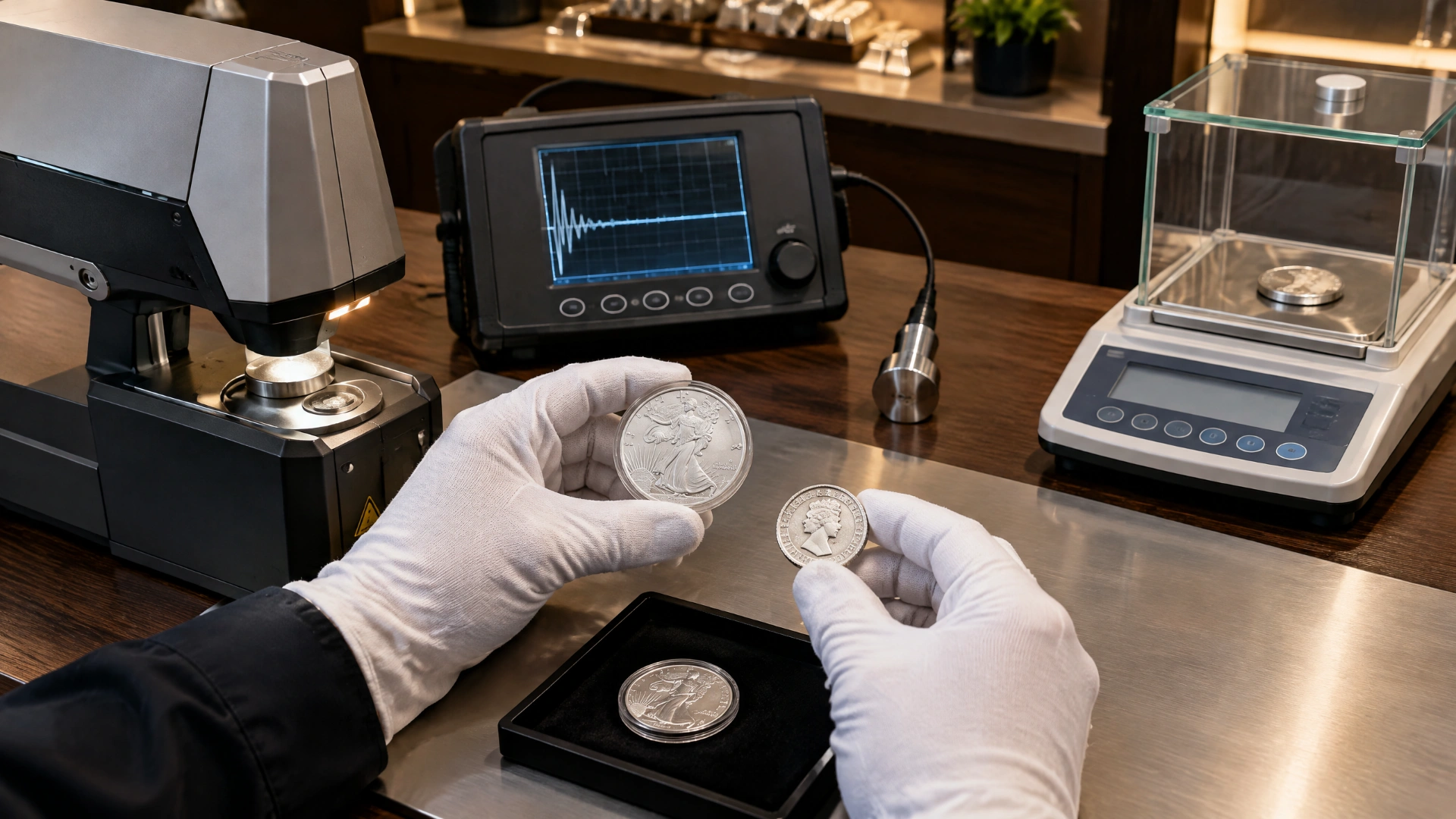
The practical advantage of a statutory specification is that it gives you something exact to test against. A Silver Eagle that is light, thick, undersized or magnetic is off a published number, and that is a fast check. A round has to be verified on its metal rather than against a legal standard.
In our shop, that verification is done with X-ray fluorescence, ultrasound and specific-gravity testing — the same three methods we described in why lead is poured inside gold bars. They apply equally to a sovereign coin and to a round from a mint nobody at the counter recognises. The difference is how much work the item saves you before testing starts, and who else makes the same product. For more on that distinction, see our guide to government mints versus private mints.
Matching the product to the job
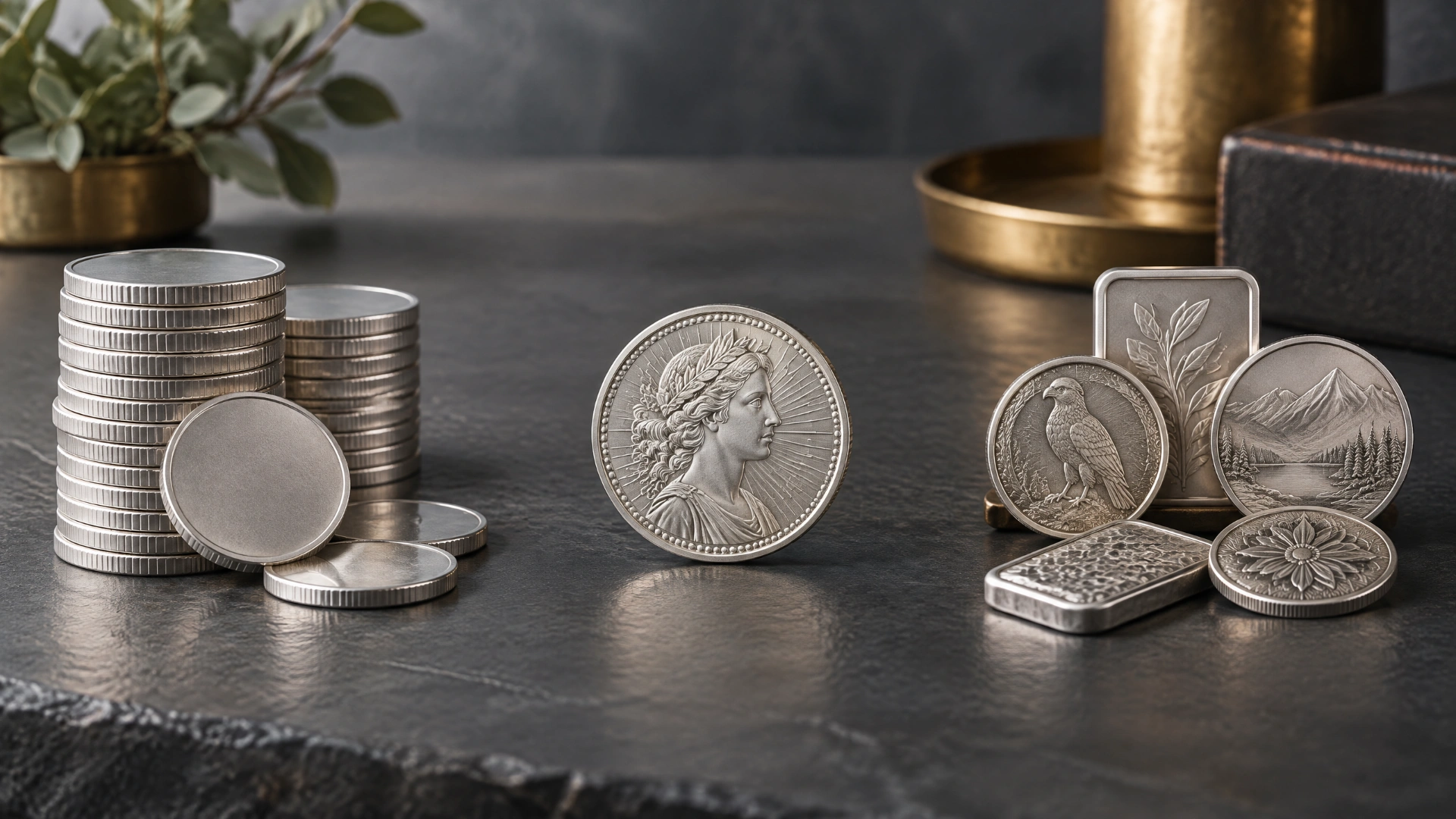
These are trade-offs, not recommendations. What fits depends on what you are trying to do with the metal, which is yours to decide.
| If you are trying to | The trade-off |
|---|---|
| Hold a set number of ounces for the smallest outlay | Rounds carry fewer premium layers. Resale leans more on the buyer knowing the mint. |
| Hold something specified in federal law | The Silver Eagle's weight, diameter and fineness are in statute and testable against it. You pay the statutory cost structure for that. |
| Hand metal to someone who does not follow the market | Sovereign coins are recognised on sight far more widely than any private round. |
| Build a set or follow a series | That is a collecting decision rather than a metal one, and it is priced as such — see our guide to numismatic versus bullion value. |
This article is educational and reflects general information about precious metals and collectible coins. It is not investment, tax or legal advice, and Stout Gold & Silver is not a registered investment adviser, broker-dealer or tax professional. Metal prices fluctuate and past performance does not indicate future results. Consult a qualified professional about your own situation.
Where Stout fits
We are a family business on SW 7th in Amarillo, operating in the Texas Panhandle since 1986, and we carry both sides of this comparison: sovereign bullion coins, bars, and silver rounds including hand-poured pieces. We are members of the ANA, the BBB and ICTA, and we submit to PCGS and NGC.
If you are weighing rounds against coins, the useful thing we can do is show you both in hand and quote them side by side against the same live market, with our current buy price alongside the sell price. Texas exempts gold, silver and numismatic coins, and platinum, gold and silver bullion, from sales tax — the conditions, and what falls outside them, are in our article on the Texas bullion sales tax exemption. Shipping is free on orders over $199.99.
Frequently asked questions
Is a silver round worth less than a Silver Eagle if they both weigh an ounce?
They hold the same silver, so the metal is worth the same. What differs is the premium each carries in the market, on the buy side and the sell side. A Silver Eagle usually costs more to acquire, and in most markets it trades at a higher premium on the way out as well, because more buyers ask for it by name. Neither is silver "at a discount" — they are two products built on the same ounce.
Are privately minted rounds legal tender?
No. A round has no face value and is not money. Legal tender status under 31 U.S.C. § 5103 applies to United States coins and currency, which includes the Silver Eagle at its one-dollar face value. That face value is nominal and far below the coin's metal value; nobody spends one.
Why does the premium on Silver Eagles change over time?
It reflects the cost structure above it: the Mint's statutory selling formula, the Authorized Purchaser chain, freight and insurance, and how much supply the Mint is releasing. When the Mint places silver bullion on allocation, distributors get less than they ask for, and that shows up in retail premium.
Can silver rounds go into a precious-metals IRA?
Eligibility is a purity and producer standard, not an approval — the IRS approves no coin, bar or round. Some rounds meet the standard and some do not, depending on fineness and who produced them. Whether a specific item qualifies, and whether an IRA suits you at all, is a question for a qualified tax professional.
How do you check a round from a mint you have never seen?
The same way we check anything else: weight and dimensions first, then X-ray fluorescence for surface composition, ultrasound for what is underneath, and specific gravity as a whole-item cross-check. A sovereign coin shortens the first step because its specification is published. It does not replace the rest.
Come and compare them in hand
Bring in what you are considering, or come and look at both. We will price a round and a sovereign coin against the same market on the same day and show you the calculation, with our current buy price next to the sell price on each. Walk-ins are welcome and appointments take priority, so call ahead if your time is tight. You can also sell to us.
Stout Gold & Silver
2300 SW 7th Ave Ste 105
Amarillo, TX 79106
(806) 374-8698
Monday–Friday 10:00 a.m. – 4:00 p.m. · Saturday and Sunday closed