A coin holder does two jobs, and most of the damage collectors bring into a shop comes from a holder that failed one of them. The first job is keeping the metal away from reactive chemistry — the plasticizers in soft vinyl, the sulfur in cardboard, the moisture in the air. The second is keeping the metal away from physical contact, including contact with the holder itself. Capsules, flips, tubes and albums each do one of those jobs well and at least one of them badly, which is why the right answer depends on what is going inside.
What follows is what each format is actually built for, what goes wrong with it, and how to tell a stable holder from a reactive one before you put a coin in it.
The two things a holder is protecting against
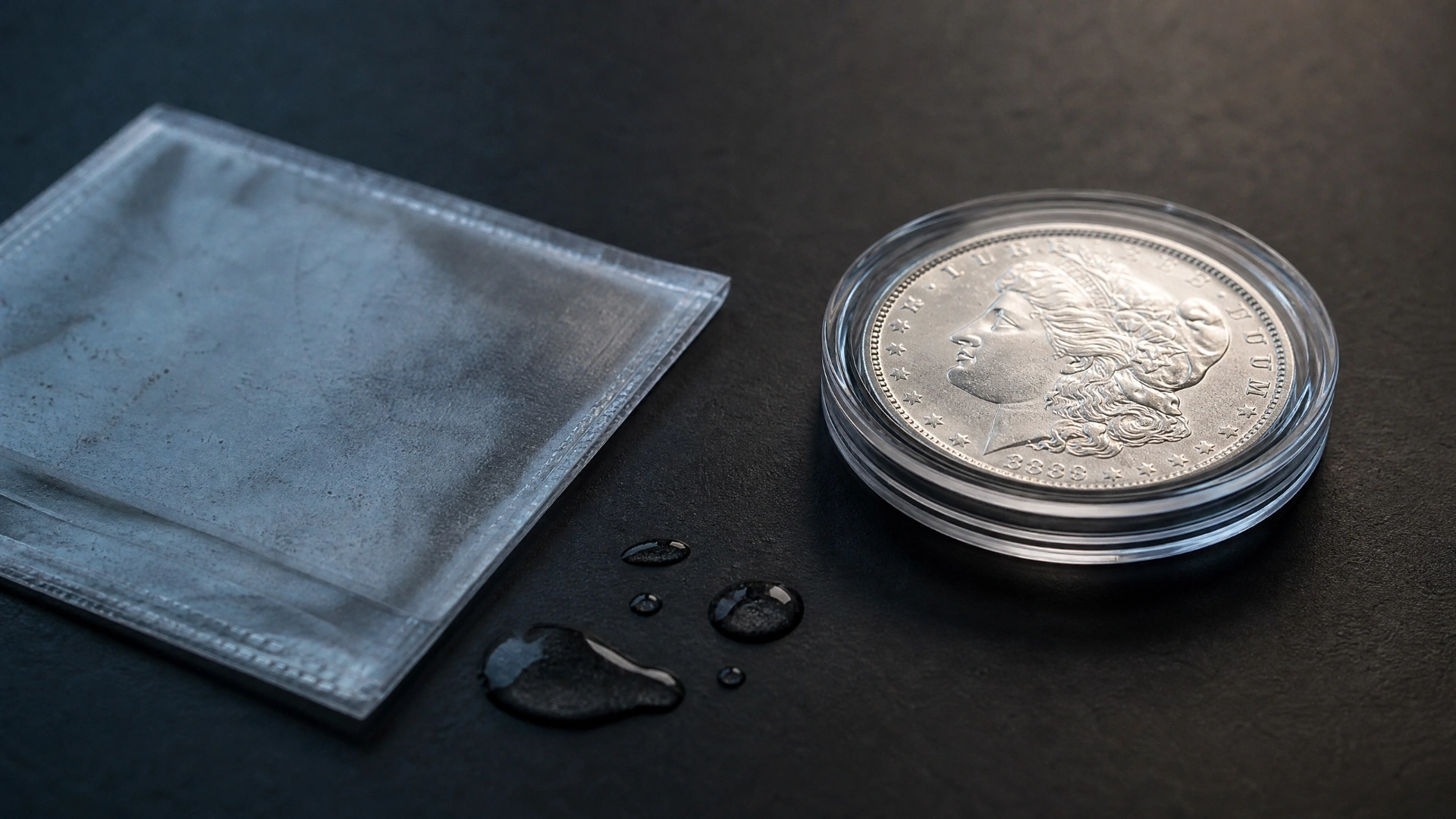
Chemistry is the slower and more expensive of the two. Metal reacts with what surrounds it, and a holder either slows that down or supplies the reactant. The Professional Coin Grading Service is blunt about the background condition in its handling and storage guidance: "moisture is a coin's enemy: water serves as a catalyst for chemical reactions." Humidity does not damage a coin by itself; it accelerates everything else already happening.
Contact damage is faster and more obvious. PCGS notes that proof surfaces are so unforgiving that "the slightest rub from a finger or other external contact may leave them with 'hairlines'," and that coins "should be gripped only by their edges." A holder that lets a coin slide, rattle or rub is doing contact damage every time it is picked up.
Those two risks pull in different directions. A soft, flexible holder is kind to a surface and often chemically hostile; a rigid, inert one is chemically quiet and harder on a coin during insertion. No single format wins both.
PVC: the one thing to check before anything else
Polyvinyl chloride is the material that turns a storage question into a conservation problem. Soft PVC flips are pliable because they contain plasticizers, and those plasticizers do not stay put. Numismatic Guaranty Company's conservation arm describes the mechanism directly in its note on PVC residue: PVC "has an unfortunate habit of leaching out of the plastic holder and forming a dangerous residue on the surface of the coin inside," and "the process of becoming a residue is accelerated by humidity, temperature, and the ambient air."
It progresses in stages that are worth recognizing early. NGC describes a "light white or pale green haze" first, then "green spots to shiny green globs on the surface or high points of the design" that "turn jade green," and finally "a shiny green layer to completely cover the surface of the coin." The important sentence is the one about what is happening underneath: the residue "will begin to corrode the surface of the coin and is permanent," and the corrosion "is a continual process." PCGS describes the same compound as "unstable," tending "to break down over time, releasing harmful chemicals that actually may attack the surfaces of your coins."
Professional conservation can lift the residue — NGC states that its conservation service "can effectively remove PVC residue from the surface of all types of coins" — but removing residue is not the same as undoing etching. NGC also states that it will not certify a coin carrying active PVC residue, so a piece left long enough is outside the grading system until it has been treated.
Soft PVC flips are not used out of ignorance. They are cheap, they do not crack, they take a staple cleanly, and a coin is visible from both sides without being removed. For moving a coin across a counter or through the mail over a few days that is genuinely useful, and it is why the format survives. The problem is a function of time: a flip that is fine for a week is a liability at five years.
What to use instead of PVC
The alternatives are the same three plastics that libraries and archives have settled on. The International Federation of Library Associations and Institutions, in its guidance on choosing appropriate storage material, states that "polyethylene, polypropylene, or polyester (polyethylene terephthalate or PET) plastic zip bags without any additional slip or coating agents are considered stable," and advises custodians to "avoid polyvinyl chloride (PVC) and other unknown plastics."
In practice that means Mylar-type polyester flips, which are rigid and clear, and polypropylene or polyethylene sleeves. The trade against soft vinyl is real: polyester flips are stiff, they crease at the fold, and a coin dropped in carelessly can catch an edge. Two-pocket polyester is the standard working answer — coin in one pocket, ticket in the other, no staple near the metal.
Labeling is the weak point. "Archival," "inert" and "PVC-free" are marketing words with no single legal definition, and the one formal test people cite is narrower than it looks. The Photographic Activity Test is ISO 18916, and the Image Permanence Institute is clear about what it screens for: oxidation and reduction reactions that damage photographic images, and chromophores that cause yellowing of the support — the paper or plastic the image sits on. It is a photographic standard. A PAT-passing enclosure is very good evidence that the material is chemically quiet, but it was never designed to certify anything about silver or gold. Ask the supplier what the plastic is, by name, rather than relying on the adjective on the packet.
Capsules: the format built for one coin at a time
A capsule is a rigid two-part plastic shell holding a single coin with nothing touching its faces. It is the closest thing to a grading holder a collector can buy loose, and the right default wherever the surface is part of the value — a proof, a high-grade type coin, a piece you would be annoyed to scratch.
Capsules come in two fits. A direct-fit capsule is sized to one specific coin and grips the edge, which is why they are sold both by diameter and by the coin they fit — 16.5 mm for a tenth-ounce Gold Eagle, 40 mm for a one-ounce Silver Eagle. A ring-fit capsule uses an interchangeable foam or plastic gasket inside a standard shell, so one shell size covers a range of diameters by swapping rings. Ring-fit is more forgiving of an odd diameter and of thick, high-relief pieces; direct-fit is tidier and cheaper per coin when you are housing a run of the same thing.
What a capsule does not do is seal. Names like "air-tite" describe a friction fit that greatly slows air exchange rather than a hermetic one. A capsule slows toning; it does not stop it. Anyone selling you a holder on the promise that a coin inside will never change is overselling the product. Treat the capsule as the innermost layer and let the box and the room do the rest.
Tubes: built for bullion, not for grade
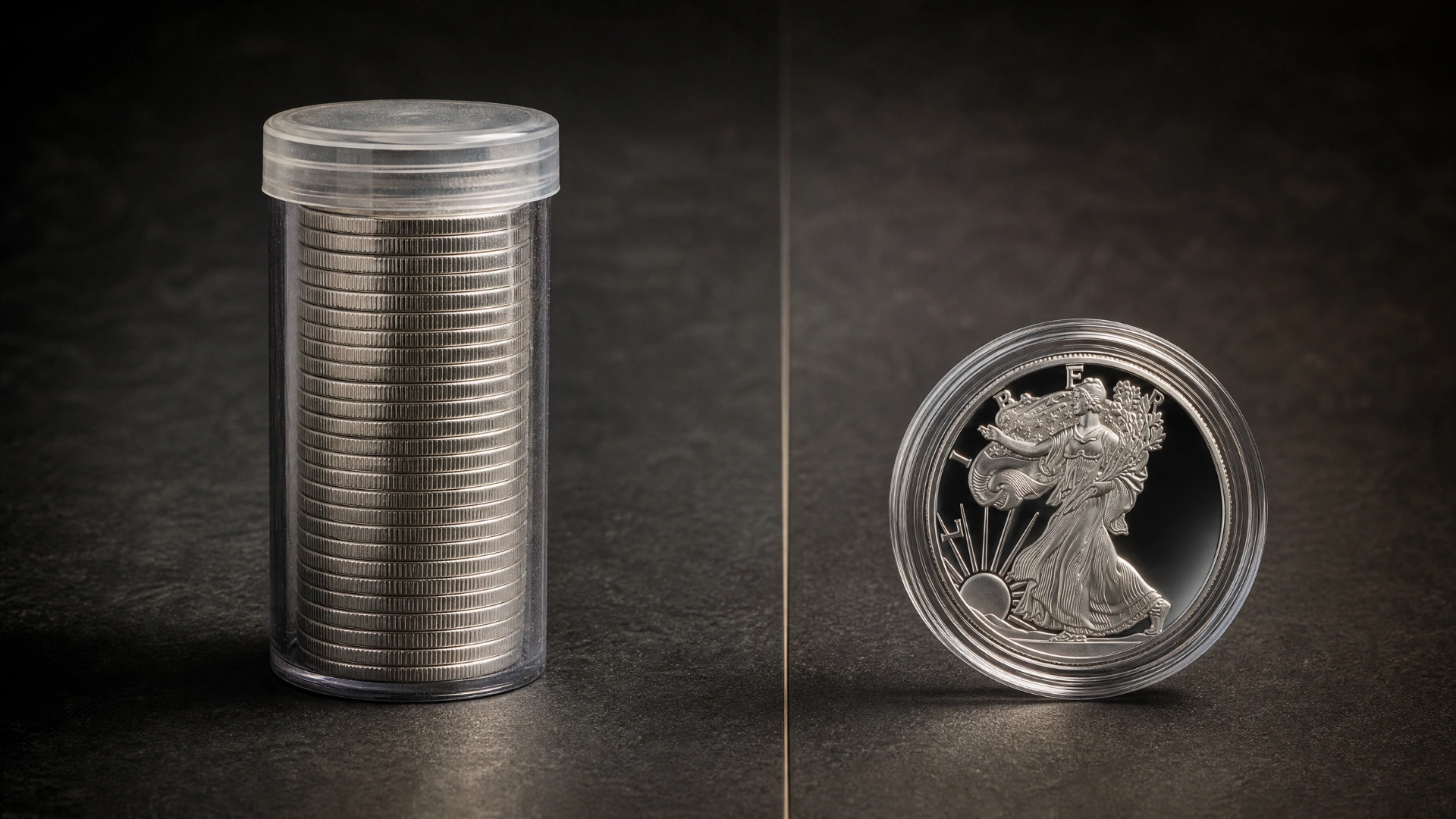
A tube is a rigid plastic cylinder holding a stack of same-size coins under a friction or screw cap. It is the most space-efficient format there is, and it keeps a large quantity of metal off the air and out of the light in one item of packaging.
It also lets coins touch each other, and that is the whole decision. Inside a tube, coins move against one another every time it is handled. For bullion — metal re-priced by weight and purity when it is sold — that is a non-issue, which is why mints and distributors ship bullion in tubes. For a coin whose value sits in a grade it is the wrong holder, because the contact marks a tube produces are what a grader is looking for.
Two practical notes. Square tubes stack without rolling but let a round coin shift more inside; round tubes hold the stack tighter. And a factory-sealed mint tube carries information as well as metal — opening one changes nothing about the silver, but it changes how the next buyer looks at the lot.
Whether surface change on silver affects what you are paid is a separate question with a genuinely mixed answer, and we have covered it at length in milk spots, patina and toning on silver.
Albums and folders: two specific failure modes
An album is built for looking at a collection rather than for archiving high-grade coins, and both halves of that follow from the same design decision.
The first failure mode is mechanical. PCGS warns that "the sliding plastic liners typically found above and below the coins in many popular albums pose a threat" because they "may leave 'slide marks' or hairlines." The slide is what makes the album work — it is how both faces stay visible — and it drags across the highest points of the design every time it is opened.
The second is chemical, and it applies to cardboard generally. On stapled cardboard two-by-twos, PCGS notes that "flecks of the cardboard often come to rest on the surfaces of the coins" and go on to cause chemical reactions, and separately that "these holders are sealed with staples, which can easily scratch a coin." Paper and board are not inert; sulfur compounds in board are a well-known driver of toning on silver, which is why an album page can leave a rim of color exactly where the coin sat.
None of that makes albums useless. For a date-and-mintmark set in circulated grades, an album is what makes the project legible — you can see the holes, which is the point of collecting a series. Where a hairline costs money, use capsules, and keep the album for the set you are building rather than the coins you are preserving.
Comparison
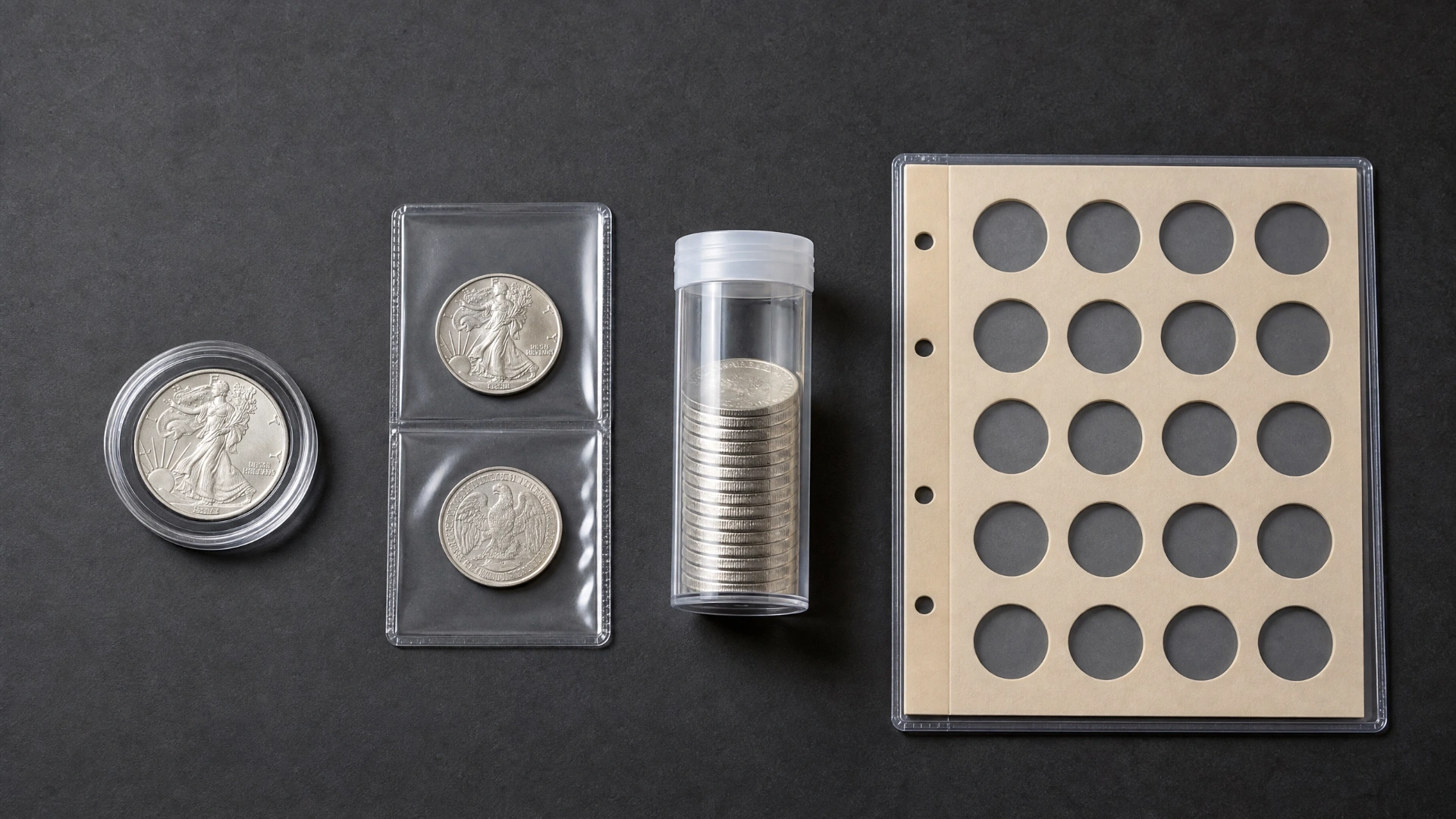
| Format | Best at | Main failure mode | Suits |
|---|---|---|---|
| Capsule (direct-fit or ring-fit) | No contact with either face; rigid protection | Not sealed — slows air exchange rather than stopping it | Proofs, high-grade type, anything where surface is value |
| Polyester (Mylar-type) flip | Inert, clear both sides, cheap per coin | Stiff; can crease at the fold and catch an edge on insertion | Working storage, dealer transit, sorting |
| Soft PVC flip | Pliable, will not crack, easy to fill | Plasticizer leaches out and corrodes the surface permanently | Short-term transit only — never long-term storage |
| Tube | Space, stacking, bulk quantity in one package | Coins contact each other and mark | Bullion priced by weight and purity |
| Album with sliding liners | Seeing a whole set at once; the collecting project itself | Slide marks and hairlines; board chemistry at the rim | Circulated date sets, beginners, display |
| Stapled cardboard 2×2 | Cheap, writable, universally understood | Board flecks on the surface; staples scratch | Bulk circulated material, inventory tickets |
The part the holder cannot do
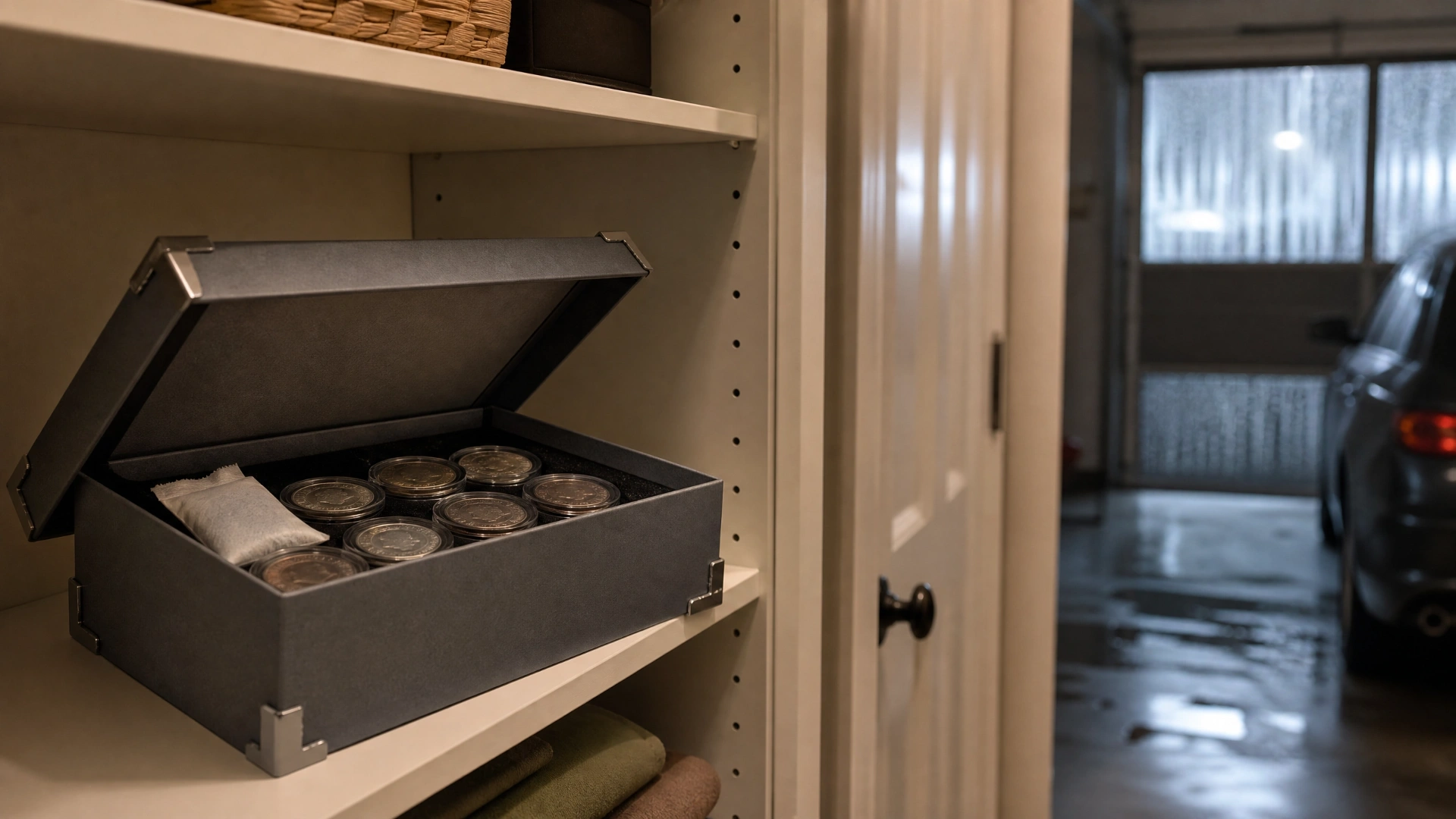
Every holder above is one layer, and the layer around it matters as much. Because moisture is the catalyst, a dry, temperature-even space does more than any upgrade from one plastic to another: an interior closet beats a garage, and a sealed box with a desiccant pack beats a better flip in a humid room. Handle by the edges, and let a cold container reach room temperature before opening it, so condensation does not form inside the holder you just bought.
Where a collection lives is a different question from what it sits in, and the security and access side of it is covered in our guide to bullion storage versus a home safe.
What we would tell you at the counter, and what we stock
Stout Gold & Silver has been family owned and operated in the Texas Panhandle since 1986, and Brett and Hannah Stout run the shop in Amarillo. The advice we give in person is duller than any catalog. Bring the coin with you, or a caliper measurement, because a capsule that is a millimeter off either will not close or lets the coin rattle. If something is sitting long-term in a soft vinyl flip, move it — the reaction is time-dependent and a polyester flip costs almost nothing against a details grade. And if a coin already shows green haze, do not try to clean it: bring it in and we will tell you honestly whether professional conservation is worth it or whether the sensible answer is to leave it alone.
Our merch and supplies page carries Air-Tite capsules across the standard diameter range from 16.5 mm to 48 mm, including direct-fit sizes for one-ounce Silver Eagles, silver dollars, Philharmonics and tenth-ounce Gold Eagles; ring-fit holders for high-relief pieces; ultra-thick capsules for Perth Mint silver bars; a square storage tube for the one-ounce Gold Eagle; and an empty slab box for graded coins. Shipping is free on orders over $199.99. We also buy, sell and trade bullion and numismatic coins, and walk-ins and appointments are both welcome.
This article is educational and reflects general information about precious metals and collectible coins. It is not investment, tax or legal advice, and Stout Gold & Silver is not a registered investment adviser, broker-dealer or tax professional. Metal prices fluctuate and past performance does not indicate future results. Consult a qualified professional about your own situation.
Frequently asked questions
How can I tell whether a flip is PVC?
Soft, floppy and slightly tacky usually means PVC; rigid, crisp and prone to creasing usually means polyester. An older flip that smells faintly sweet or plastic is a strong signal. Rather than guessing, ask the supplier what the plastic is by name — polyethylene, polypropylene and polyester are the three that IFLA lists as stable for storage.
Is PVC damage reversible?
The residue can be removed professionally; the corrosion underneath cannot. NGC states that its conservation service can effectively remove PVC residue from all types of coins, but also that the residue corrodes the surface and that the corrosion is permanent. A coin caught at the white-haze stage usually comes back well. One with jade-green globs on the high points often does not.
Can I store bullion and graded coins the same way?
Generally no, because they are priced differently. Bullion is re-priced by weight and purity, so contact marks inside a tube do not change what it is worth. A coin whose value depends on its grade is judged on exactly those marks, so it belongs in a capsule or a grading holder where nothing touches the faces.
Do capsules stop toning?
No. Capsules sold to collectors are friction-fit rather than hermetically sealed, so they slow air exchange considerably without stopping it. Toning is slowed, not prevented. Treat the capsule as the innermost of several layers and control humidity and temperature around it, since moisture acts as the catalyst for the reactions involved.
Are coin albums safe for a collection I care about?
They are safe for the collection and risky for individual high-grade coins. The sliding liners that make both sides visible are the same parts PCGS warns can leave slide marks or hairlines, and album board can drive toning at the rim. Use albums for circulated date sets and display, and capsules for anything where a hairline costs money.
Come and size it properly
Bring the coin, not the guess. We will size a capsule against the actual piece, tell you which format suits what you are holding, and say so plainly when the honest answer is that the holder you already have is fine.
Stout Gold & Silver
2300 SW 7th Ave Ste 105
Amarillo, TX 79106
(806) 374-8698
Monday–Friday 10:00–16:00 · Saturday closed · Sunday closed