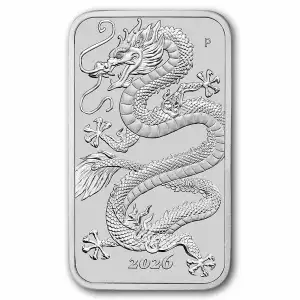
Three different things happen to the surface of silver, and they do not carry the same consequence when you sell. Milk spots are opaque white marks widely attributed to the minting process rather than to storage. Toning is silver reacting with sulfur compounds in the air around it. Patina on a poured or minted bar is that same reaction on a product sold into a different market entirely.
Whether any of the three changes the number you are offered comes down to one question: is the piece being bought for the metal in it, or for the grade on the holder? On a bullion coin traded near its metal content, a surface deposit is not silver leaving the coin. On a certified collectible, color is part of the grade — and the difference between attractive and questionable color can be the difference between a numeric grade and no grade at all.
Milk spots: white, opaque, and usually not your fault
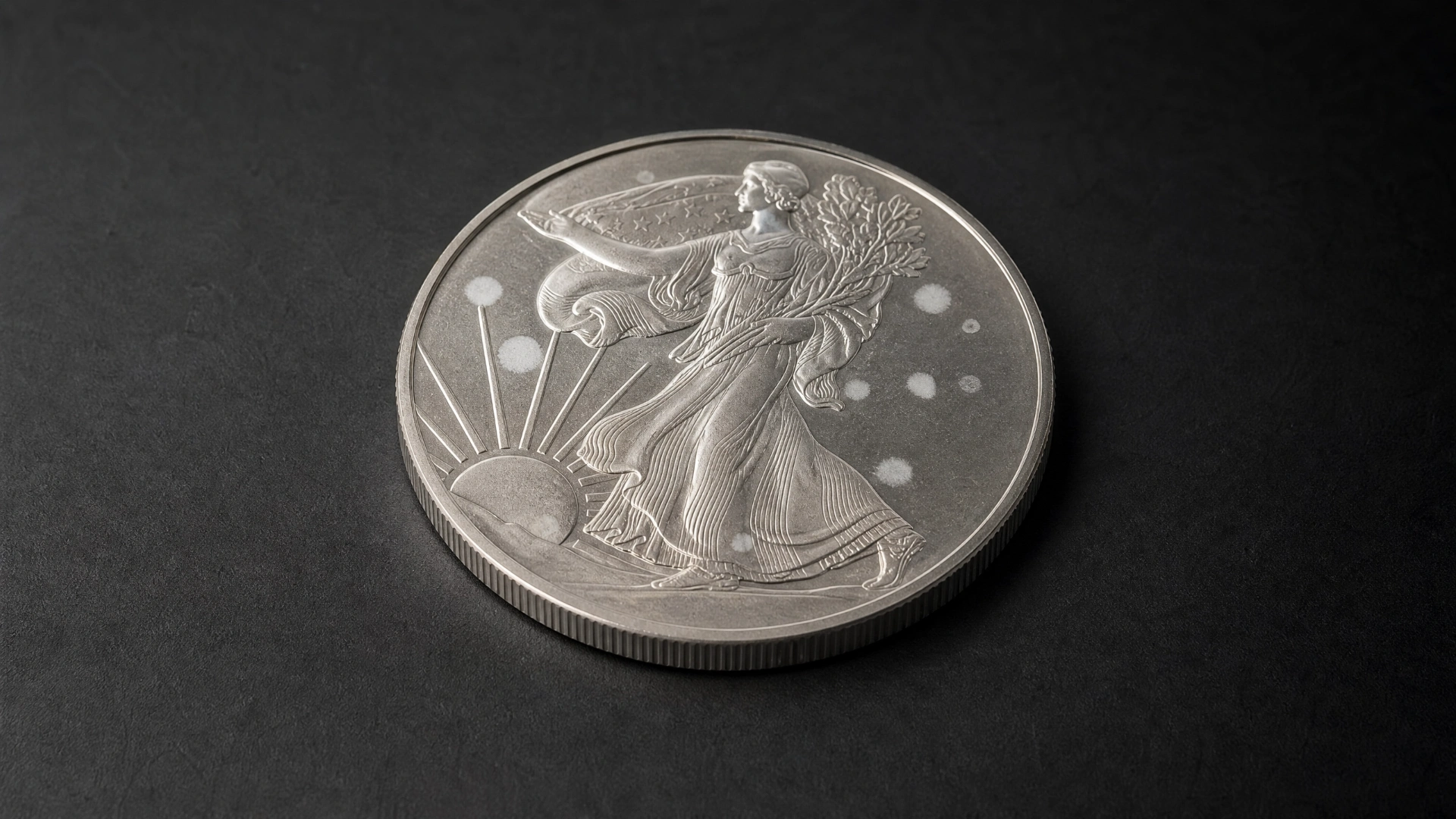
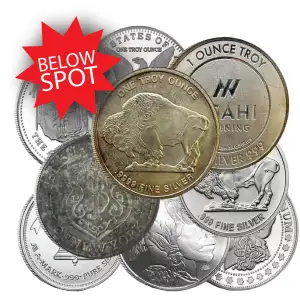
Milk spots are small whitish patches on the surface of modern silver coins, most familiarly on American Silver Eagles. They are opaque rather than iridescent, they have hard edges, and they resist the treatments that lift tarnish.
The timing surprises people. Spots frequently appear after the coin has left the mint, and after it has been graded and sealed. PCGS addresses this in its published guidance on MS-70 Silver Eagles, noting that its standard for MS-70 requires "flawless surfaces under 5x magnification" and that "if the coins develop white milk spots at some future date, then PCGS will take care of the coins under the terms of the PCGS Grading Guarantee."
A sovereign mint treats it as a production-side problem too. The Royal Canadian Mint markets MINTSHIELD, which it describes as "the world's first and only proven solution for reducing white spots on every Silver Maple Leaf bullion coin dated 2018 or later" — a technology that, in the Mint's words, "tackles the root of the cause".
NGC's published grading guide for American Silver Eagles shows how spots translate into a number. At MS/PF 69 an acceptable imperfection is "a small, unobtrusive milk spot"; at 68 the negatives "might include contact marks, hairlines or more numerous milk spots"; at 67 there "might be some hairlines or milk spots that are more numerous or thicker". Spotting is not pass-or-fail. It is a variable the grader weighs against everything else on the coin.
Toning: the metal reacting with the room it lives in
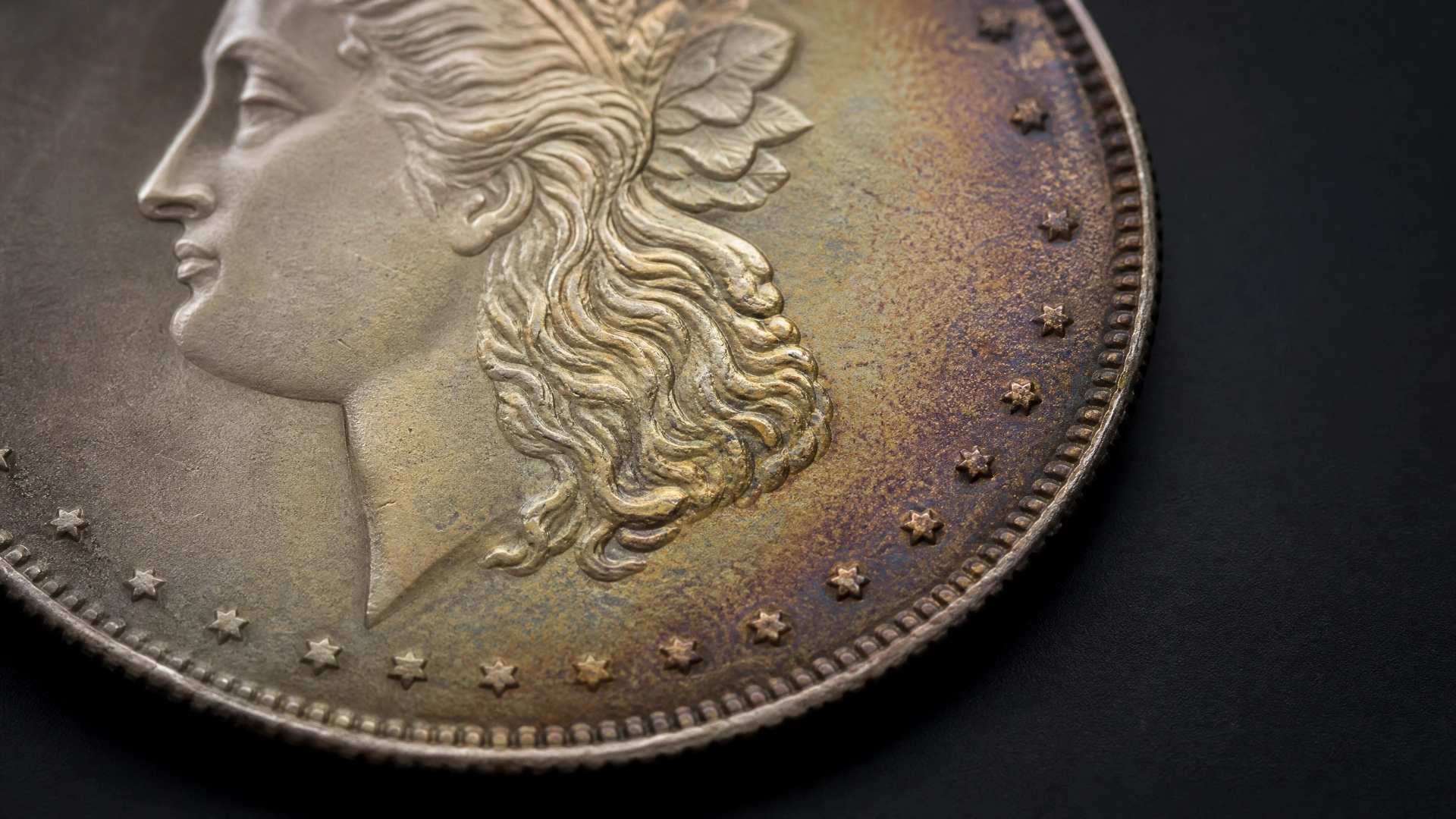
Toning is the color change that comes from silver reacting with sulfur-bearing compounds in its surroundings. It is a surface chemistry problem, not a purity problem, and the conditions that drive it are ordinary household ones. The National Park Service's museum handbook lists the triggers for silver corrosion as "high humidity, sulfur compounds, etching from fingerprints, organic vapors", and describes the visible progression as "slight gray dullness through blue/purple that deepens to brown/black as corrosion becomes thicker."
The pattern usually tells you where a coin was kept. Coins stored in old cardboard albums tone in bands that follow the openings. Coins kept in paper envelopes tone from the edges inward, because that is where the air and the sulfur in the paper reach first. Coins that sat in a bank roll for decades tone at the ends and stay bright in the middle. Even rim toning is a different signal from a blotch in the center of a field, and it is one of the things a grader is reading.
Patina on bars, and why the bar market treats it differently
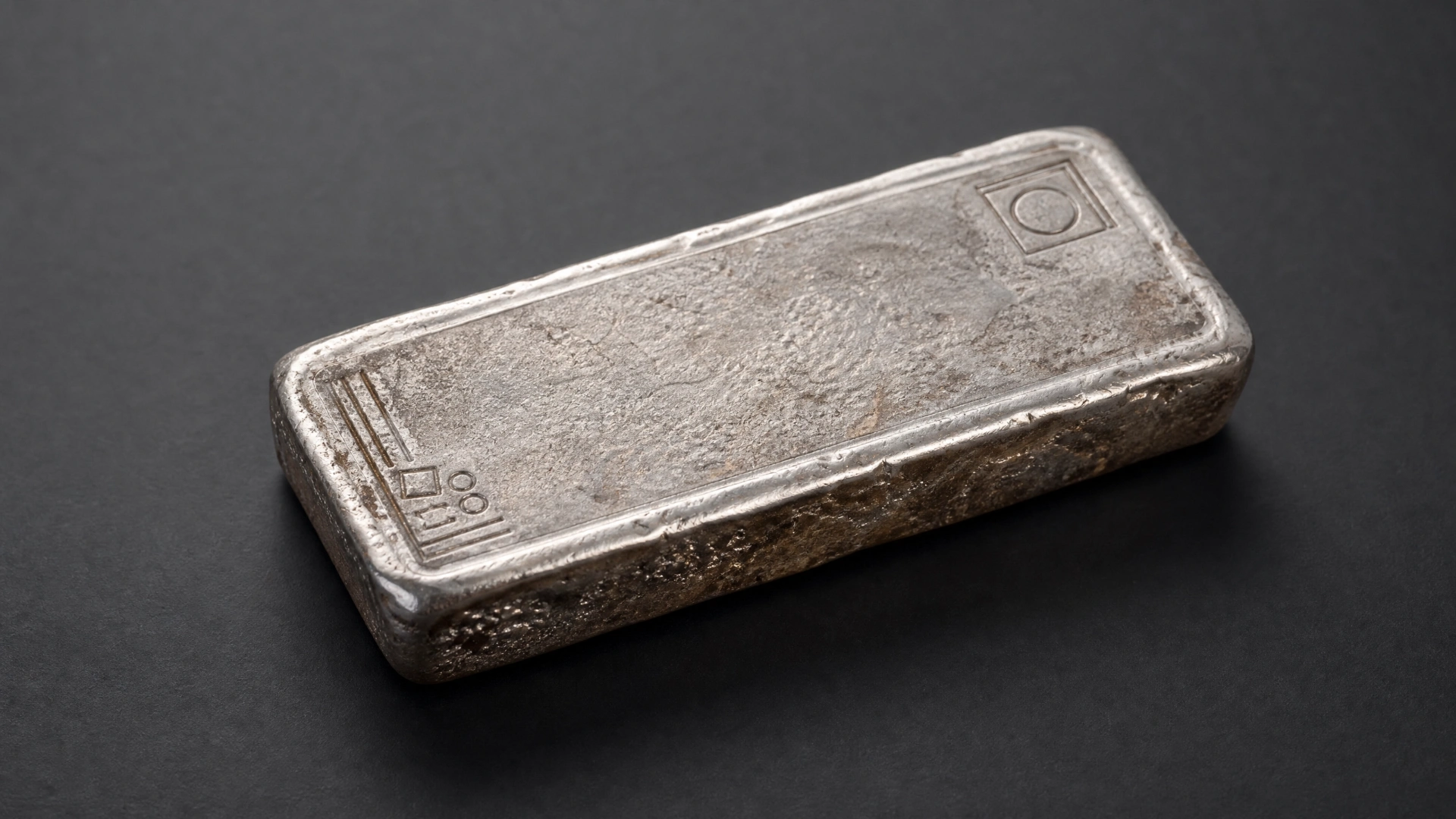
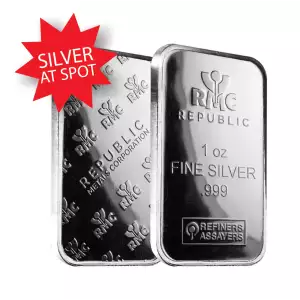
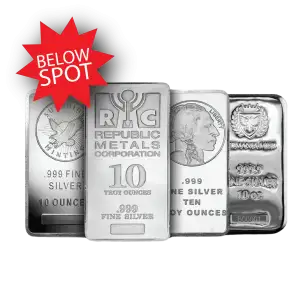
A silver bar tones for the same reason a coin does, and hand-poured bars — more surface texture, more exposed grain — often show it sooner and more unevenly. Collectors of poured silver call this patina rather than toning, but the chemistry does not change with the vocabulary.
What does change is the standard the product is measured against. The LBMA's Good Delivery rules govern the large refinery bars that clear the wholesale London market rather than the retail pieces most people own, but they are instructive, because the appearance criteria in the technical specifications are entirely structural. Refiners are told to avoid "surface cavities, cracks, holes or blisters" and "excessive shrinkage", and to keep the sides and bottom "flat and reasonably smooth". Color is not among the criteria. The benchmark standard for a silver bar is about integrity and legible markings.
That framing carries over to a counter. What a buyer reads on a bar is the refiner's mark, the stated weight and the stated fineness, and whether the bar has been physically interfered with — see our piece on recognizable mint hallmarks. Toning that leaves all of that legible is a cosmetic fact. Toning heavy enough to obscure a hallmark is a different problem, because it makes the bar harder to identify.
What the grading services actually do with color
Color is not a side note in grading; it is one of the things graded. PCGS says its graders look for "original, natural-looking, attractive toning", that coins appearing unnatural are "either going to end up with a lower grade or not graded", and that "toning can be positive, neutral or negative — it depends on what the toning looks like." On the same page, PCGS states that coins it concludes have been artificially toned "will be encapsulated in a PCGS Genuine holder" — carrying, on its published no-grade list, code 91, "Questionable Color". Related codes catch the neighboring problems: 92 for cleaning, 94 for altered surfaces, 97 for environmental damage.
A grade is an opinion recorded by a named company on a given day, which is why a coin is "graded MS-65 by PCGS" rather than "is MS-65". Two services can see the same coin differently, and so can the same service on resubmission.
"Questionable" is a judgment about origin, not about beauty. A coin can be attractive and still be bagged as questionable color, because the grader's question is whether the color arrived by itself. That judgment is the most subjective call in the certified market, which is why toning premiums are the least predictable part of a price.
Why cleaning a toned coin is the expensive mistake
Polishing silver does not lift a layer off the top of the metal. It removes metal. The National Park Service handbook puts it plainly: "Cleaning and polishing remove original metal. Over-cleaning often results from a desire to have metals bright and shiny... Intense treatment often results in the loss of information from the object." On a coin, what is lost is the original mint luster and the fine detail of the strike, and neither comes back.
The grading services can see it. Abrasive cleaning is its own no-grade code, and a cleaned coin that would have graded comes back details-only — a different and generally thinner market than the one it was in that morning.
The practical rule is short: bring it as it is. Conservation professionals work from the same premise — an untouched surface leaves every option open, and a polished one closes most of them.
The four surface conditions side by side
The four surface conditions compare on two questions: what they do to the metal, and where they actually bite.
| Condition | What it is | Changes the silver content? | Where it matters most |
|---|---|---|---|
| Milk spots | Opaque white patches associated with the minting process; frequently appear later, sometimes after grading | No — the fineness and weight are set by the mint's specification | Certified modern bullion, where the step between 70 and 69 can carry a material premium — check a current price guide for the date and service |
| Toning | Silver reacting with sulfur compounds and humidity in its environment; ranges from light gold through iridescence to black | No — it is a surface reaction | Collectible and certified coins, where color is graded and can push a coin either way |
| Patina on bars | The same reaction on a bar's larger, often textured surface; more visible on hand-poured pieces | No | Rarely decisive, unless it obscures the refiner's mark, weight or fineness |
| Cleaning or polishing | Abrasive removal of surface metal, usually by the owner | Marginally, and permanently — metal is physically removed | Everywhere. The one condition here that is neither reversible nor neutral |
Where a resale number actually comes from
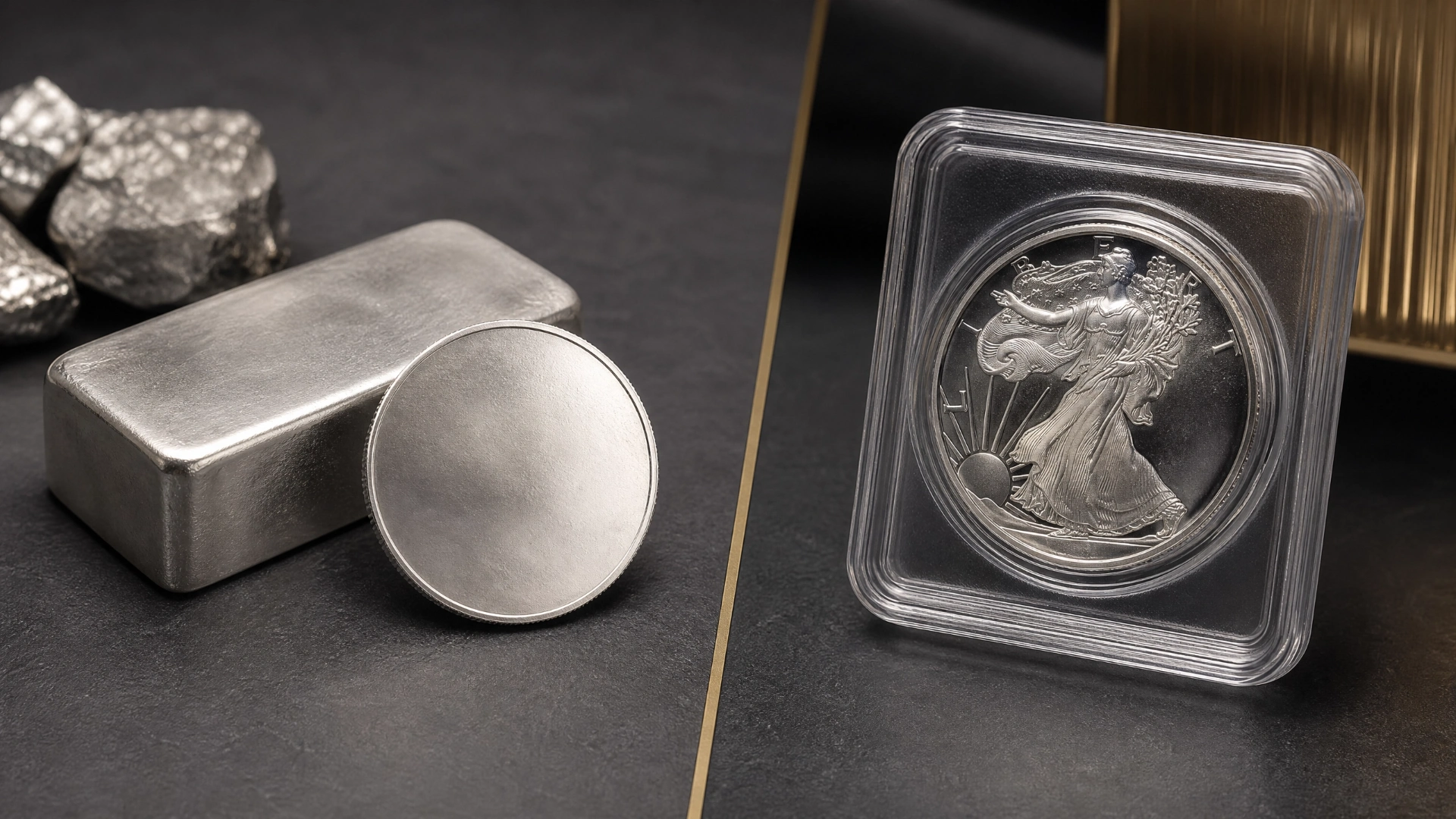
Silver moves through two markets, and they price surfaces differently.
A piece traded on its metal is priced from fine weight against the market. The US Mint states that on the American Eagle silver bullion coin, "each coin's weight and fineness of one troy ounce of .999 fine silver is guaranteed by the United States Government". Read that precisely: what is guaranteed is the weight and the fineness, not the coin's value. And a deposit on the surface does not take silver out of the coin, which is why milk spots on a coin being bought as bullion are a cosmetic matter rather than a weight matter.
A piece traded as a collectible is priced from grade, eye appeal and demand for that date and mintmark, and there color sits inside the calculation rather than beside it. It is the same distinction we walk through in numismatic value versus bullion value, and the reason two apparently identical Eagles can be offered on different bases.
Looking at silver in person and at a distance
Photographs carry a great deal. A milk spot, a toning band that follows an album opening, a legible hallmark and an obvious cleaning all show up in a decent picture — which is why remote buyers, mail-in services and the grading companies themselves work from postal submissions every day. That route needs no travel, reaches a national market, and can produce competing offers.
What a photograph carries poorly is how a surface behaves under a moving light: original luster under a haze versus a surface that has been worked on, or toning a grader will call original versus toning that raises a question. In-person assessment adds that and adds immediate testing, at the cost of a drive. Both routes answer the question with different information.
Storing silver so this happens more slowly
Environmental toning responds to ordinary care, even though no storage method prevents it entirely.
- Keep humidity down and stable — it is on the National Park Service's list of corrosion triggers, and swings are worse than a steady level.
- Keep silver away from sulfur sources: rubber bands, wool, some adhesives, untreated cardboard, and paper envelopes that are not sulfur-free.
- Handle by the edge. Fingerprints etch, and an etched fingerprint is permanent.
- Use inert holders — flips and capsules made without PVC. Softeners in the wrong plastic cause their own damage, and it looks nothing like toning.
- Decide where a collection lives. Options run from a home safe to third-party storage, with different access and insurance consequences; we compare them in bullion storage versus a home safe.
What we look at when a spotted or toned piece comes across the counter
Stout Gold & Silver has been family-owned in the Texas Panhandle since 1986, and the two questions we work through on a silver piece are the ones above: what is it made of, and which market is it in.
The first is a testing question. The methods we use on metal brought to the counter are X-ray fluorescence analysis, ultrasound and specific gravity — the same three we describe in our article on why lead gets poured inside gold bars. Specific gravity and ultrasound read the body of a piece rather than its surface, so a dark coin is not, in general, a harder coin to verify.
The second is a judgment question. Whether a toned Morgan is a submission candidate or a piece of common silver, whether a spotted Eagle is worth certifying, whether a poured bar's patina is hiding anything — those are calls made on the piece itself, under a light. We buy, sell and trade both bullion and numismatic coins, and we look at both sides before saying which one a piece belongs on.
This article is educational and reflects general information about precious metals and collectible coins. It is not investment, tax or legal advice, and Stout Gold & Silver is not a registered investment adviser, broker-dealer or tax professional. Metal prices fluctuate and past performance does not indicate future results. Consult a qualified professional about your own situation.
Frequently asked questions
Do milk spots reduce the silver content of a coin?
No. Fineness and weight are set by the issuing mint's specification — the US Mint states that the weight and fineness of one troy ounce of .999 fine silver is guaranteed by the United States Government on the American Eagle — and a surface deposit does not remove silver from the coin. What milk spots can affect is the grade, and therefore the price of a coin sold on its grade rather than on its metal.
Can milk spots be removed?
They do not respond to the treatments that lift tarnish, and attempts to scrub them off remove metal and leave evidence a grading service can identify. Because they are widely attributed to the minting process rather than to storage, there is no home remedy we would recommend. Bring the coin as it is.
Is toning good or bad for a coin's value?
It depends entirely on the coin and the color. PCGS states plainly that toning "can be positive, neutral or negative — it depends on what the toning looks like." Graders look for original, natural-looking, attractive toning; color judged to have been induced is encapsulated without a numeric grade under the "Questionable Color" designation. It is the most subjective area in certified coins.
Should I clean a toned coin before selling it?
No. Polishing removes original metal, not just the discoloration, and the National Park Service's conservation guidance describes over-cleaning as causing permanent loss. Grading services identify abrasive cleaning and assign a details-only designation instead of a grade. Cleaning is the most common way a seller reduces what a piece is worth before anyone has looked at it.
Does a tarnished silver bar sell for less than a bright one?
On a bar traded for its metal, discoloration is generally cosmetic. The LBMA's Good Delivery appearance criteria for wholesale bars address structural defects such as cavities, cracks, holes and blisters rather than color. What does matter is legibility: if toning obscures the refiner's mark, the stated weight or the fineness, the bar becomes harder to identify, and identification is what a buyer is paying for.
Where is Stout Gold & Silver, and when is it open?
Stout Gold & Silver is at 2300 SW 7th Ave Ste 105, Amarillo, TX 79106, and the phone number is (806) 374-8698. The store is open Monday to Friday, 10:00 a.m. to 4:00 p.m., and closed Saturday and Sunday. Walk-ins and appointments are both accepted for bullion and numismatic coin evaluation.
Bring it in and we will take a look
If you have silver you are unsure about — spotted Eagles, a toned collection inherited in old albums, poured bars darkened in a drawer — we evaluate bullion and numismatic coins, and walk-ins and appointments both work. See what we buy on our sell to us page, and check the hours before you drive over; they are narrow.
Stout Gold & Silver
2300 SW 7th Ave Ste 105
Amarillo, TX 79106
(806) 374-8698
Monday–Friday 10:00 a.m. – 4:00 p.m. · Saturday and Sunday closed
stoutgold.co