TL;DR – American Gold Eagles in a nutshell
- American Gold Eagles are the U.S. Mint’s flagship bullion coins, backed by the U.S. government and trusted by mainstream U.S. investors.
- Many American investors choose Gold Eagle coins as their main gold holding because they are highly recognizable, liquid, and easy to resell.
- As a long‑term gold investment, Eagles offer simple exposure to gold’s hedge and wealth‑preservation role, plus IRA eligibility for retirement savers.
- Compared with other popular coins (Buffalo, Maple Leaf, Krugerrand), Eagles stand out for their 22k durability, U.S. branding, and deep home‑market demand.
- Before buying your first American Gold Eagle coin, you should understand sizes, premiums, dealer choice, and how Eagles fit into your broader gold strategy.
What Is an American Gold Eagle Coin?
American Gold Eagle = the official U.S. Mint gold bullion coin, guaranteed by the U.S. government for weight, content, and purity, designed primarily for investors rather than collectors.
Introduced in 1986, the American Gold Eagle is the flagship gold bullion coin of the United States and has become the benchmark physical gold holding for many U.S. investors.
Key Specs at a Glance (What Makes an Eagle “An Eagle”)
-
Metal and purity
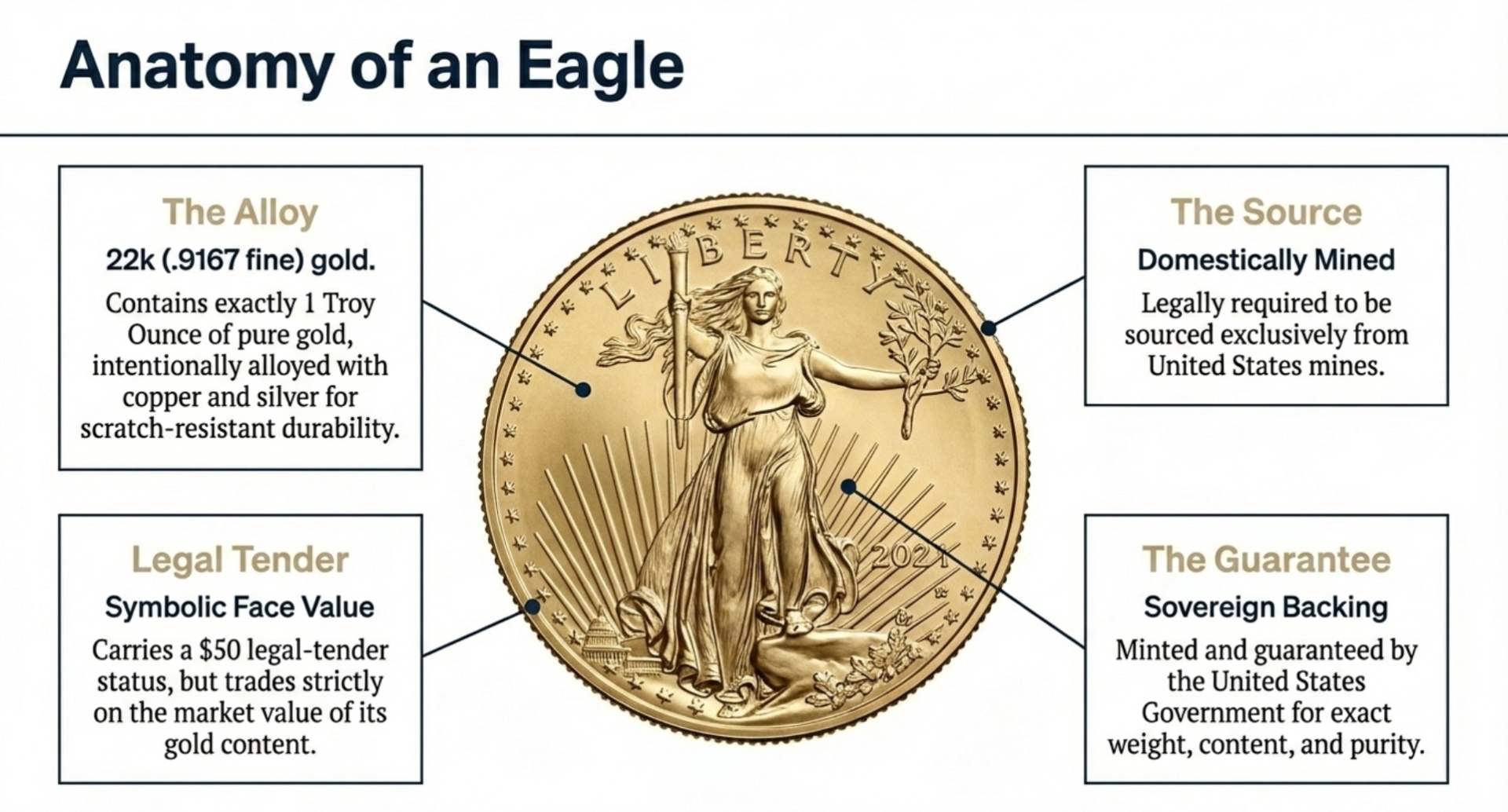
22k (.9167 fine) gold alloyed with copper and silver.
Each 1 oz American Gold Eagle contains exactly 1 troy ounce of pure gold, with the alloy added for strength. -
Denominations and face values
1 oz ($50), 1/2 oz ($25), 1/4 oz ($10), 1/10 oz ($5) legal‑tender coins.
Traded at gold value, not face value (the face value is largely symbolic). -
Legal and branding features
Minted by the U.S. Mint, backed by the United States government.
Gold legally required to be sourced from U.S. mines.
Why Many American Investors Choose Gold Eagles as Their Main Gold Holding
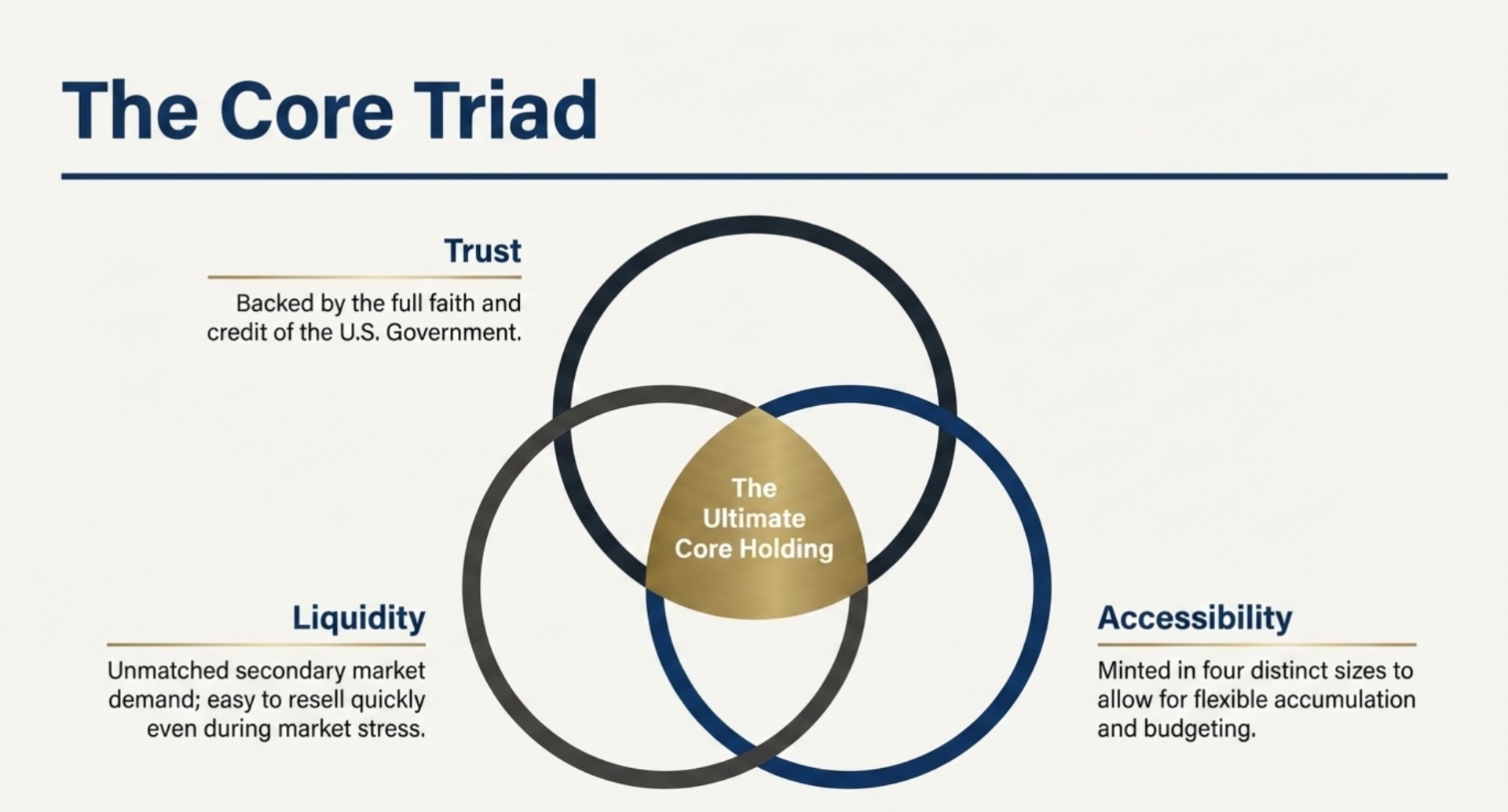
U.S. investors choose Gold Eagles as their core holding because they combine government backing, unmatched local recognition, and practical buying options in one coin.
1. Government Backing and Investor Trust
-
Full faith and credit
Gold Eagles are guaranteed by the U.S. government for weight and purity, which gives conservative and retirement‑focused investors extra confidence. -
Domestic sourcing
By law, the gold must come from U.S. mines, reinforcing the identity of Eagles as the “home” gold coin for American investors. -
Perceived safety
For many first‑time or cautious buyers, that government stamp is the deciding factor when choosing a primary gold holding.
2. Liquidity and Recognition in the Real Market
-
Deep secondary market
Eagles are one of the most traded bullion coins in the U.S., so most dealers quote buy and sell prices on them every day. -
Easy resale
Because dealers and investors instantly recognize them, American Gold Eagles are typically easy to sell quickly at market‑competitive rates, even during periods of stress. -
Practical takeaway
If your main question is “How easy will this be to sell later?”, Eagles punch above their weight as a core holding.
3. Accessibility Through Multiple Sizes
-
Four common sizes
1 oz, 1/2 oz, 1/4 oz, and 1/10 oz let investors ladder in at different price points. -
Flexible accumulation
Fractional Gold Eagles make it easier to add regularly (monthly/quarterly) without committing to a full ounce each time. -
Trade‑off to understand
Smaller sizes usually carry higher premiums per ounce, but they provide flexibility for budgeting and potential future resales in smaller pieces.
Are American Gold Eagles a Good Long‑Term Gold Investment?
Yes—American Gold Eagles are widely considered a strong long‑term gold investment for U.S. investors seeking a simple, conservative way to hold physical gold.

Long‑Term Hedge and Wealth Preservation
-
Gold’s role
Historically, gold has helped offset inflation, currency risk, and financial‑system shocks over the long term. -
Eagles as the vehicle
Gold Eagles package that exposure into a widely accepted, government‑backed format that fits easily into most U.S. portfolios. -
Investor behavior
Many investors steadily accumulate Gold Eagles over years as a form of “hard‑asset savings,” rather than trying to trade short‑term price moves.
Stability of Demand and Resale
-
Multi‑decade demand
Since 1986, demand for American Gold Eagles has remained robust, especially during economic or geopolitical uncertainty. -
Supportive resale environment
Ongoing demand helps support competitive dealer buyback prices and tight spreads, which matters for long‑term total returns. -
Practical implication
For someone asking “Will people still want this coin in 10–20 years?”, Eagles have a strong track record of staying relevant.
Gold IRAs and Retirement Portfolios
-
IRA eligibility
American Gold Eagles are explicitly permitted in many self‑directed Gold IRAs under U.S. tax rules. -
Retirement fit
Their status and recognition align with the conservative, compliance‑driven nature of retirement assets. -
Steps to use in an IRA
Work with an IRS‑approved custodian, choose IRA‑eligible coins (like Eagles), and ensure approved storage—details a professional can guide you through.
Key Factors That Affect Gold Coin Value
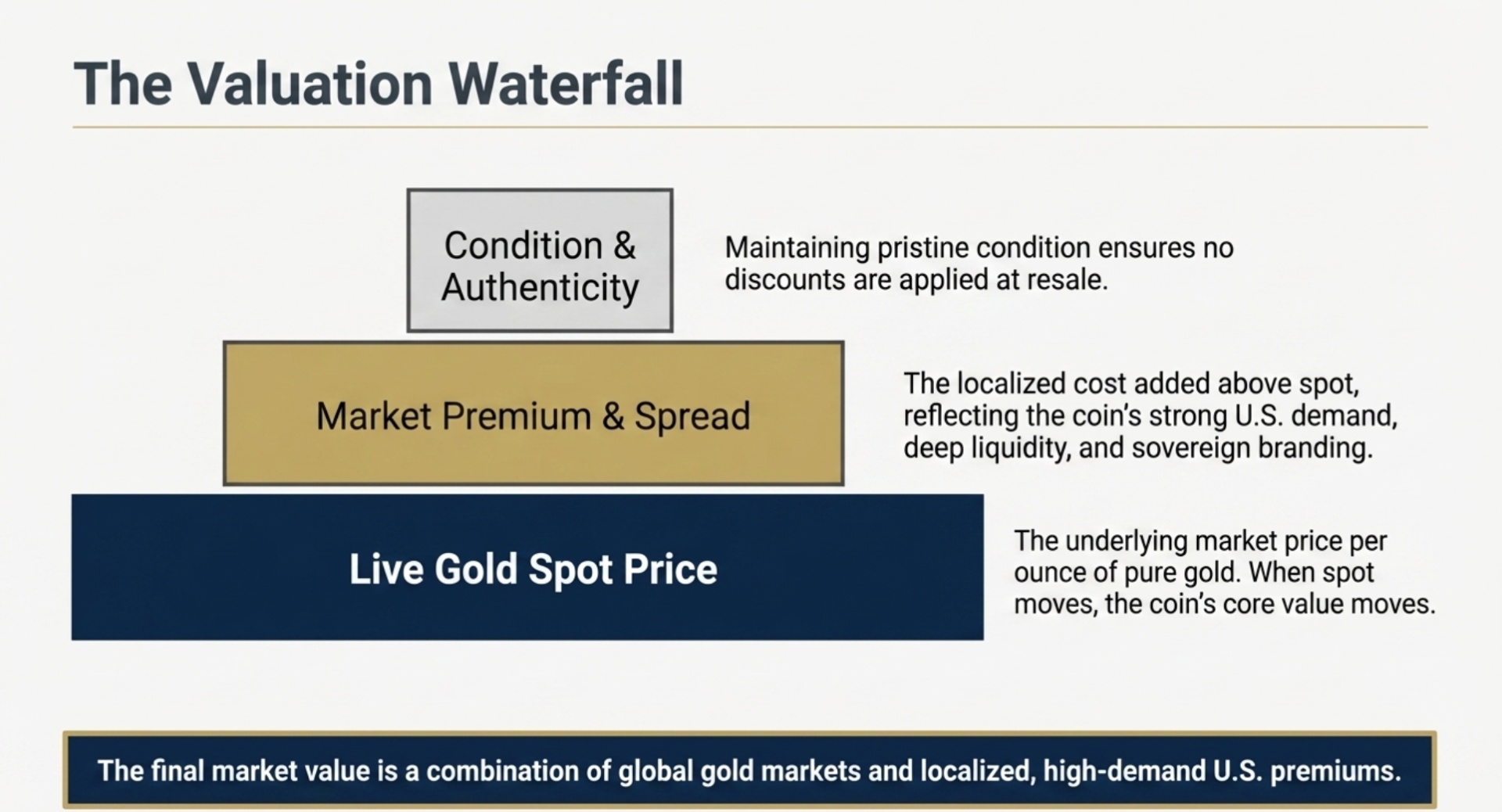
The value of any gold coin—including American Gold Eagles—depends on its gold content, market gold price, demand, premiums, and condition.
1. Gold Content and Purity
- The number one driver is how much pure gold the coin contains (for Eagles, 1 oz pure gold in the 1 oz version).
- Purity (22k vs 24k) affects marketing and preference but not the underlying ounce of gold.
2. Spot Price of Gold
- Spot price is the current market price per ounce of gold; when spot rises or falls, bullion coin values move with it.
- All bullion coins (Eagles, Buffalos, Maple Leafs, Krugerrands) follow spot, with premiums layered on top.
3. Premiums and Spreads
- Premium = how much you pay above spot; spread = difference between what you pay and what a dealer typically pays to buy back.
- Popular coins like Eagles usually have fair but noticeable premiums that reflect strong demand, branding, and liquidity.
4. Liquidity and Market Demand
- Coins that many dealers and investors actively trade (like Gold Eagles) tend to enjoy better liquidity and buyback pricing.
- Limited‑market coins can look cheaper upfront but be harder to sell later.
5. Condition and Authenticity
- Bullion value usually dominates, but heavily damaged or questionable coins may need extra verification or discounts.
- Buying from reputable dealers reduces authenticity and condition risk from the start.
American Gold Eagle vs Other Popular Gold Coins
American Gold Eagles differ from other popular gold coins mainly in their 22k alloy, U.S. legal‑tender status, and how central they are in U.S. investors’ portfolios.
Comparison Snapshot: Eagle vs Buffalo vs Maple Leaf vs Krugerrand
| Feature | American Gold Eagle | American Gold Buffalo | Canadian Maple Leaf | South African Krugerrand |
|---|---|---|---|---|
| Mint / Country | U.S. Mint, United States | U.S. Mint, United States | Royal Canadian Mint, Canada | South African Mint, South Africa |
| Purity | 22k (.9167) | 24k (.9999) | 24k (.9999) | 22k (.9167) |
| Gold content (1 oz coin) | 1 troy oz pure gold (plus alloy) | 1 troy oz pure gold | 1 troy oz pure gold | 1 troy oz pure gold |
| Legal‑tender status | U.S. legal tender | U.S. legal tender | Canadian legal tender | Legal tender in South Africa |
| Typical U.S. role | Core holding for U.S. investors | 24k alternative / secondary core | Popular international alternative | Classic, globally recognized bullion |
| Durability | More scratch‑resistant (alloyed) | Softer (pure gold) | Softer (pure gold) | More scratch‑resistant (alloyed) |
| Common perception (U.S.) | Default “home” bullion coin | Premium 24k option for purity seekers | Trusted foreign choice | Long‑standing world bullion standard |
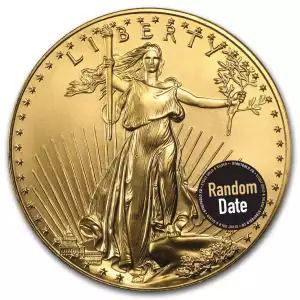 Read more aboutAny Year - 1oz American Gold Eagle
 Read more aboutAny Year - 1oz Canadian Gold Maple Leaf .9999
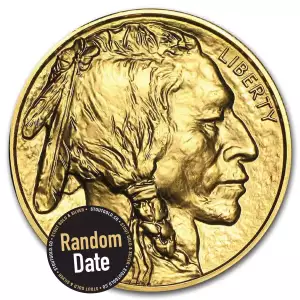
What to Know Before Buying Your First American Gold Eagle Coin
Before buying your first American Gold Eagle coin, you should understand pricing, sizing, and how to select a trustworthy dealer.
How Are American Gold Eagles Priced vs Spot Gold?
-
Check spot first
Look up the live gold spot price per ounce—this is your baseline. -
Understand additions
Add the coin’s premium (usually a few percent above spot, varying by size and demand) plus shipping and payment fees. -
Compare dealers
For “what to know before buying your first American Gold Eagle coin,” always compare total price and reputation, not just the cheapest advertised number.
Which Size American Gold Eagle Should Beginners Buy?
-
1 oz Gold Eagles
Often the most cost‑efficient per ounce and a common choice for a primary holding. -
Fractional Eagles (1/2, 1/4, 1/10 oz)
Better for smaller, regular purchases and more flexibility, but with higher percentage premiums. -
Practical tip
Many beginners start with 1 oz if budget allows, then add fractionals over time as part of dollar‑cost averaging.
How to Choose a Dealer for Your First Gold Eagle
-
Reputation and transparency
Look for established dealers with clear pricing, published premiums, and buyback policies. -
Education focus
Favor dealers who provide guides like this one instead of just hard‑sell tactics and “limited‑time” pressure. -
Test‑order approach
Consider placing a smaller first order to confirm the process, service, and delivery before scaling up.

How American Gold Eagles Fit Into a Broader Gold Strategy
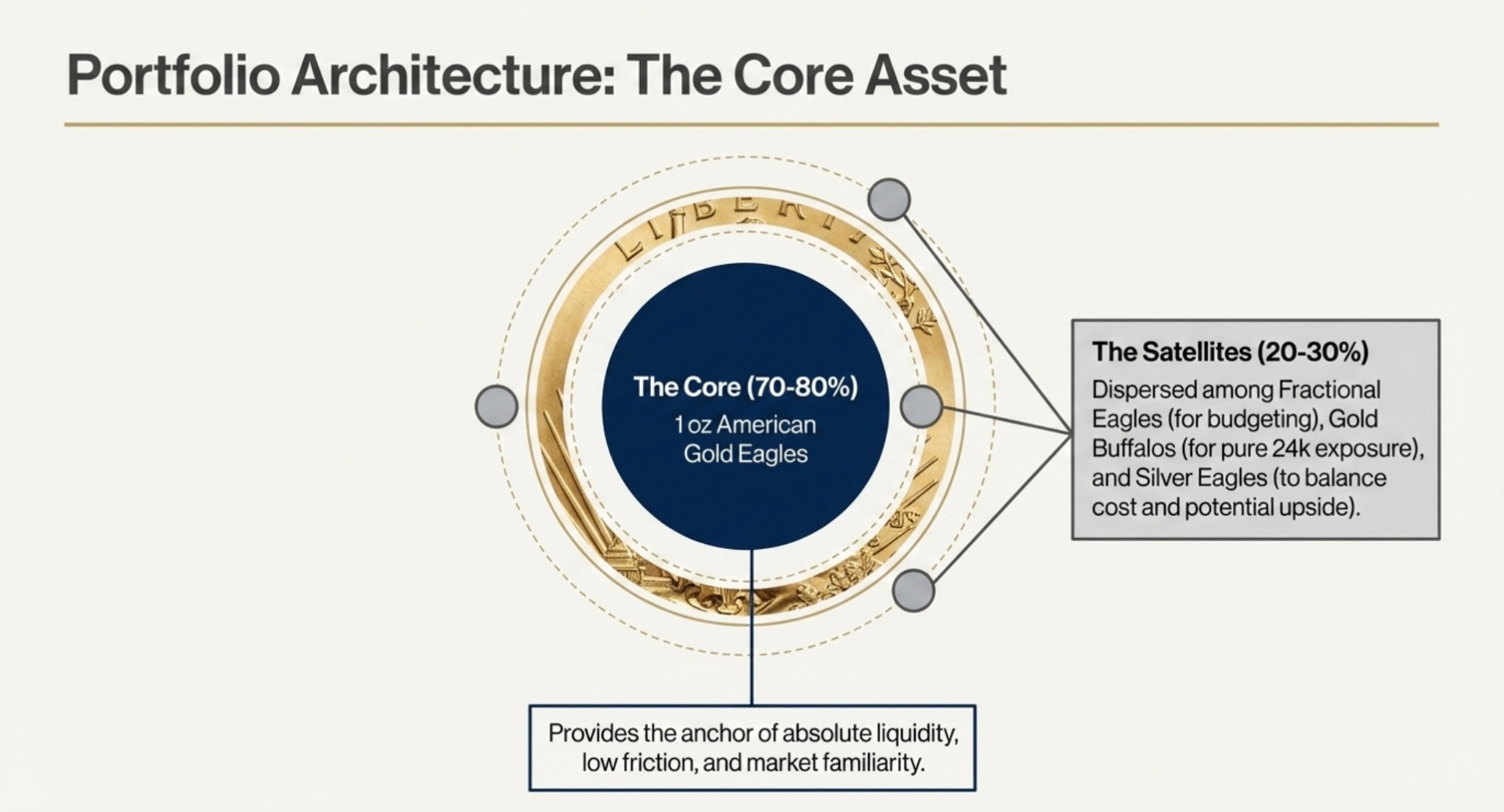
Most U.S. investors use American Gold Eagles as the central pillar of a physical gold strategy, then add other products around them.
Using Gold Eagles as Your Core Holding
-
Core allocation
Many investors keep the majority of their physical gold allocation in 1 oz American Gold Eagles because of their liquidity and familiarity. -
Simple example
An investor might hold 70–80% of their physical gold in Eagles, with the remainder in Buffalos, bars, or select foreign coins.
Combining Gold Eagles with Silver and Other Metals
-
Gold vs silver mix
Some investors pair American Gold Eagles with American Silver Eagles or other silver bullion to balance cost and potential upside. -
Broader diversification
Others add small allocations to platinum or palladium, but keep Gold Eagles as the anchor asset.
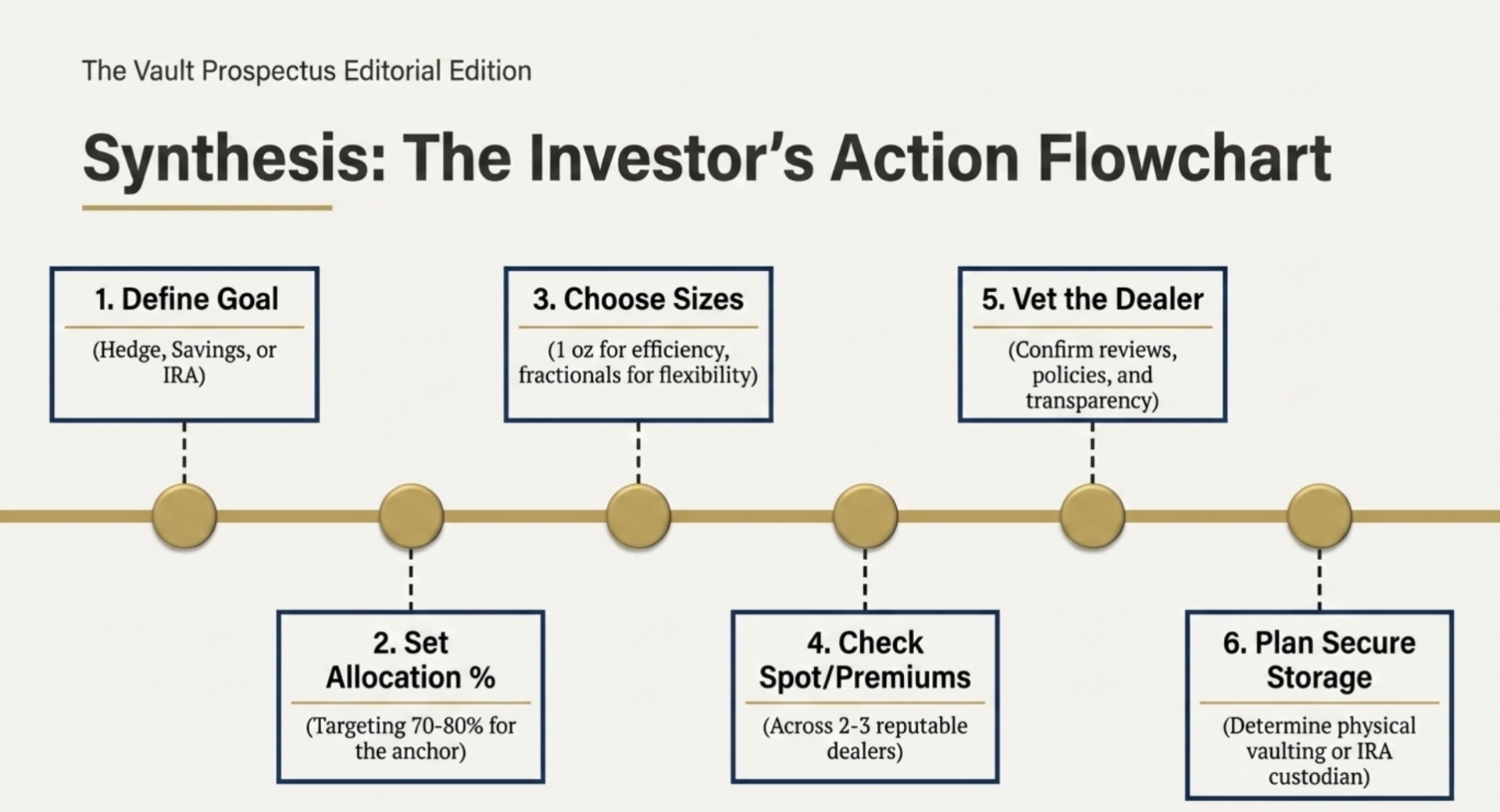
Quick Checklist: Buying American Gold Eagles with Confidence
-
Define your goal
Hedge, long‑term savings, IRA, or diversification? -
Decide on your Gold Eagle allocation
What share of your overall gold holdings will be in Eagles? -
Choose your sizes
1 oz for efficiency, fractionals for flexibility—or a mix. -
Check spot and premiums
Review live gold prices and compare Eagle premiums from 2–3 reputable dealers. -
Review dealer reputation and policies
Confirm reviews, shipping, payment options, and buyback terms. -
Place a first, comfortable‑sized order
Start with an amount that fits your plan; add steadily over time. -
Plan storage and records
Decide where to store your Eagles and keep invoices and documentation safe.
Frequently Asked Questions
Why do so many American investors choose Gold Eagle coins as their main gold holding?
Short answer: Because American Gold Eagles combine U.S. government backing, high recognition, and strong liquidity in one simple coin.
Explanation: U.S. investors know that dealers everywhere understand Eagles, quote on them daily, and trust the U.S. Mint guarantee, making them a natural default choice for a primary physical gold holding.
Are American Gold Eagles a good long‑term investment?
Short answer: Yes, they are widely considered a conservative, long‑term gold investment for U.S. investors.
Explanation: Eagles give you direct exposure to gold’s long‑term performance with decades of strong demand, a deep resale market, and compatibility with many Gold IRAs, making them well‑suited for “buy and hold” strategies.
What is the difference between American Gold Eagles and American Gold Buffalos?
Short answer: Gold Eagles are 22k alloy coins; Gold Buffalos are 24k pure gold coins.
Explanation: Both contain 1 oz of pure gold in their 1 oz versions, but Eagles include copper and silver for toughness, while Buffalos are .9999 pure and softer; many investors use Eagles as the core holding and Buffalos as a 24k alternative.
How are American Gold Eagles different from other popular gold coins like Krugerrands or Maple Leafs?
Short answer: Eagles are the U.S. legal‑tender option and the most “home market” friendly coin for American investors.
Explanation: Krugerrands, Maple Leafs, and others are also respected bullion coins, but Eagles benefit from U.S. branding, domestic legal‑tender status, and especially strong U.S. dealer and investor familiarity, which often makes them easier to resell in the U.S. market.
Is a 22k American Gold Eagle less valuable than a 24k gold coin?
Short answer: No—both still contain 1 oz of pure gold; the 22k alloy just adds durability.
Explanation: Market value for bullion is based mainly on pure gold content, so a 1 oz Eagle and a 1 oz 24k coin each carry 1 oz of gold; price differences come more from premiums, demand, and brand than from 22k vs 24k alone.
Are American Gold Eagles eligible for a Gold IRA?
Short answer: Yes, American Gold Eagles are approved for many self‑directed Gold IRAs.
Explanation: IRS rules list certain coins, including Gold Eagles, as acceptable for IRAs when held via an approved custodian and stored in qualified facilities, which is why they are a staple in U.S. Gold IRA portfolios.
What should I know before buying my first American Gold Eagle coin?
Short answer: Learn how Eagles are priced, pick the right size, and buy from a reputable dealer.
Explanation: Understanding spot price and premiums, deciding whether 1 oz or fractional Eagles fit your budget and goals, and choosing an established dealer with clear policies will make your first American Gold Eagle purchase far smoother and more confident.
If you are ready to make American Gold Eagles a core part of your gold strategy, start by checking live American Gold Eagle prices, comparing premiums from a trusted dealer, and choosing the mix of sizes that fits your long‑term plan - not just today’s headlines.