Among the peso-sized and larger Mexican silver coins in the table below, silver content runs from 0.8681 troy ounces in the 1947-1948 Cuauhtemoc 5 pesos down to 0.0514 troy ounces in the Morelos peso of 1957-1967. The date decides which: the big pesos struck through 1914 are .903 fine, the peso of 1920-1945 is .720 fine, and the last silver pesos of the 1960s are only .100 fine. The table below gives the weight, fineness and silver content of each common type, and many of the later coins print the same figures on their own faces.
Fineness is the share of pure silver in a coin's alloy, written as a decimal: .720 means 720 parts silver in every 1,000. Actual silver weight (ASW) is the amount of pure silver in the coin, given in troy ounces.
Silver content of Mexican coins by type and year
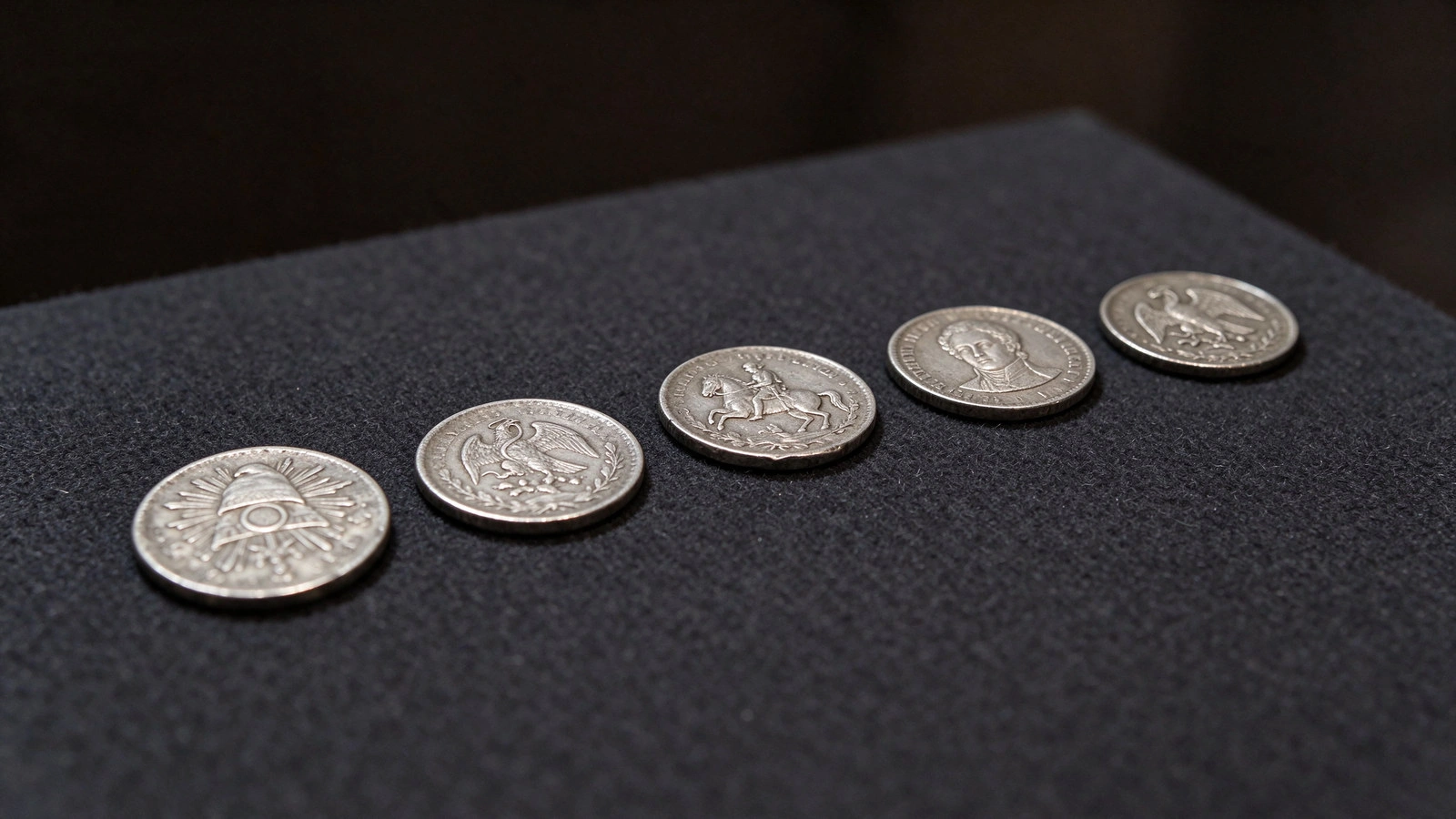
The silver in a Mexican coin is its gross weight multiplied by its fineness, and the weights below are the standard weights. Wear takes metal off but leaves the fineness alone, so a worn coin holds a little less silver than its row shows.
| Coin | Dates on coins | Fineness | Gross weight | Silver content (troy oz) |
|---|---|---|---|---|
| 8 reales, cap and rays | 1823-1897 | .903 | 27.07 g | 0.7859 |
| Peso, cap and rays | 1898-1909 | .9027 | 27.073 g | 0.7857 |
| Peso, "Caballito" (horse and rider) | 1910-1914 | .903 | 27.07 g | 0.7859 |
| Peso, cap and rays | 1918-1919 | .800 | 18.125 g | 0.4662 |
| Peso, cap and rays | 1920-1945 | .720 | 16.66 g | 0.3857 |
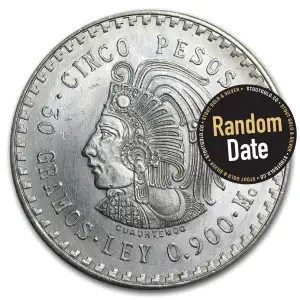
| 5 pesos, Cuauhtemoc | 1947-1948 | .900 | 30 g | 0.8681 |
| Peso, Morelos | 1947-1949 | .500 | 14 g | 0.2251 |
| Peso, Morelos | 1950 | .300 | 13.33 g | 0.1286 |
| 5 pesos, Hidalgo (large) | 1951-1954 | .720 | 27.777 g | 0.6430 |
| 5 pesos, Hidalgo (small) | 1955-1957 | .720 | 18.055 g | 0.4179 |
| 10 pesos, Hidalgo | 1955-1956 | .900 | 28.888 g | 0.8359 |
| Peso, Morelos | 1957-1967 | .100 | 16 g | 0.0514 |
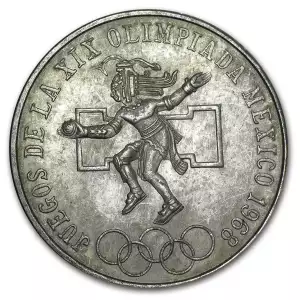
| 25 pesos, Olympic Games | 1968 | .720 | 22.5 g | 0.5208 |
| 100 pesos, Morelos | 1977-1979 | .720 | 27.77 g | 0.6428 |
Weights and finenesses come from NGC's World Coin Price Guide for the 8 reales, the 1898-1909 peso, the Caballito, the 1920-1945 peso, the Cuauhtemoc 5 pesos, the 1947-1949 peso and the 1957-1967 peso. Greysheet's catalog supplies the 1918-1919 peso, the 1950 peso, both large and small Hidalgo 5 pesos and the 10 pesos. The 25 pesos weight is from the Olympic Museum's catalog entry and the 100 pesos from Greysheet. Banco de Mexico's own list of its silver coins runs from 1919 to 1968, and for every type in the table that appears on it, the fineness above matches that list. The 8 reales, the 1898-1909 peso, the Caballito, the 1918-1919 peso, the large Hidalgo 5 pesos and the 100 pesos are not on it. Silver content is calculated from those weights and finenesses.
NGC's price guide lists 4,000,000 Morelos pesos dated 1949 and notes that they were not released for circulation; Banco de Mexico's list gives the type's years as 1947-1948. Not every year inside a range was struck either: NGC's guide lists no 1920-1945 pesos dated 1928-1931, 1936-1937, 1939 or 1941-1942, and Banco de Mexico's list skips the same years. The table covers the main national types only.
How the peso lost its silver, one step at a time
The Mexican peso went from .903 fine in 1914 to .100 fine in 1957, and each cut produced a new coin type. Following the steps in order makes the table above easier to read.
The large peso held its standard of roughly 27 grams at .903 through 1914. The 1918 peso was smaller and only .800 fine. A decree of 27 October 1919 then set the .720 standard that lasted for decades: a peso of 16.666 grams, a 50 centavos of 8.333 grams and a 20 centavos of 3.333 grams, according to the table of coins in circulation reproduced in the Banco de Mexico's published history.
The same history records that the .720 silver peso, 50 centavos and 20 centavos were demonetized in 1945, and that on 9 September 1947 Congress approved three new silver coins. The 5 pesos was set at 30 grams and .900 fine, or 27 grams of pure silver. The new peso was cut to .500 fine and 14 grams, which is 7 grams of pure silver.
After that the peso kept thinning. Banco de Mexico lists the 1950 Morelos peso at .300 fine and the 1957-1967 Morelos peso at .100. By 1970 the circulating peso was a 9-gram copper-nickel coin with no silver in it at all. Silver stayed in the larger denominations a while longer, which is why the 25 pesos of 1968 and the 100 pesos of 1977-1979 are both .720.
A pattern runs through these coins: several were built around a round number of grams of pure silver. The 1920-1945 peso carries 12 grams of fine silver, the 1947 5 pesos 27 grams and the 1947 peso 7 grams, and the 100 pesos says 20 grams outright on its face.
Reading the weight and fineness stamped on the coin
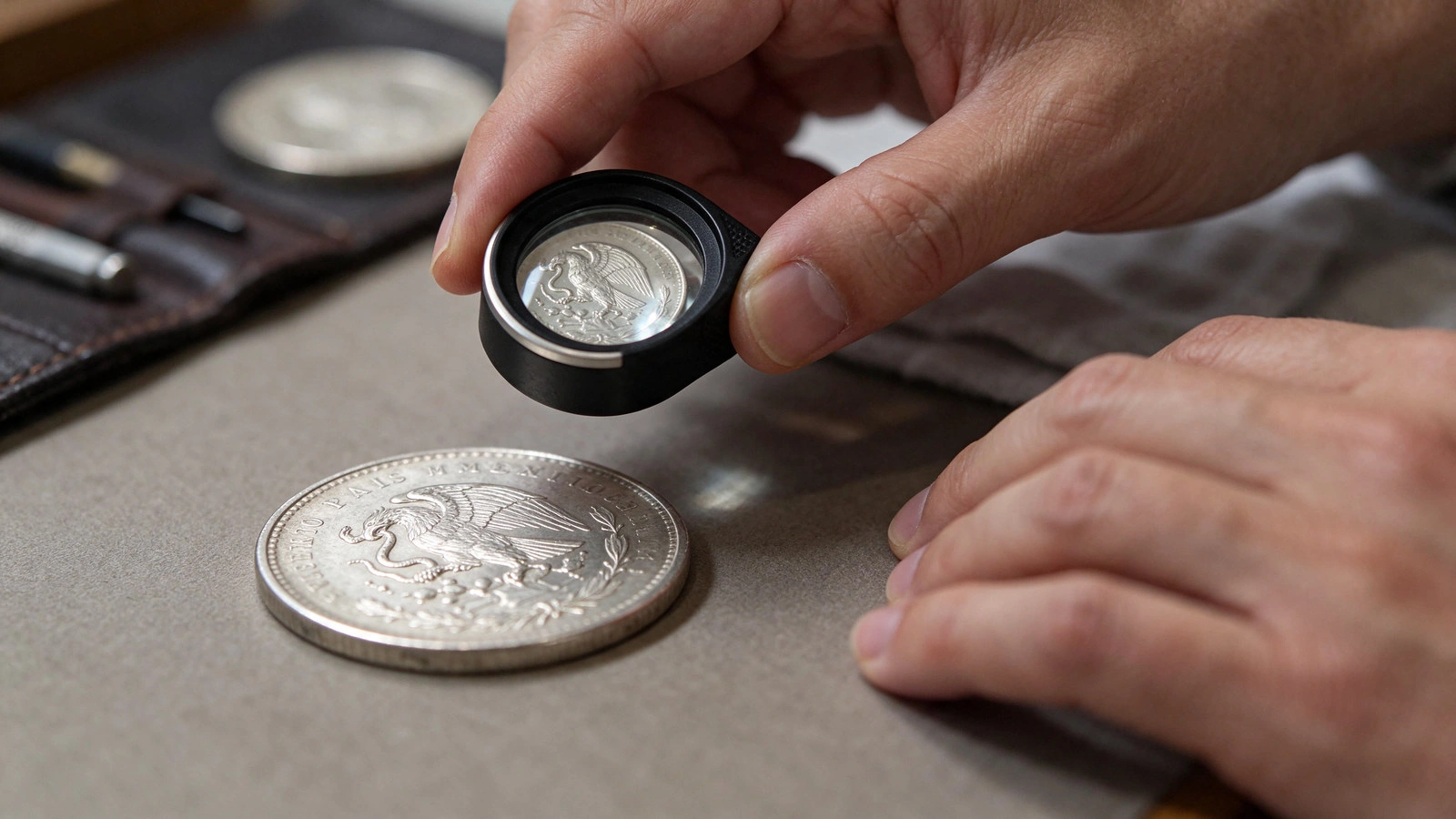
Many 20th-century Mexican silver coins state their own fineness, and some state their weight too. LEY is the Spanish term for the legal fineness, so "LEY 0.720" on a coin means 720 parts silver per 1,000.
- The 1920-1945 peso shows 0.720 near the top of the eagle side, split into "0.7" and "20" by the eagle's head, per Greysheet's description. Read across the eagle's head, the two halves give 0.720, so a coin that seems to read 0.7 and 20 is showing its fineness, not two separate numbers.
- The 1947-1948 Cuauhtemoc 5 pesos reads 30 GRAMOS and LEY 0.900 around the portrait.
- The 1951-1954 Hidalgo 5 pesos reads PESO 27 7/9 G and LEY 0.720 on the eagle side.
- The 1955-1956 10 pesos reads 28.888 G and LEY 900.
- The 1968 Olympic 25 pesos shows LEY 0.720 beside the coat of arms but no weight.
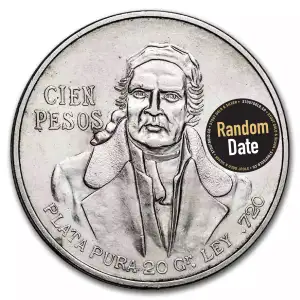
- The 1977-1979 100 pesos reads PLATA PURA 20 Gr. and LEY .720 below the bust of Morelos.
The 100 pesos is the easiest of all to work with. Its legend gives the pure silver directly: 20 grams, or about 0.643 troy ounces. On the coins that state both, multiply the stated weight by the stated fineness to get grams of silver; for the rest, start from the weight in the table. The 1957-1967 peso states neither, so its .100 fineness comes from Banco de Mexico's list rather than from the coin.
What people mean by "Mexican silver dollar"
"Mexican silver dollar" usually means the dollar-sized 8 reales or peso of about 27 grams at .903 fine. The cap-and-rays 8 reales, with an eagle and snake on one side and a Liberty cap in rays on the other, was issued by the Republic of Mexico from 1823 to 1897, according to NGC.
The decimal peso of 1898-1909 and the Caballito of 1910-1914 kept almost exactly the same silver, 0.7857 and 0.7859 troy ounces. All three sit at the top of the older end of the table, and all three can carry a collector premium well above their silver, depending on date, mint, assayer and condition.
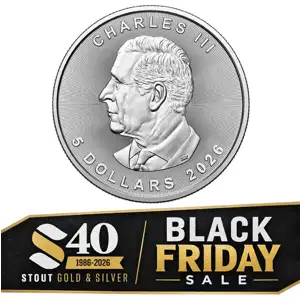
The modern Libertad is a different kind of coin: a bullion coin, not a circulating one, and Banco de Mexico lists the silver series at .999 fine. It is the only coin in this article sold by its silver weight in ounces.
Working out the melt value of a Mexican coin
Melt value is the worth of the silver in a coin at the day's spot price, with nothing added for the coin itself. The formula is the same for every type in the table: gross weight in grams, times fineness, divided by 31.1035 to convert grams to troy ounces, times spot.
Take the 1968 Olympic 25 pesos. Its 22.5 grams at .720 fine hold 16.2 grams of silver, which is 0.5208 troy ounces, so its melt value is 0.5208 times the day's spot price. Twenty of them hold about 10.4 ounces.
Melt is not the same number as the price on a dealer's shelf. A shelf price adds a premium over spot, and a dealer's buy price sits below its sell price; our guide to how a bullion trade-in is priced walks through how those pieces fit together. Mexican coins in collector grades, and the scarcer dates, are priced on condition and demand rather than on silver alone.
If you already stack 90% and 40% U.S. silver coins, Mexican silver works the same way, with one extra step: the fineness changes from type to type, so the date has to be read before the arithmetic starts.
Checking a Mexican silver coin for fakes and damage
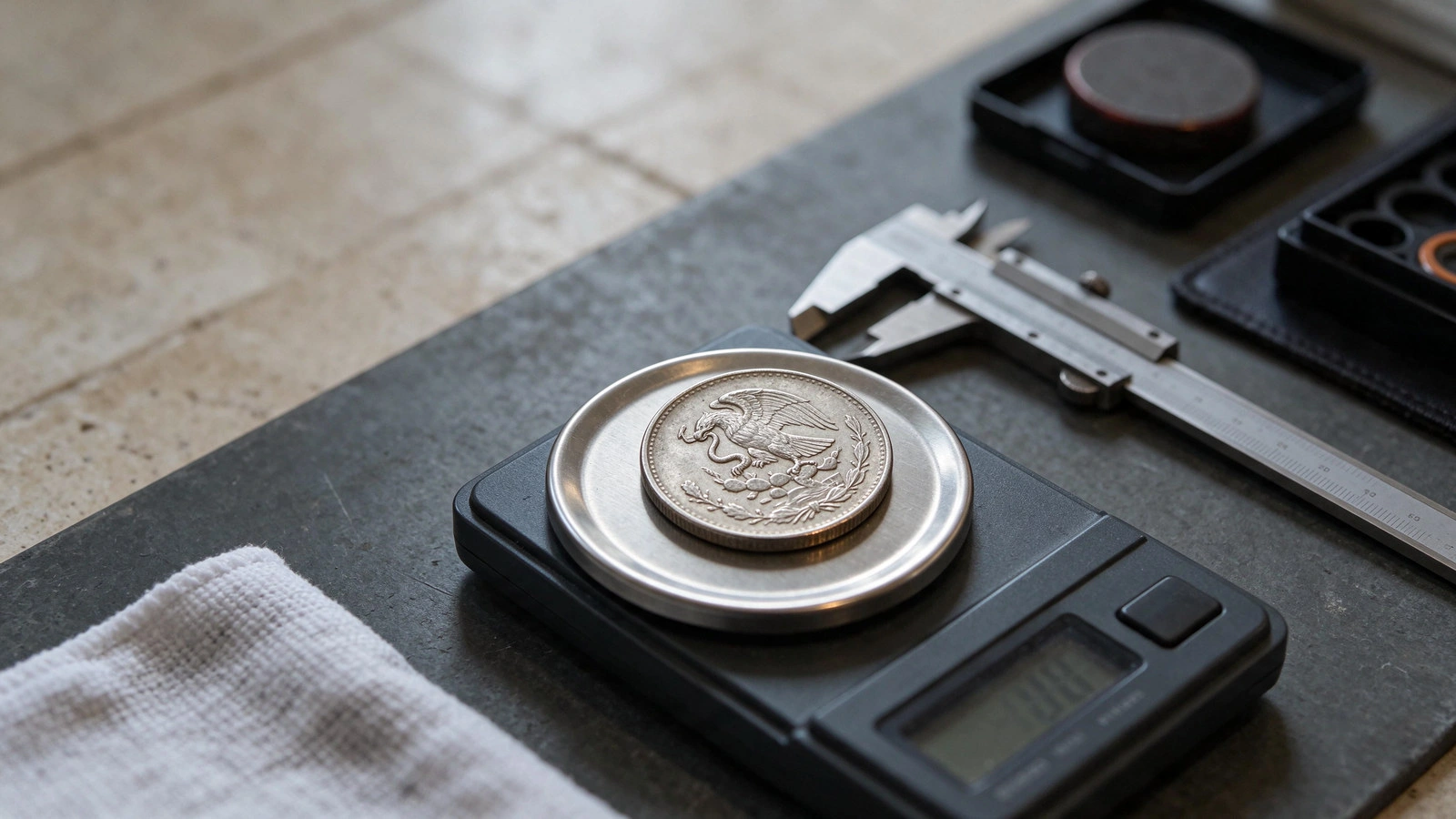
The table doubles as a first screening tool. A genuine coin should be close to its listed weight, allowing a little for wear, and a 1920-1945 peso that weighs 13 grams has a question attached to it. A jeweler's scale and a pair of calipers catch many problems before anything else is needed; NGC's guide gives 34 mm as the diameter of the 1920-1945 peso, for example.
Silver is not attracted to a magnet, so a coin that jumps to one is not what it claims to be. Holes, solder marks and loop scars are another matter. Banco de Mexico's notice on altered coins says that perforated coins, coins that have been cut out, and coins showing traces of non-monetary use are no longer legal tender in Mexico. A hole also takes silver with it, so weigh a holed coin rather than reading its silver off the table.
For the higher-value pieces, such as an 8 reales, a Caballito or an uncirculated 10 pesos, a coin certified by PCGS or NGC arrives with the authentication already done. The grade on the holder is the grading service's opinion of the coin's condition.
Mexican silver coins we carry
On 21 November 2026 our Mexican silver coins page listed eight types as in stock, most in average circulated condition and the 100 pesos as AU/BU, meaning about uncirculated to brilliant uncirculated: the 1920-1945 peso, the 1947-1949 Morelos peso, the 1957-1967 peso, the 1947-1948 Cuauhtemoc 5 pesos, both Hidalgo 5 pesos types, the 1968 Olympic 25 pesos and the 1977-1979 100 pesos. The 1955-1956 10 pesos was out of stock that day, and the Libertads were listed in several sizes, none of them in stock; the 2024 1 oz BU was on pre-sale. Stock changes from day to day, and each listing on that page shows its own current status.
Most of these are random-date listings, and the date you receive is our choice from what is on hand. Orders over $199.99 ship free.
Selling works differently for bullion-grade pesos and for collector coins. We can lock a price over the phone from a detailed and fairly accurate description, and that price can change if what arrives is different. Numismatic coins have to be seen in our office before we give a price. The details, including how we pay sellers, are on our sell to us page.
This article is educational and reflects general information about precious metals and collectible coins. It is not investment, tax or legal advice, and Stout Gold & Silver is not a registered investment adviser, broker-dealer or tax professional. Metal prices fluctuate and past performance does not indicate future results. Consult a qualified professional about your own situation.
Frequently asked questions
How much silver is in a Mexican peso?
It depends on the date. A peso dated 1898-1914 was struck with about 0.786 troy ounces at .903 fine, and the 1918-1919 peso with 0.4662 ounces at .800. The 1920-1945 peso was struck with 0.3857 ounces at .720, the 1947-1949 Morelos peso 0.2251 ounces at .500, the 1950 peso 0.1286 ounces at .300, and the 1957-1967 peso only 0.0514 ounces at .100.
Is the 1968 Mexican 25 pesos coin real silver?
Yes. The 1968 Olympic 25 pesos is .720 fine and weighs 22.5 grams, so as struck it holds 16.2 grams of pure silver, or 0.5208 troy ounces. The coin shows LEY 0.720 beside the coat of arms. Wear removes metal but not fineness, so a heavily worn example holds a little less than that.
What does 0.720 mean on a Mexican coin?
It is the fineness: 720 parts pure silver in every 1,000 parts of the coin, with copper making up the rest. LEY, which often appears beside the number, is Spanish for the legal standard. Multiply the coin's weight by 0.720 to get its grams of silver, then divide by 31.1035 for troy ounces.
Which Mexican silver coins hold the most silver?
Of the circulating types in our table, the 1947-1948 Cuauhtemoc 5 pesos holds the most, at 0.8681 troy ounces. The 1955-1956 10 pesos follows at 0.8359 ounces, then the pre-1915 pesos and 8 reales at about 0.786. The larger silver Libertads hold more, because the Libertad is a bullion coin sold by weight: the 1 ounce size is a full troy ounce at .999 fine.
Are old Mexican silver coins still legal tender?
Not the old .720 pesos: Banco de Mexico's published history records that the .720 silver peso, 50 centavos and 20 centavos were demonetized in 1945, and its list of 20th-century silver pieces calls them no-longer-circulating coins. The Libertad series is legal tender under Banco de Mexico's notice on altered coins, except for pieces that are perforated, cut out or show traces of non-monetary use.
Mexican silver in Amarillo
Walk-ins are welcome on weekdays if you would rather ask about a peso at the counter than order it online.
Stout Gold & Silver
2300 SW 7th Ave Ste 105
Amarillo, TX 79106
(806) 374-8698
Monday-Friday 10am-4pm, Saturday and Sunday closed