
The Texas Bullion Depository, sometimes called the Texas gold depository, is a state agency in the Texas Comptroller's office, operated under contract by a private company from a facility in Leander, north of Austin. It publishes its fee schedule and account agreement, stores metal on a segregated basis, and is governed by a chapter of the Government Code. A private vault, whether at a dealer, a bank or a private depository, is a contract with a business, and its terms are whatever that contract says. Neither is better by default; the useful comparison is document against document.
This article sets out what the state depository's own statute, fee schedule and account agreement say, and the questions worth putting to any private vault, including ours.
What the Texas Bullion Depository is

The Texas Bullion Depository is a state-administered storage facility for gold, silver, platinum and palladium, created by the Texas Legislature in 2015. Its statute, Chapter 2116 of the Government Code, opens plainly: Section 2116.002 establishes it "as an agency of this state in the office of the comptroller." Section 2116.003 places it under a bullion depository administrator appointed by the Comptroller.
Day-to-day operation is contracted out. The Comptroller's office identifies a private company it contracted to run the depository, and describes the operation as running without taxpayer dollars (Comptroller news release, 12 June 2025). The same release reported total deposits above $400 million as of 6 June 2025.
The depository began accepting deposits in 2018, and its 40,000-square-foot facility on 10 acres in Leander was completed in 2019, according to a Comptroller release from 28 July 2025.
What the statute says about the metal you deposit
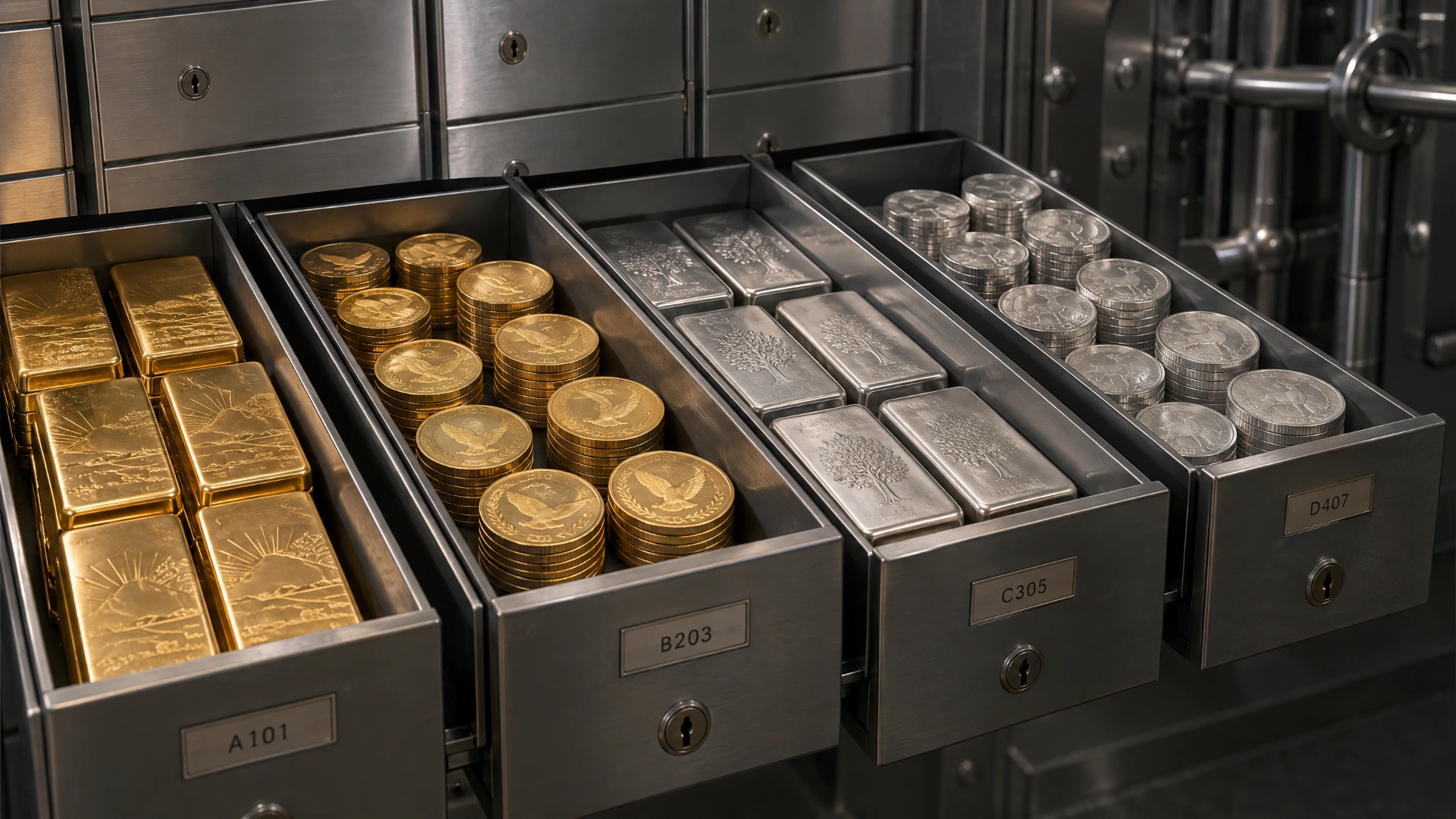
Chapter 2116 fences deposited metal off from the state's own budget. Under Section 2116.004, deposits and the bullion held for them are not available for legislative appropriation, and may be redeemed, liquidated or transferred only to meet the depository's obligations to account holders and to the agents, banks and other intermediaries it deals with, under the chapter and its rules. Fee revenue is handled separately and goes to general revenue.
Four other provisions shape what an account actually is:
- Section 2116.005: each deposit is recorded in troy ounces pure, whatever its form, and is credited under Comptroller standards that can refer to the form deposited, such as mint, denomination or assay mark.
- Section 2116.006: on a written or electronic demand, the depository must deliver the metal "not later than 10 business days after the date of presentment," either at its settlement facility or by shipping to an address the account holder names.
- Section 2116.013: the depository may not pay interest, or anything in the nature of interest, on an account. The depository pays nothing on stored metal.
- Section 2116.023: a confiscation or seizure attempted by an authority other than the State of Texas, in the course of a generalized declaration of illegality or emergency relating to precious metals, is declared void under Texas law, and withdrawals from affected balances are suspended until substitute arrangements can be made.
That last section is worth reading at its actual scope. It states Texas law about one kind of event. This article makes no prediction about how it would fare in a conflict with federal authority, and neither should any seller of metal.
What the Texas Bullion Depository's own terms say
The depository's published documents answer in public most of the questions that, at many private vaults, you would need to ask for. Its current Personal Account Agreement and fee schedule are both effective 1 April 2026, and its FAQ fills in the rest.
- Storage basis. Segregated storage is the only option currently offered, and the FAQ says you receive the same metals back on withdrawal. The agreement states that legal title to the metal remains with you.
- Who can open an account. U.S. citizens and residents, including business entities. The FAQ says services for depositors from other nations will open in the future.
- Insurance. The FAQ states that account assets are insured through Lloyd's of London, at a higher declared value where one is declared, for example on a numismatic coin. The agreement ties the depository's liability to metal content value unless a higher value is declared.
- Getting metal there. A deposit request is submitted online first, and items must be on the depository's approved list. The agreement says the depository is not responsible for loss in transit and encourages depositors to insure their own shipments.
- Testing. The depository may test a deposit but is not required to, and the agreement states that accepting a deposit after testing is not a guarantee of what the metal is.
- Getting metal back. There is no withdrawal fee. Domestic shipping is $17.95 plus 0.0018 times the spot value (or the declared value, where there is one), and the schedule says the fee includes 100% insurance on the shipment to the account holder. Alaska, Hawaii, U.S. territories and large shipments are quoted separately. An in-person pickup is $35 per transaction, by appointment.
- Unpaid fees. The depository holds a lien on the account and, on default, may transfer or liquidate part or all of the balance. Texas law governs, with venue in Travis County.
- Oversight. The FAQ says a Texas accounting firm audits the depository and reports to the Comptroller on a regular schedule, and that the depository is subject to audits by the State of Texas.
Storage is charged as an annual rate on the account's average daily value, accrued daily and billed quarterly, with a $25 quarterly minimum. One rate applies to the whole balance, not in slices. Because the fee is a percentage of value, the dollar cost of storing the same metal rises and falls with the metal price.
| Average daily value of the account | Annual rate |
|---|---|
| $0.01 to $499,999.99 | 0.49% |
| $500,000.00 to $999,999.99 | 0.44% |
| $1,000,000.00 to $2,499,999.99 | 0.39% |
| $2,500,000.00 to $4,999,999.99 | 0.34% |
| $5,000,000.00 and above | Negotiable |
Rates from the Texas Bullion Depository schedule of fees effective 1 April 2026, for non-IRA accounts. The schedule's own worked example is an account averaging $100,000 at 0.49%, which accrues $1.34 a day. The depository may change fees on 30 days' notice, so check the live schedule before relying on any figure here.
IRA storage, and the 2025 legal tender law
Since June 2025 the depository has been set up to hold precious-metal IRA assets, through a partnership with a private self-directed IRA custodian announced by the Comptroller. In that arrangement the custodian administers the IRA and the depository stores the metal; they are different roles, and IRA accounts sit outside the fee schedule above. The IRS rules on what an IRA may hold are a separate question, and one for a tax professional.
The Legislature also passed House Bill 1056 in 2025. Its legal tender section, new Section 2116.101, took effect on 1 September 2026.
The rest of the bill takes effect on 1 May 2027, including a provision that the Comptroller "may" establish electronic systems for payments using a currency backed by bullion held in the depository. "May" is permission, not a launch date. The bill itself says no one may be required to offer or accept gold and silver specie or currency as legal tender for a debt.
What a private vault is, and why the terms vary

A private vault is any storage a business offers under its own contract: a dealer's on-site vault, a private depository, or a bank safe deposit box. Unlike the state depository, there is no single statute or published schedule to read. The terms live in the agreement, and they differ from one provider to the next.
The vocabulary matters more here than anywhere. Segregated storage is metal kept physically apart and returned to you as the same items; commingled storage is metal held in a shared pool, from which you are owed an equivalent amount. Whether metal is allocated or unallocated, segregated or commingled, decides whether specific bars are recorded as yours or whether you hold a claim against a pool. We set those four terms out, along with what Texas warehouse law does when a contract is silent, in Segregated, Allocated, Commingled: What Storage Terms Mean.
Each model has real advantages, and they are not the same ones:
| Question | Texas Bullion Depository | A private vault |
|---|---|---|
| Who you contract with | A state agency, under Government Code Chapter 2116 | A business, under its own agreement |
| Where the terms are published | Online: agreement, fee schedule and FAQ | Usually in the agreement you are given; ask for it |
| Storage basis | Segregated only, per its FAQ | Varies: allocated, unallocated, segregated or commingled |
| Insurance and audit | Stated in its FAQ and agreement | Varies; ask who insures, for what value, and who audits |
| Getting metal in and out | Shipping, or pickup in Leander by appointment | Often local; some allow in-person deposit and collection |
| What it accepts | Items on its approved list | Set by the provider |
| How it is priced | Percentage of value, with a quarterly minimum | Varies: flat fee, per box, or percentage of value |
The trade-off is concrete for a Panhandle owner. The state depository's terms are public and its governing law is on the page, but Leander, north of Austin, is a long way from the Panhandle, and metal goes in and out by insured shipping or an appointment. A local vault may let you deliver and collect metal in person, but whether it does, and on what terms, is a question to put to that provider.
The questions worth putting to either one
The full clause-by-clause list is in our storage-terms guide linked above. These eight are the ones that matter most for this comparison, with how the state depository answers each in its published terms:
- Is my metal segregated and recorded to me by item, or held in a commingled pool? (State depository: segregated only, at present.)
- Who holds legal title to the metal while it is stored? (State depository: you do, per its agreement.)
- Who insures it, against what, and at what value: metal content, declared value, or something else? (State depository: insured through Lloyd's of London per its FAQ, at a higher value where one is declared; its agreement ties liability to metal content value otherwise.)
- Who audits the holdings, how often, and does the audit report to anyone outside the business? (State depository: an accounting firm reporting to the Comptroller, plus state audits, per its FAQ.)
- What exactly is charged, on what basis, and how can the fee change? (State depository: a published percentage of value, changeable on 30 days' notice.)
- How do I withdraw, how long does it take, and who carries the risk on the way back to me? (State depository: delivery within 10 business days under the statute, with return shipping insured per its fee schedule.)
- What happens to my metal if fees go unpaid, or if the provider stops trading? (State depository: a lien and a right to liquidate on default, per its agreement.)
- Which law governs the agreement, and where would a dispute be heard? (State depository: Texas law, Travis County courts.)
A private provider's answers will differ, and that is the point of asking. The Commodity Futures Trading Commission's precious metals fraud advisory lists, among its warning signs, an agreement that does not identify where the physical metal is located, which is why "where exactly is my metal?" is a reasonable first question anywhere, including here.
Where Stout Gold & Silver fits
We keep bullion storage on site in Amarillo; our bullion storage page describes it as an on-site safety depository. If you are weighing a vault with us against the state depository or anyone else, put the same eight questions to us that you would put to Leander, and compare the answers.
If the decision you are actually making is whether to keep metal at home at all, that is a different question, and Bullion Storage vs Home Safe covers it.
This article is educational and reflects general information about precious metals and collectible coins. It is not investment, tax or legal advice, and Stout Gold & Silver is not a registered investment adviser, broker-dealer or tax professional. Metal prices fluctuate and past performance does not indicate future results. Consult a qualified professional about your own situation.
Frequently asked questions
Is the Texas Bullion Depository run by the state?
It is a state agency in the Texas Comptroller's office, established by Government Code Section 2116.002, with an administrator appointed by the Comptroller. Daily operations are contracted to a private company, according to the Comptroller's office, which says the operation runs without taxpayer dollars. So the governing law, the administrator and the oversight are the state's, while day-to-day operation is the contractor's.
Do I have to live in Texas to use the Texas Bullion Depository?
No. The depository's FAQ says accounts are open to U.S. citizens and residents, including business entities, and does not list Texas residency as a requirement. It says services for depositors from other nations will open in the future. Accounts are opened online, and you do not need a depository agent to open one or store metal.
Is metal at the depository pooled with other people's?
Not at present. The depository's FAQ says it currently offers only segregated storage, so you receive the same metals back on withdrawal, and it mentions a pooled option as planned for the future. Its agreement states that legal title remains with the depositor. Any future pooled option would come with its own terms, which would be worth reading separately.
How much does the Texas Bullion Depository charge?
For non-IRA accounts, the fee schedule effective 1 April 2026 charges an annual rate on average daily value, starting at 0.49% below $500,000, accrued daily and billed quarterly with a $25 quarterly minimum. There is no account setup fee and no withdrawal fee, but shipping is charged. Fees can change on 30 days' notice.
Can the federal government seize metal held at the Texas Bullion Depository?
Texas law declares one kind of seizure void, but this article makes no prediction about how that state law would fare against federal authority. Government Code Section 2116.023 covers a seizure by an authority other than the State of Texas, made under a generalized declaration of illegality or emergency involving precious metals. It also suspends withdrawals from affected balances until substitute arrangements are made.
Can I store bullion with Stout Gold & Silver instead?
Stout Gold & Silver offers bullion storage on site at 2300 SW 7th Ave Ste 105 in Amarillo. Ask us how our storage works, put the same questions to us you would put to any provider, and compare the answers side by side. We are open Monday to Friday, 10am to 4pm, and closed on weekends, so call ahead on (806) 374-8698.
Talk to us about storing metal in the Panhandle
Whether you end up with the state depository, a vault with us, or something else, the decision is easier when you have each provider's answers side by side. Call or stop by during the week, and bring your questions.
Stout Gold & Silver
2300 SW 7th Ave Ste 105
Amarillo, TX 79106
(806) 374-8698
Monday-Friday 10:00am-4:00pm, Saturday and Sunday closed