A sealed assay card tells you what the refiner said about a bar on the day it left the refinery. It does not tell you that the bar inside the card today is the same one the refiner sealed. That gap — small, but real — is why a bullion counter runs its own tests on carded bars that look perfect, and why a buyer who understands the gap is in a stronger position than one who trusts the packaging.
None of this means carded bars are a bad way to own gold. It means the card is one piece of evidence among several, and the counter's job is to check the others.
What an assay card actually certifies
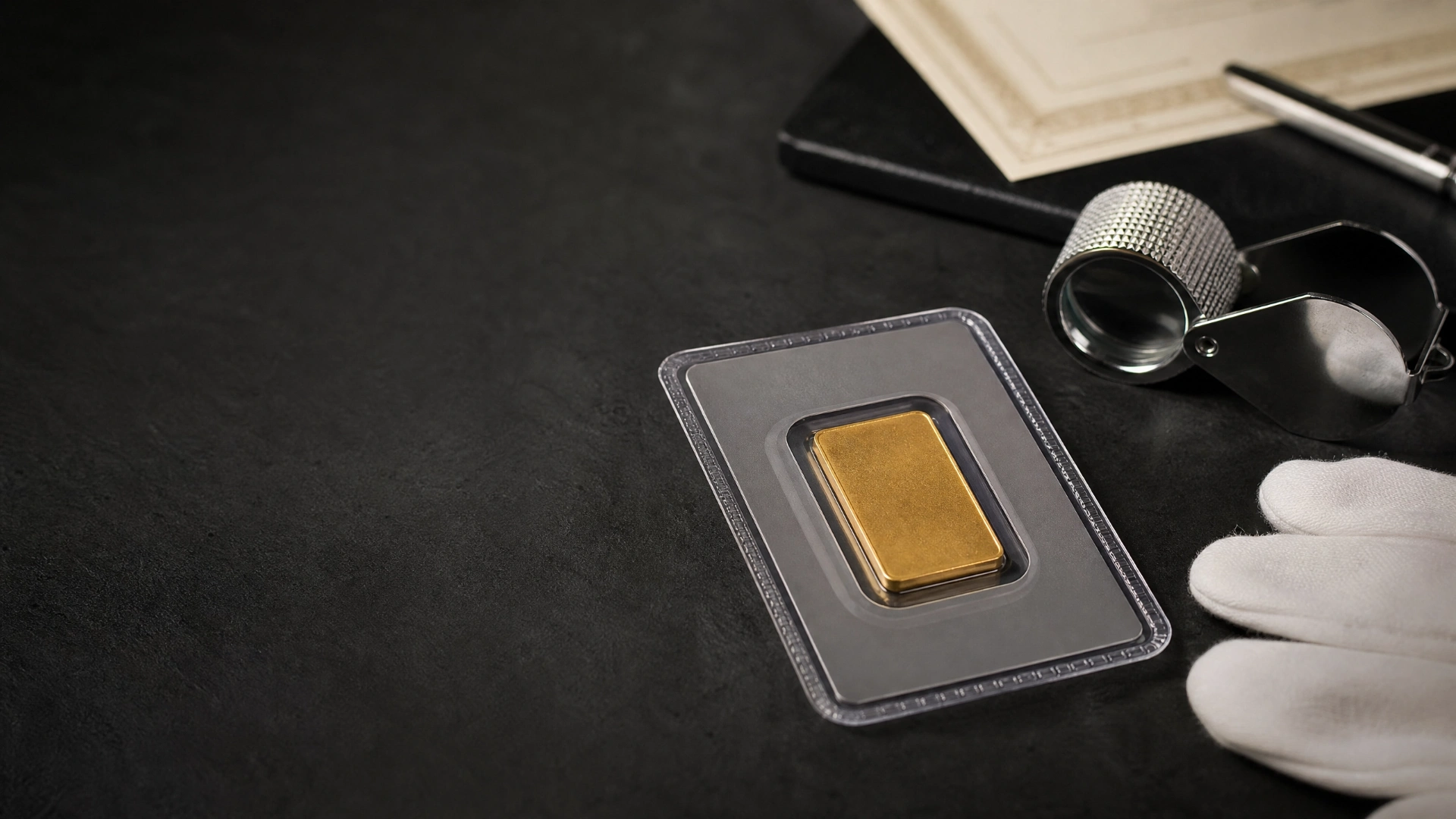
An assay card is tamper-evident packaging that seals a small bullion bar behind clear plastic alongside a printed certificate of assay. The certificate carries the refiner's name, the stated weight, the stated fineness, a serial number matching the number stamped on the bar, and usually the signature or mark of a named assayer.
What it certifies is a statement made by the refiner at the point of manufacture: this bar, bearing this serial, was assayed at this fineness and this weight. That is genuinely useful. It is also a historical claim rather than a present one.
The same logic runs through the wholesale market, where markings do the identifying. The London Bullion Market Association's Technical Specifications require a Good Delivery bar to carry a refiner's stamp, an assay mark, the fineness, a serial number and the month and year of manufacture in MMYY form — and require them to be applied by pressure stamping or dot matrix punching, with laser engraving not permitted under any circumstances. We have written separately about what those mint marks and hallmarks mean. The point here is simpler: markings are the market's identity system, and identity systems attract forgery.
The packaging is the easiest part to copy
Counterfeiters have moved past the crude plated brick. The LBMA's own analysis of the problem, published in Alchemist issue 117, describes operations that reverse-engineer genuine products, use "3D printing to create dimensionally accurate molds," and replicate "branded assay cards with tamper-evident seals." Documentation fraud sits alongside the metal fraud: forged paperwork misrepresenting a product's origin, purity or value.
The case that changed how the trade thinks about this is one the same LBMA article describes: a 2019 discovery of "more than 1,000 counterfeit gold bars, worth over $50 million" which, the article records, "matched expected assay and weight specifications, and some tested at 99.98 percent purity."
Read that again, because it inverts the usual assumption. The gold was real. The stamps were not. A bar can be genuine metal and still be a counterfeit product, because what was forged was the brand, the serial and the provenance — the things that determine whether the wholesale market will take it back without re-assay.
That is a different failure mode from the base-metal core, which the same LBMA analysis describes as "base metal plating and alloy manipulation, using other metals with dense cores to maintain the weight while minimising the gold content." We have written separately about how those core fakes are built. This article is about the other half of the problem: the packaging, the paperwork and the number.
Gold bar serial number verification: what it proves
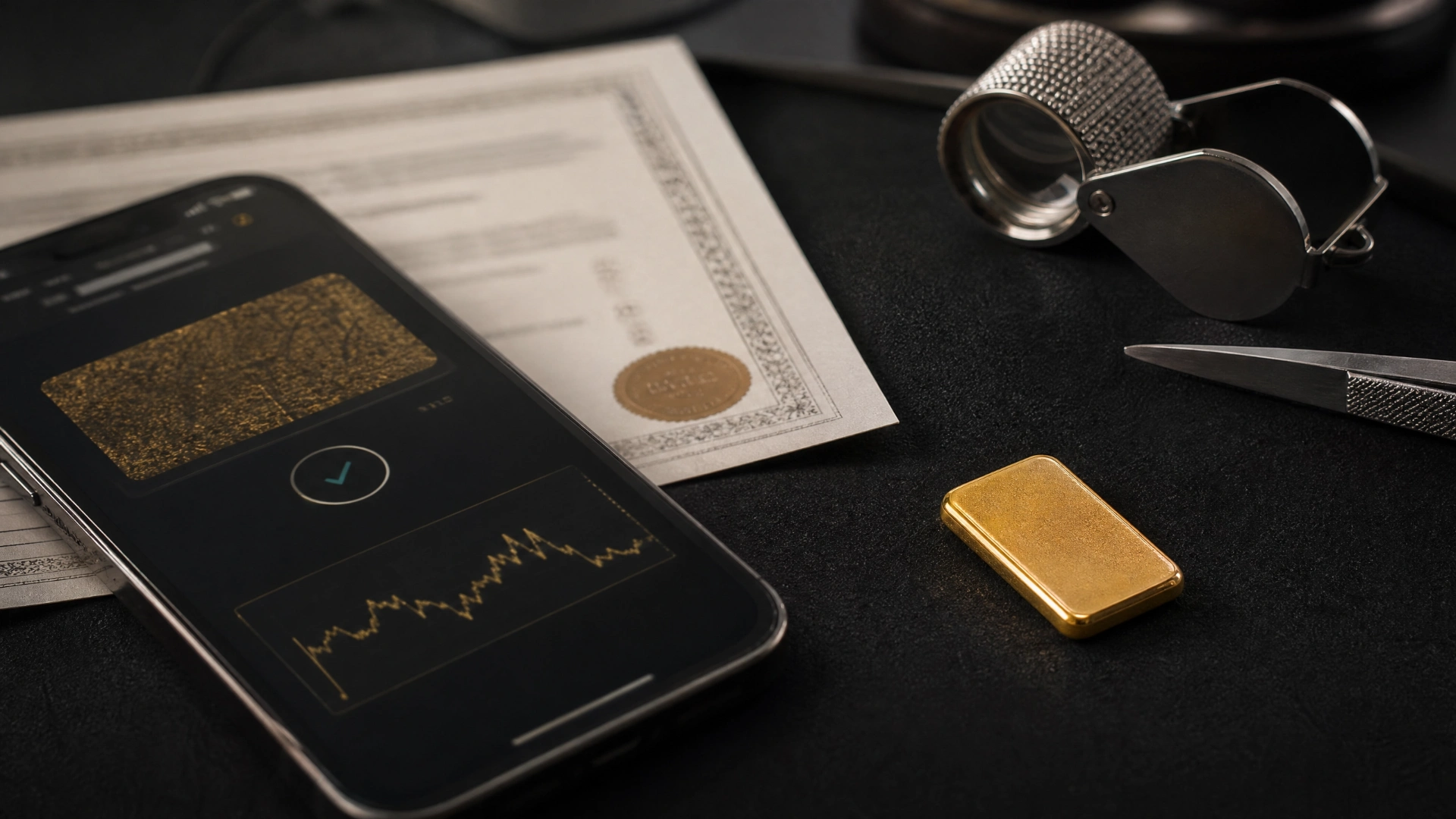
A serial number check confirms that a number exists in the refiner's records and matches a bar of the stated weight and fineness. It does not, on its own, confirm that the bar in front of you is the one that number belongs to. A number can be copied onto another bar, and it can be copied onto several.
The industry's answer to that has been to stop treating the number as the identity and start treating the metal as the identity. MKS PAMP's VERISCAN system, which received LBMA Security Feature accreditation under the Gold Bar Integrity programme on 1 March 2023, "captures the unique surface profile of each PAMP bullion product" and reconciles a phone-camera scan against "MKS PAMP's production digital record which is securely stored in a central database." The company describes it as working whether the bar is "within or without their sealed assay card packaging."
The principle behind the wider programme is set out in the LBMA's Gold Bar Integrity Initiative security feature specification: an accredited feature has to be applied during production, must not meaningfully affect the bar's weight or purity, must stay readable through the bar's whole life, and must populate an LBMA database with serial number, assay information, brand and production date.
The practical takeaway for a retail buyer is narrow and useful. Where a refiner offers a registry or surface-scan check, use it — it is stronger evidence than the card. Where it does not, the serial is a cross-reference, not a proof.
The specific gravity test, and the one metal it cannot see
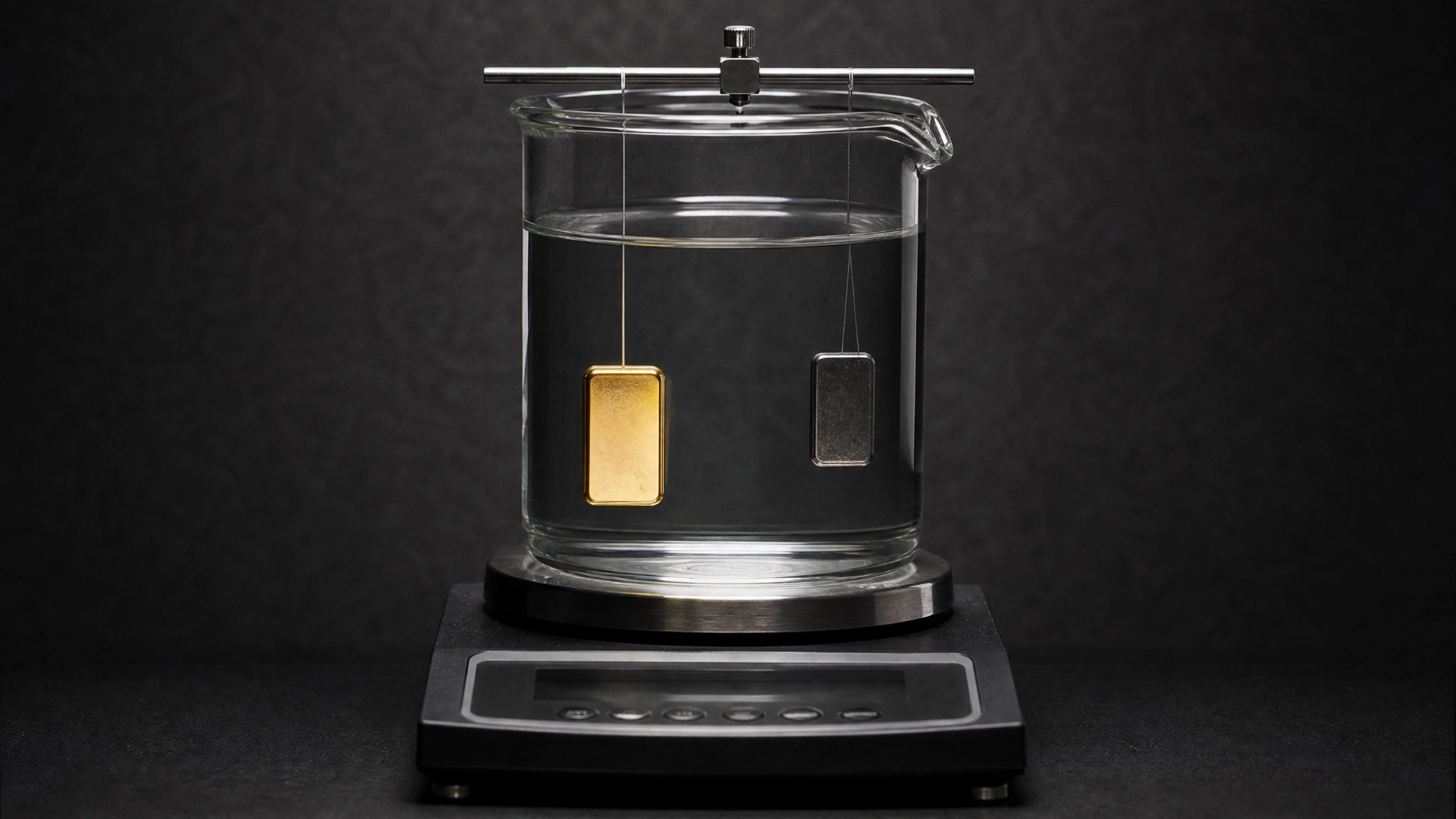
Specific gravity is the ratio of a material's density to the density of water. The test is old, cheap and non-destructive: weigh the bar in air, weigh it suspended in water, and the difference gives the volume. Divide mass by volume, compare against the known density of the metal, and plated brass, plated lead, hollowed bars and low-karat alloys all show up immediately — their densities are nowhere near gold's.
It has one well-known blind spot, and it is worth stating precisely rather than dramatically. The Royal Society of Chemistry's periodic table lists the density of gold and the density of tungsten at the same rounded figure: 19.3 g cm-3. Two metals that close cannot be reliably separated by a shop-floor displacement measurement, where a fraction of a gram of buoyancy error, a trapped air bubble or a warm water bath moves the result further than the difference you are looking for.
So specific gravity does not clear a bar. It rules out a large family of cheap fakes quickly, which is exactly why it is usually the first test rather than the last.
Where ultrasound comes in
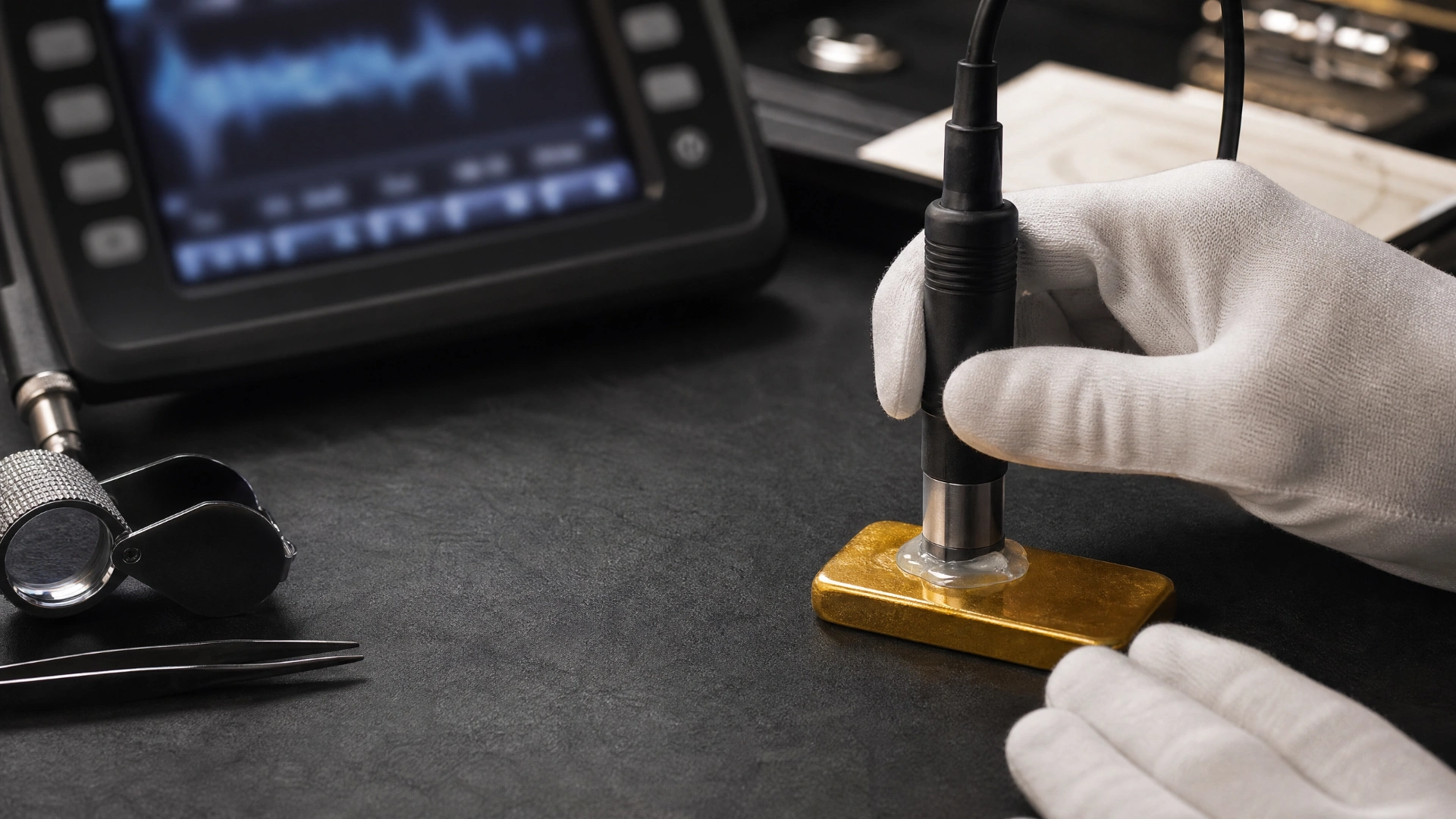
Ultrasonic testing sends a high-frequency sound pulse into the bar and times the echo returning from the far face. Sound travels through different metals at different speeds, so the transit time through a solid gold bar of a known thickness falls in a predictable range. A core of another metal changes both the timing and the shape of the returning signal, and an interface between two metals produces an echo where a solid bar produces none.
This is the test that reaches the interior, and it is the natural partner to specific gravity precisely because tungsten's density is so close to gold's while its acoustic behaviour is not.
It has its own limits: it needs a flat, parallel surface and a coupling medium, so it works far better on a bar than on a coin or an irregular casting, and thin or heavily textured bars read poorly. It also needs the bar out of the assay card — which is the trade-off carded bars force on everyone.
How the tests stack up
| Method | What it measures | Catches | Does not catch | Card can stay sealed? |
|---|---|---|---|---|
| Assay card and certificate | The refiner's recorded statement at manufacture | Nothing on its own — it is a document | Replicated cards and seals; substituted contents | Yes |
| Serial number check | Whether the number exists in the refiner's records | Invented and mistyped numbers | A real number copied onto another bar | Yes |
| Surface-scan registry (where offered) | The bar's own surface profile against a production record | Cloned serials on a different bar | Products not enrolled in a registry | Yes, per MKS PAMP for VERISCAN |
| Dimensions and weight | Whether the bar matches published specifications | Off-spec castings and reworked bars | Dimensionally accurate copies | Gross weight only |
| Specific gravity | Density of the whole object | Plated base metal, hollows, low-karat alloys | Tungsten cores, at shop-floor precision | No |
| XRF | Elemental composition of a thin surface layer | Wrong alloy, wrong metal, plating over base metal | What is under a sufficiently thick gold layer | No |
| Ultrasound | Sound transit time and internal echoes | Cores and voids inside a solid bar | Irregular shapes; very thin bars | No |
No row in that table clears a bar by itself, and the LBMA article makes the same point plainly: "No single method offers complete certainty, particularly against well-executed fakes." The tests are complementary because each one's blind spot is another one's strength.
Should you break the seal?
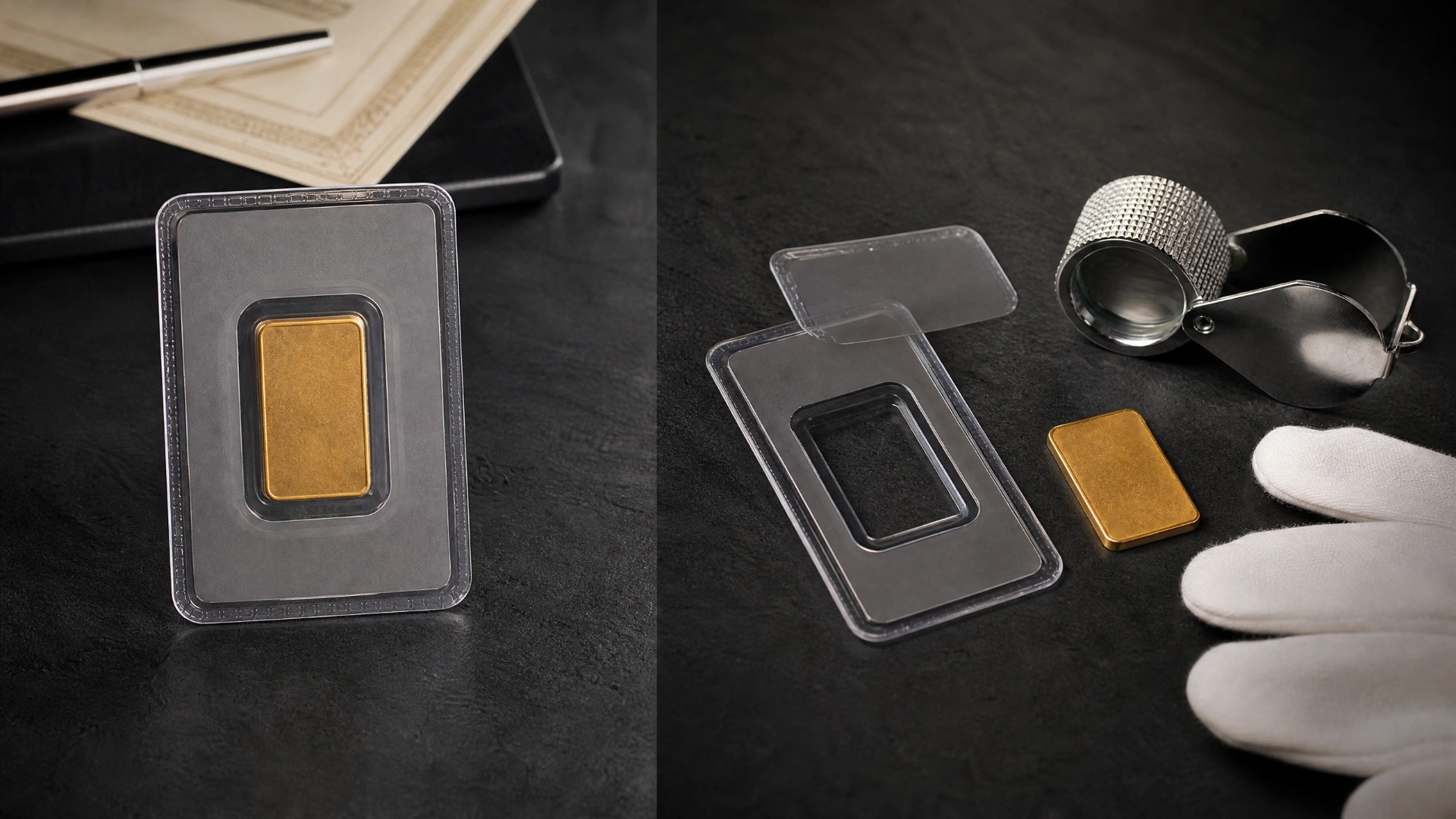
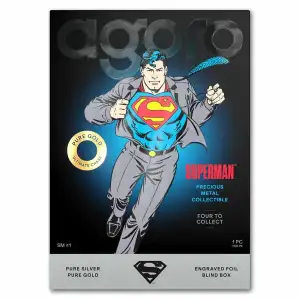
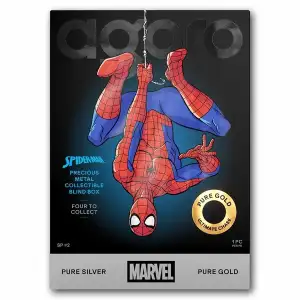
There is a real trade-off on both sides. Keeping the card intact preserves the presentation, keeps the certificate physically married to the bar, and on collectible and licensed series the packaging is part of what a later buyer is paying for. Opening it allows the tests that reach the metal, and gives you a bar whose contents you have verified rather than inferred — which, on plain bullion, is usually worth more than the packaging.
We resolve it by test order: everything that can be done through the card first, and the seal opened only where those tests leave a question unanswered, or where the seller wants the bar verified before a transaction.
What we do at the counter
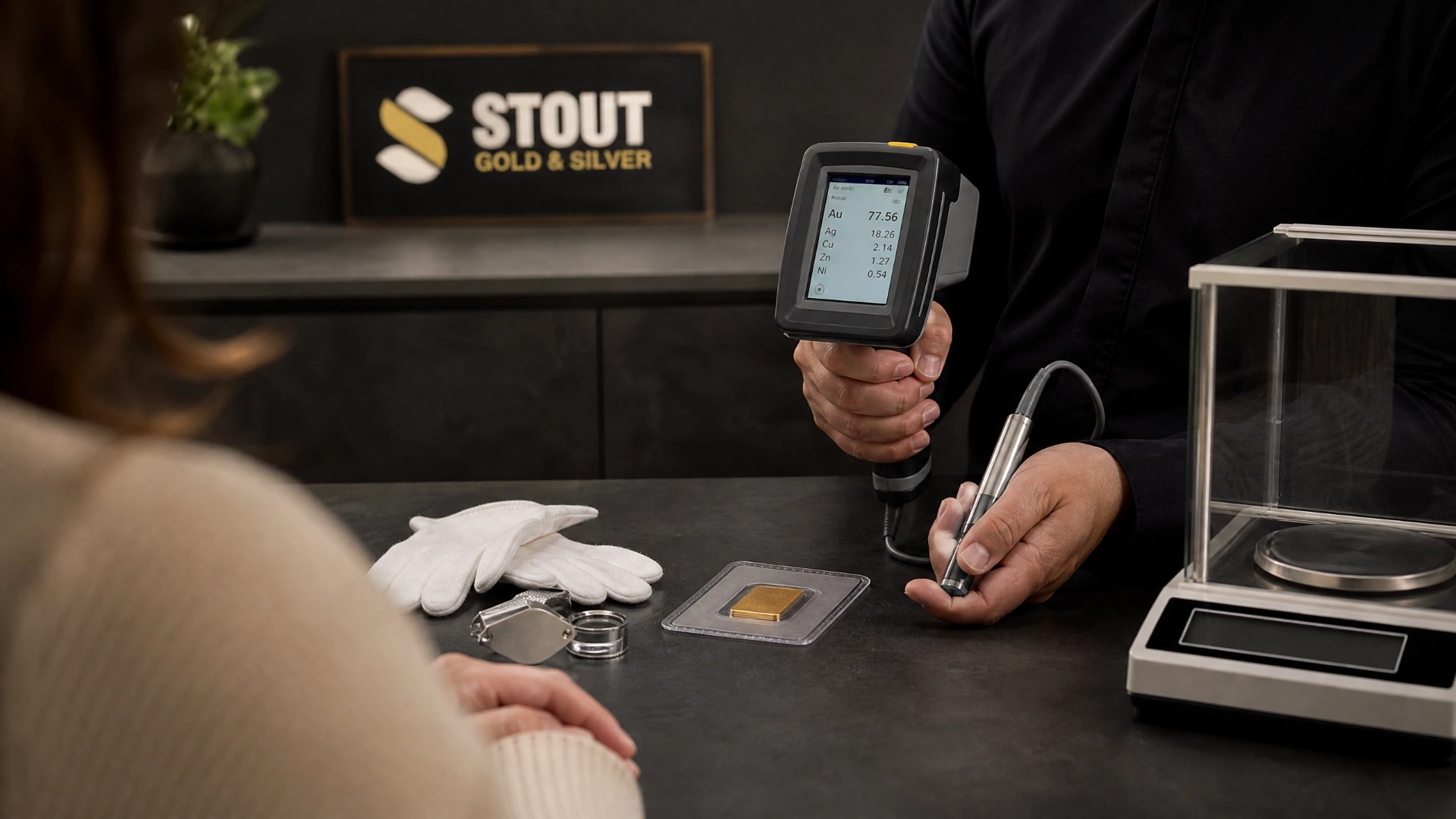
Stout Gold & Silver uses X-ray fluorescence, ultrasound and specific gravity testing on bullion that comes across the counter, whether the item arrived in a card or loose in a coffee tin. Each method answers a different question, and the readings are worth having explained rather than summarised — a seller who understands what was measured understands the offer that follows.
We can also tell you when a test is not worth running. A common one-ounce sovereign coin from a mint whose specifications are public does not need an ultrasound. A four-figure bar in unfamiliar packaging does.
This article is educational and reflects general information about precious metals and collectible coins. It is not investment, tax or legal advice, and Stout Gold & Silver is not a registered investment adviser, broker-dealer or tax professional. Metal prices fluctuate and past performance does not indicate future results. Consult a qualified professional about your own situation.
Frequently asked questions
Does opening the assay card reduce what a bar is worth?
On plain bullion bars, the metal carries the value and an opened card generally makes little difference to what a dealer will pay. On collectible and licensed series, intact original packaging can be part of what a later buyer is paying for, so the answer changes with the product. If you are unsure which category a bar falls into, ask before you open it.
Can a dealer test a bar without breaking the seal?
Partly. A gross weight through the card, visual inspection of the stamps and the card itself, a serial number check and, for enrolled products, a surface-scan registry check can all be done sealed. Specific gravity, XRF and ultrasound need the bar itself. A counter will normally work through the sealed tests first and only open the card if something is unresolved.
Is a bar with a certificate safer than one without?
A certificate is useful evidence and easier to resell against, but the LBMA's own analysis records counterfeit operations replicating branded assay cards with tamper-evident seals. Treat the certificate as one input rather than the answer, and put more weight on tests that read the metal.
Why can't specific gravity detect a tungsten core?
Because the two metals are too close in density. The Royal Society of Chemistry lists both gold and tungsten at 19.3 g cm-3, and the difference between them is smaller than the measurement error of a typical shop-floor water-displacement setup. Ultrasound is the practical answer, because it reads the inside rather than the average.
What should I bring if I want a bar checked in Amarillo?
Bring the bar, the card or certificate if you still have it, and any original purchase paperwork. We will weigh it, look at it, and run the tests the item warrants, and tell you what the readings mean. Bringing something in to be looked at does not commit you to selling it.
Have a bar you want verified?
Bring it to the shop and we will run the tests the item warrants and explain what each reading means. Whether you are checking something you already own or selling metal you have held for years, the process is the same. We can test what comes across the counter; we cannot test a bar we have not seen, wherever it was bought. If you would rather start from something with a known chain of custody, our bullion range is on the site.
Stout Gold & Silver
2300 SW 7th Ave Ste 105
Amarillo, TX 79106
(806) 374-8698
Monday–Friday 10:00–16:00 · Saturday and Sunday closed
stoutgold.co
Family owned and operated in the Texas Panhandle since 1986.