
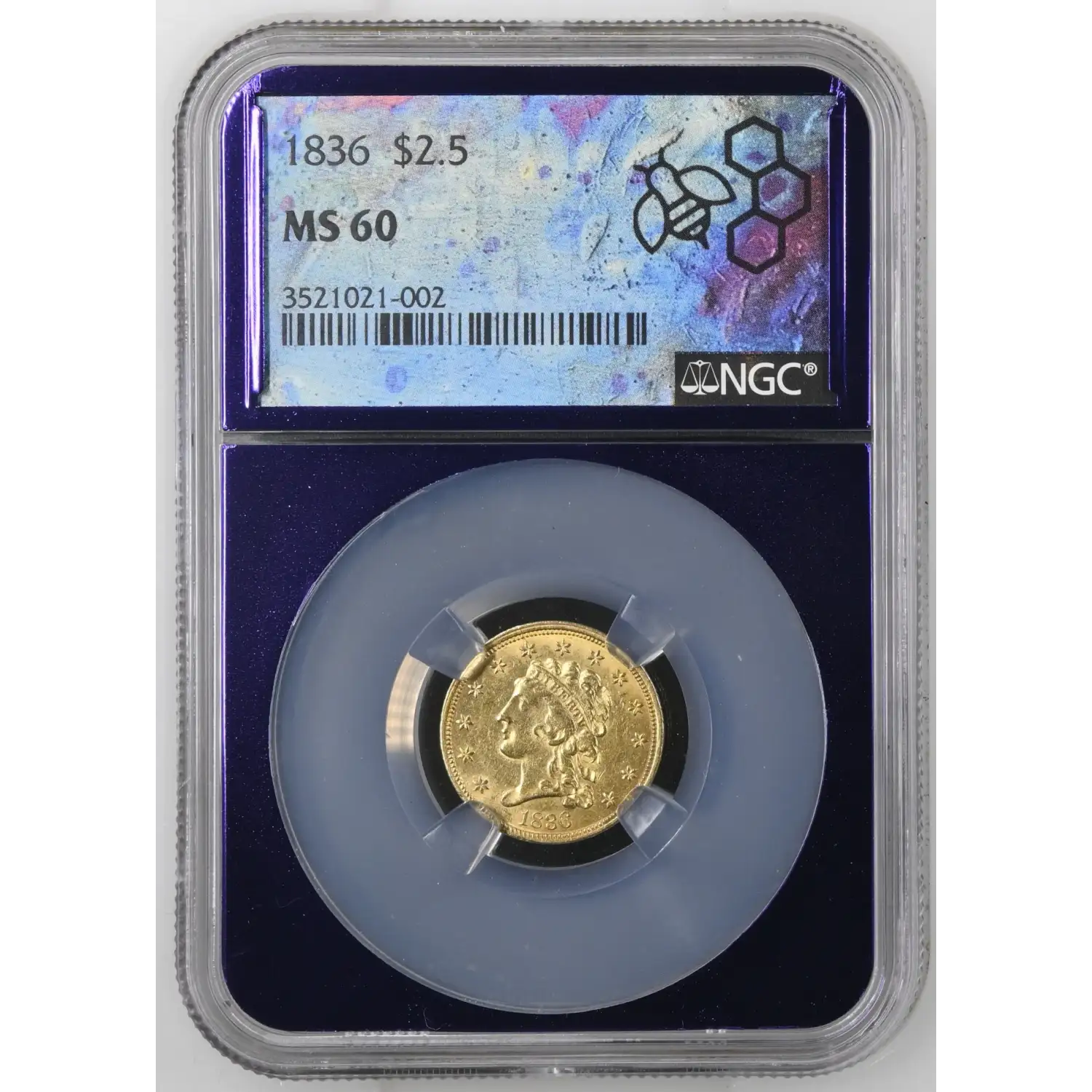
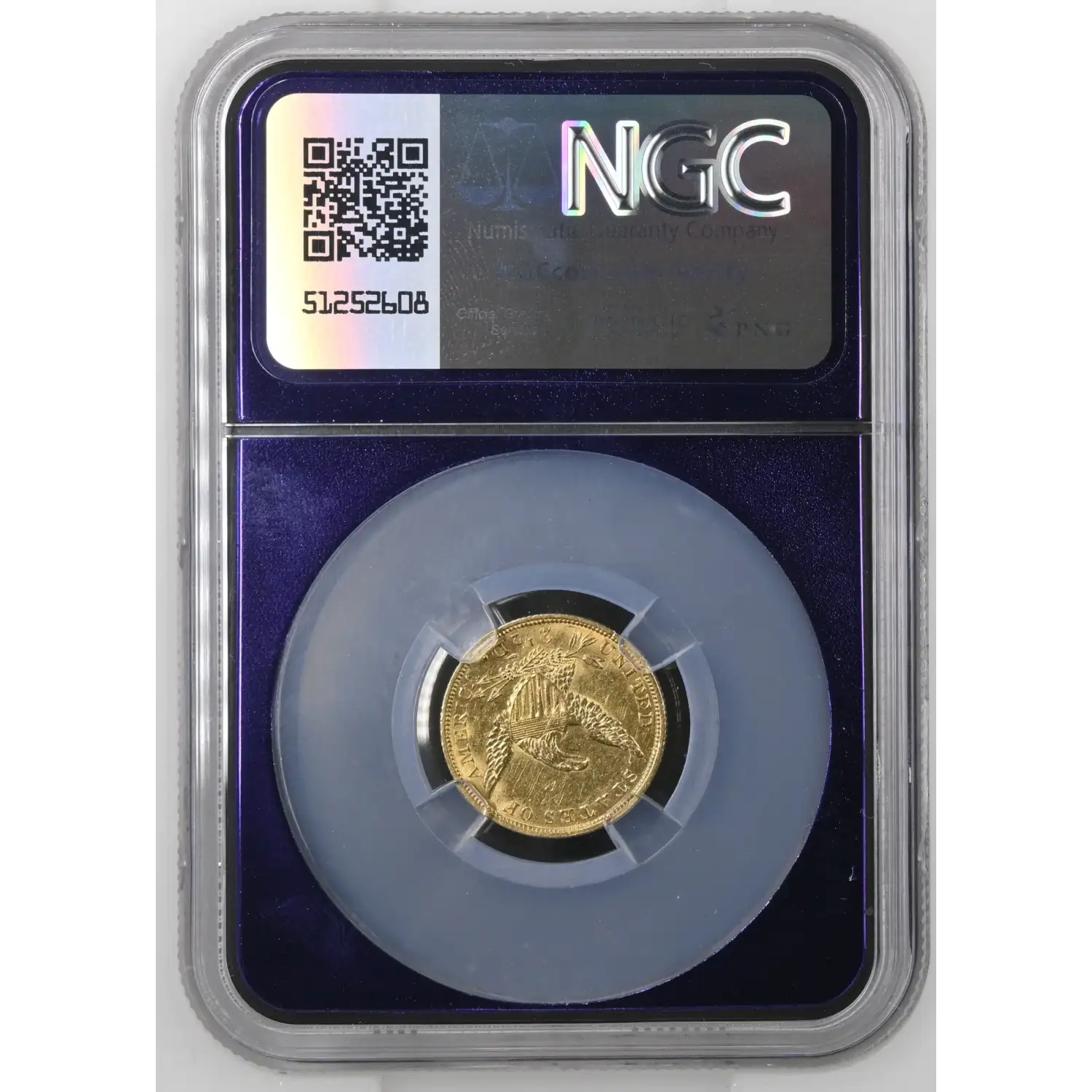
1836 2.5 Classic Head Gold Quarter Eagle No Motto on Reverse NGC MS-60 | Trader Bea Slab
This historic 1836 Classic Head Gold Quarter Eagle represents an important era of early U.S. coinage. Struck nearly two centuries ago and certified by NGC in Mint State-60 condition, this $2.50 gold piece offers collectors the opportunity to own an impressive example of early American gold preserved in uncirculated condition.
The Classic Head Quarter Eagle was produced for only a brief period from 1834 through 1839, making the series a fascinating addition to any collection of historic U.S. gold coinage.
Coin Highlights:
Contains .12094 oz of gold.
Certified MS-60 by NGC, guaranteeing the coin's authenticity and condition.
Struck by the United States Mint in 1836.
Historic $2.50 denomination, commonly known as the Quarter Eagle.
Designed by U.S. Mint Chief Engraver William Kneass.
Obverse: Features Liberty facing left wearing a headband inscribed "LIBERTY," surrounded by 13 stars with the date 1836 below.
Reverse: Depicts a heraldic eagle with a shield upon its breast, clutching an olive branch and arrows, surrounded by "UNITED STATES OF AMERICA" and the denomination.
An attractive Mint State example of early U.S. gold coinage from the short-lived Classic Head series.
Classic Head Gold Quarter Eagles
Introduced in 1834, the Classic Head Quarter Eagle was created following a reduction in the weight and fineness of U.S. gold coinage. William Kneass' distinctive Liberty design would remain in production for just six years before being replaced by Christian Gobrecht's Liberty Head design in 1840. Because many surviving Classic Head Quarter Eagles exhibit circulation, damage or other impairments, certified Mint State examples are especially desirable among collectors.
Add this 1836 $2.50 Classic Head Gold Quarter Eagle NGC MS-60 to your collection today!
I think “Mint State Early U.S. Gold” is the hook I'd use on the Stout listing. A nearly 190-year-old gold coin in an NGC MS-60 holder sells itself better than trying to stretch “rare date.”
Related products

‘’I would highly recommend making online purchases from Stout Gold & Silver. I was a little hesitant at first because it was going to be my first time purchasing from them so I gave them a call and they took extra time to walk me through the process. Turns out there was not much to it, I placed the order for check payment, mailed off my check and they sent me an update when my order was being shipped out. All the pieces of silver came exactly as described and were undamaged, they did a very good job packaging the pieces. All and all, I am very satisfied and look forward to placing my next order with them. I hope this is helpful comment for anyone interested in doing business with them.’’
 Verified Customer
‘’ Started buying silver coins a few years ago, great service, honest prices. I always deal with a guy named Brett, he is pretty funny, super helpful, and very nice. 10/10 would buy again from them. ’’
Verified Customer
‘’Best Gold and Silver dealer bar none! And the safe storage is both affordable and very secure. This business also has the advantage of being owned run by Tom Stout, who i would trust with just about anything. Admittedly I'm friends with Tom as well as a customer but he really is a man of his word, if he says it, that's the way it's going to happen.’’
Verified Customer
‘’Ordered a 1986 Proor Libertad and was very pleased with my purchase! Great price and super fast shipping with no hassle. It even came with the original box and I thought it was just the coin. I work at a coin shop and it’s great to do business with other great coin shops. I highly recommend this shop! Thanks for the amazing coin!’’
Verified Customer
‘’Stout is very dependable and willing to make sure you get what you want! Thanks for the great service!’’
Verified Customer


